

Obtención de Biocuero a Partir de Celulosa Bacteriana Mediante Curtido Mineral y Vegetal
##plugins.themes.bootstrap3.article.main##
Percy Fermín Velasquez - Ccosi

Raul Cartagena-Cutipa
Jorge Adalberto Málaga Juárez
Roger Gómez Mamani
Jesús Arias Escobar
Resumen
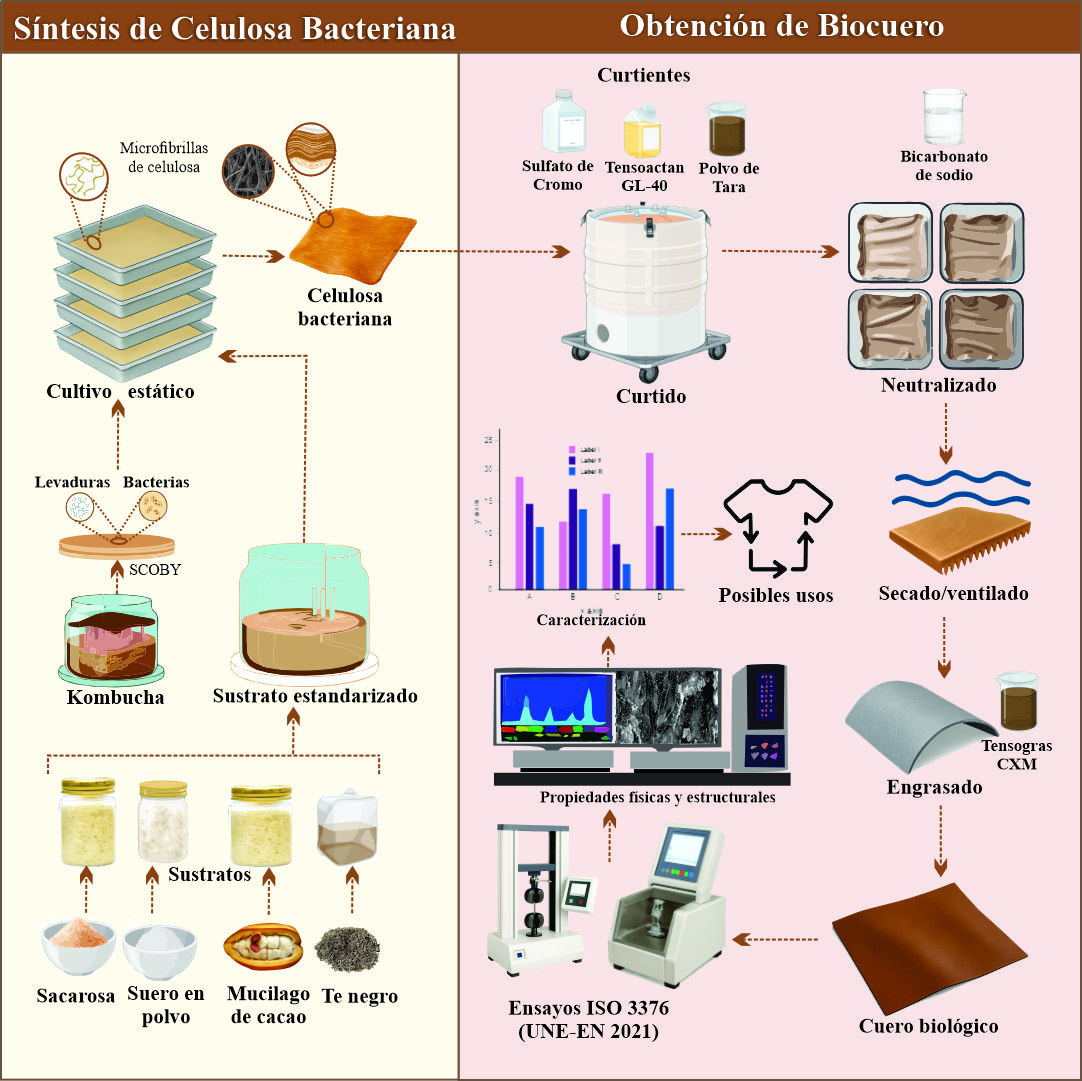
El proceso convencional de producción de cuero presenta riesgos ambientales, debido al uso del cromo. Este estudio tuvo el objetivo de obtener materiales alternativos tipo cuero convencional a partir de celulosa bacteriana (CB) producida mediante fermentación estática de un cultivo simbiótico de bacterias y levaduras (SCOBY) en sustratos formulados con sacarosa comercial (SA), mucílago de cacao (MC) y suero de leche en polvo hidrolizado (SL). Se evaluaron diez formulaciones según un diseño simplex centroide con puntos axiales aumentados, se alcanzó el mayor rendimiento de CB (30,08 ± 0,15 g/L) con 150 g de SA y 50 g de MC (T1), y se obtuvo una pureza del 96 %. La CB se sometió a curtición mineral (sulfato de cromo, SC), sintética (tensotan GL-50, T-GL) y vegetal (polvo de tara, PT) en mezclas puras y combinadas. El tratamiento con 5 % de T-GL y 5 % de PT (T6) presentó la mayor resistencia a la tracción (23,12 ± 0,74 N/mm²), mientras que la mayor elongación (17,22 ± 0,80 %) se obtuvo con 5 % de SC y 5 % de T-GL (T4). Las micrografías SEM mostraron fibras aleatorias y adhesivas en las muestras curtidas con SC, y depósitos de partículas y agrietamiento en las curtidas con PT, lo que explica su menor desempeño mecánico. Se concluye que el biocuero de CB tiene potencial como sustituto del cuero convencional; sin embargo, los curtientes vegetales requieren optimización, incluyendo el uso de fijadores, para mejorar la estabilidad y las propiedades mecánicas.
Descargas
Descargas
Detalles del artículo
Citas
Abol-Fotouh, D., Hassan, M. A., Shokry, H., Roig, A., Azab, M. S., & Kashyout, A. (2020). Bacterial nanocellulose from agro-industrial wastes: low-cost and enhanced production by Komagataeibacter saccharivorans MD1. Scientific reports, 10(1), 3491. https://doi.org/10.1038/s41598-020-60315-9
Adamopoulou, V., Bekatorou, A., Brinias, V., Michalopoulou, P., Dimopoulos, C., Zafeiropoulos, J., Petsi, T., & Koutinas, A. A. (2024). Optimization of bacterial cellulose production by Komagataeibacter sucrofermentans in synthetic media and agrifood side streams supplemented with organic acids and vitamins. Bioresource Technologynull, 130511-130511. https://doi.org/10.1016/j.biortech.2024.130511
Amorim, L. F. A., Li, L., Gomes, A. P., Fangueiro, R., & Gouveia, I. C. (2023). Sustainable bacterial cellulose production by low cost feedstock: Evaluation of apple and tea by-products as alternative sources of nutrients. Cellulose, 30(9), 5589-5606. https://doi.org/10.1007/s10570-023-05238-0
Antolak, H., Piechota, D., & Kucharska, A. (2021). Kombucha tea—A double power of bioactive compounds from tea and symbiotic culture of bacteria and yeasts (SCOBY). Antioxidants (Basel, Switzerland), 10(10), 1541. https://doi.org/10.3390/antiox10101541
Ariram, N., & Madhan, B. (2020). Development of bio-acceptable leather using bagasse. Journal of Cleaner Production,.250(119441), 119441. https://doi.org/10.1016/j.jclepro.2019.119441
Ayyappan, V. G., Vhatkar, S. S., Bose, S., Sampath, S., Das, S. K., Samanta, D., & Mandal, A. B. (2022). Incorporations of gold, silver and carbon nanomaterials to kombucha-derived bacterial cellulose: Development of antibacterial leather-like materials. Journal of the Indian Chemical Society, 99(1), 100278. https://doi.org/10.1016/j.jics.2021.100278
Bae, S. O., & Shoda, M. (2005). Production of bacterial cellulose by Acetobacter xylinum BPR2001 using molasses medium in a jar fermentor. Applied microbiology and biotechnology, 67(1), 45–51. https://doi.org/10.1007/s00253-004-1723-2
Burgos, M. L. J. (2020). Cuantificación de azúcares reductores del sustrato en residuos de piña con el método del ácido 3,5-dinitrosalicílico. Questionar: Investigación Específica, 7(1), 57–66. https://doi.org/10.29097/23461098.308
Bustillos J., Archana, L., Richa, A., Brittany, A. González, M. González, P., Sharan, R., Boesl, B., y Arvind, A. (2020). Descubriendo las características mecánicas, térmicas y químicas del cuero de hongo biodegradable con propiedades antifúngicas y antibacterianas intrínsecas. ACS Biomateriales Aplicados, 3(5), 3145-3156 https://doi.org/10.1021/acsabm.0c00164
Carreño, P. L. D., Caicedo, M. L. A. C., & Martínez, R. C. A. (2012). Técnicas de fermentación y aplicaciones de la celulosa bacteriana: una revisión. Ingeniería y Ciencia, 8(16), 307–335. https://doi.org/10.17230/ingciencia.8.16.12
Chen, C., & Liu, B. Y. (2000). Changes in major components of tea fungus metabolites during prolonged fermentation. Journal of Applied Microbiology, 89(5), 834–839. https://doi.org/10.1046/j.1365-2672.2000.01188.x
Coelho, R. M. D., Almeida, A. L. de, Amaral, R. Q. G. do, Mota, R. N. da, & Sousa, P. H. M. de. (2020). Kombucha: Review. International Journal of Gastronomy and Food Science, 22(100272), 100272. https://doi.org/10.1016/j.ijgfs.2020.100272
Ding, W., Cheng, Y., Wang, Y., & Shi, B. (2015). Bronceado combinado reducido en cromo para procesamiento de piel de oveja teñida más limpia. Mermelada. Química de cuero. Asoc. 110, 363–371. https://journals.uc.edu/index.php/JALCA/article/view/3580/2773
Ding, W., Liu, H., Remón, J., Jiang, Z., Chen, G., Pang, X., & Ding, Z. (2022). Un paso adelante hacia la producción de cuero sostenible y sin cromo: Utilización de un agente curtiente aldehídico a base de biomasa combinado con un tratamiento pionero de curtición terminal con aluminio (BAT-TAT). Journal of Cleaner Production, 333, 130201. https://doi.org/10.1016/J.JCLEPRO.2021.130201
Ding, W., Wang, Y., Zhou, J., & Shi, B. (2018). Efecto de las características de la estructura de polisacáridos sobre las propiedades del curtiente polisacárido dialdehído Carbohydrate Polymers. 201, 549–556. https://doi.org/10.1016/j.carbpol.2018.08.111
Dutta, H., & Paul, S. K. (2019). Kombucha Drink: Production, Quality, and Safety Aspects. In Production and Management of Beverages (pp. 259–288). Elsevier. https://doi.org/10.1016/B978-0-12-815260-7.00008-0
Farah, L., & Jonas, R. (1998). Production and application of microbial cellulose. Polymer Degradation and Stabiliry, 59(1-3), 101-106. http://dx.doi.org/10.1016/S0141-3910(97)00197-3
Ferreira, S. L. C., Lemos, V. A., de Carvalho, V. S., da Silva, E. G. P., Queiroz, A. F. S., Felix, C. S. A., da Silva, D. L. F., Dourado, G. B., & Oliveira, R. V. (2018). Multivariate optimization techniques in analytical chemistry - an overview. Microchemical Journal, Devoted to the Application of Microtechniques in All Branches of Science, 140, 176–182. https://doi.org/10.1016/j.microc.2018.04.002
Garcia, C., & Prieto, M. A. (2018). Bacterial cellulose as a potential bioleather substitute for the footwear industry. Microbial Biotechnology, 12(4), 582–585. https://doi.org/10.1111/1751-7915.13306
Gorgieva, S. (2020). La celulosa bacteriana como plataforma versátil para la investigación y el desarrollo de materiales biomédicos. Processes (Basel, Switzerland), 8(5), 624.
Guinea, M. (2016). Diseño de planta piloto para producción de celulosa bacteriana [Trabajo de fin de máster no publicado]. Escola Técnica Superior d’Enginyeria Industrial de Barcelona. http://hdl.handle.net/2117/98499
Henry S., Dhital, S., Sümer, H., & Butardo, V. M. (2024). Solid-state fermentation of cereal waste improves the bioavailability and yield of bacterial cellulose production by a novacetimonas sp. Isolate. Foods, 13 (19), 3052-3052. https://doi.org/10.3390/foods13193052
Heydorn, R. L., Lammers, D., Gottschling, M., & Dohnt, K. (2023). Effect of food industry by-products on bacterial cellulose production and its structural properties. Cellulose, 30 (7), 4159-4179. https://doi.org/10.1007/s10570-02305097-9
Hong F., & Qiu, K. (2008). An alternative carbon source from konjac powder for enhancing production of bacterial cellulose in static cultures by a model strain Acetobacter aceti subsp. xylinus ATCC 23770. Carbohydrate Polymers, 72(3), 545–549. https://doi.org/10.1016/j.carbpol.2007.09.015
Hornung M., Ludwig M., Gerrard AM., & Schmauder H-P. (2016). optimizing the production of bacterial cellulose in surface culture: evaluation of substrate mass transfer influences on the bioreaction (Part 1). Engineering in Life Sciences, 6(6), 537–545. https://doi.org/10.1002/elsc.200620162
Infante-Neta, A. A., D’Almeida, A. P., & Albuquerque, T. L. D. (2024). Bacterial cellulose in food packaging: A bibliometric analysis and review of sustainable innovations and prospects. Processes, 12(9), 1975-1975. https://doi.org/10.3390/pr12091975
Instituto Nacional de Calidad (INACAL). (2022). NTP 241.023:2022 Calzado. Calzado casual. Requisitos y métodos de ensayo. 5ª Edición.
Jaramillo, R., Perna, O., Revollo, A. B., Arrieta, C., & Escamilla, E. (2013). Efecto de diferentes concentraciones de fructosa sobre la producción de celulosa bacteriana en cultivo estático. Revista Colombiana de Ciencia Animal-RECIA, 5(1), 116-130. https://doi.org/10.24188/recia.v5.n1.2013.476
Kalia, S., Dufresne, A., Cherian, B. M., Kaith, B. S., Avérous, L., Njuguna, J., & Nassiopoulos, E. (2011). Cellulose-based bio- and nanocomposites: A review. International Journal of Polymer Science, 2011, 1–35. https://doi.org/10.1155/2011/837875
Kapp, J. M., & Sumner, W. (2019). Kombucha: a systematic review of the empirical evidence of human health benefit. Annals of Epidemiology, 30, 66–70. https://doi.org/10.1016/j.annepidem.2018.11.001
Khanchezar, S., Babaeipour, V., & Mostafa, A. S. (2024). Overproduction of bacterial cellulose from acetobacter xylinum bpr2001 using food industries wastes. Biotechnology and Applied Biochemistrynull. https://doi.org/10.1002/bab.2560
Khatami, K., Atasoy, M., Ludtke, M., Baresel, C., Eyice, Ö., & Cetecioglu, Z. (2021). Bioconversion of food waste to volatile fatty acids: Impact of microbial community, pH and retention time. Chemosphere, 275(129981) https://doi.org/10.1016/j.chemosphere.2021.129981
Khiabani, A., Jamab, M. S., Shakeri, M., Pahlevanlo, A., & Emadzadeh, B. (2024). Bacterial cellulose biosynthesis: Optimization strategy using iranian nabat industry waste. Heliyonnull, e35986-e35986. https://doi.org/10.1016/j.heliyon.2024.e35986
Kim, H., Song, J.E. & Kim, H.R. (2021). Estudio comparativo sobre el atrapamiento físico de proteínas de soja y hongos en la durabilidad del biocuero de celulosa bacteriana. Celulosa, 28, 3183–3200. https://doi.org/10.1007/s10570-021-03705-0
Kombucha Perú. (s.f.). Kombucha Perú. https://www.kombuchaperu.com/
Kristoffersen, E., Blomsma, F., Mikalef, P., & Li, J. (2020). The smart circular economy: A digital-enabled circular strategies framework for manufacturing companies. Journal of Business Research, 120, 241–261. https://doi.org/10.1016/j.jbusres.2020.07.044
Krystynowicz, A., & Bielecki, S. (2002). Biosynthesis of bacterial cellulose andits potential application in the different industries. PolishBiotechnology News. www.biotechnology-pl.com/science/krystynowicz.html
Laureys, D., Britton, S. J., & De Clippeleer, J. (2020). Kombucha tea fermentation: A review. Journal of the American Society of Brewing Chemists. American Society of Brewing Chemists, 78(3), 165–174. https://doi.org/10.1080/03610470.2020.1734150
Leal, J. M., Suárez, L. V., Jayabalan, R., Oros, J. H., & Escalante-Aburto, A. (2018). A review on health benefits of kombucha nutritional compounds and metabolites. CYTA Journal of Food, 16(1), 390–399. https://doi.org/10.1080/19476337.2017.1410499
Liu, D., Labas, A., Long, B., McKnight, S., Xu, C., Tian, J., & Xu, Y. (2023). Bacterial nanocellulose production using cost-effective, environmentally friendly, acid whey based approach. Bioresource Technology Reportsnull, 101629. https://doi.org/10.1016/j.biteb.2023.101629
Liu, Z., Siddique, F., Yan, W., Haque, M. A., Li, N., Yang, X., & Lin, C. S. K. (2024). Efficient production of bacterial cellulose using komagataeibacter sucrofermentans on sustainable feedstocksdevelopment. Chemsuschemnull. https://doi.org/10.1002/cssc.202401578
Mardawati, E., Rahmah, D. M., Rachmadona, N., Saharina, E., Pertiwi, T. Y. R., Zahrad, S. A., Ramdhani, W., Srikandace, Y., Ratnaningrum, D., Endah, E. S., Andriani, D., Khoo, K. S., Pasaribu, K. M., Satoto, R., & Karina, M. (2023). Pineapple core from the canning industrial waste for bacterial cellulose production by komagataeibacter xylinus. Heliyon, 9 null. https://doi.org/10.1016/j.heliyon.2023.e22010
Martínez Yee, & Contreras Zentella, E. E. (2004). Celulosa bacteriana en Gluconacetobacter xylinum. Revista Especializada en Ciencias Químico-Biológicas, 7(1), 19–25. https://doi.org/10.1111/epi.12525
McCarthy, SP. (2003). Polímeros biodegradables. Andrady, AL, Ed., Plastics and the Environment, John Wiley and Sons, Inc., Nueva York, 359-377. http://dx.doi.org/10.1002/0471721557.ch9
Mendoza, C. J. W., Velásquez, C. P. F., & Gómez, G. Y. (2020). Caracterización estructural, física y química de la fibra de rastrojo de la cosecha de piña (ananas comosus) golden como alternativa para elaborar papel. Ingeniería Investiga, 2(2), 314–323. https://doi.org/10.47796/ing.v2i2.408
Montgomery, D. C. (2017). Design and analysis of experiments. (I. John Wiley & Sons, Ed.) (Ninth Edit, Vol. 9). Arizona State University
Naisini & Balarman (2020). Development of bio-acceptable leather using bagasse. Journal of Cleaner Production, 250(119441), 119441. https://doi.org/10.1016/j.jclepro.2019.119441
Nguyen VT., Flanagan B., Gidley MJ., & Dykes. G. A. (2008). Characterizationof cellulose production by a Gluconacetobacter xylinus strain from Kombucha. Cu-rrent Microbiology, 57(5), 449-453. https://doi.org/10.1007/s00284-008-9228-3
Pal, S., Nisi, R., Stoppa, M., & Licciulli, A. (2017). Silver-functionalized bacterial cellulose as antibacterial membrane for wound-healing applications. ACS Omega, 2(7), 3632–3639. https://doi.org/10.1021/acsomega.7b00442
Pang, X., Ding, Z., Ding, W., Xiao, X., Liao, X., & Shi, B. (2019). Investigación de la síntesis de un nuevo agente curtiente epoxi glicidil éter-amina y su rendimiento curtiente. Mermelada. Química de cuero. Asoc. 114, 228–239. https://acortar.link/3RmjmK
Ploska, J., Garbowska, M., Klempova, S., & Stasiak-Rozanska, L. (2023). Obtaining bacterial cellulose through selected strains of acetic acid bacteria in classical and waste media. Applied Sciences, 13 (11), 6429-6429. https://doi.org/10.3390/app13116429
Rastogi, A., & Banerjee, R. (2020). Statistical optimization of bacterial cellulose production by Leifsonia soli and its physico-chemical characterization. Process Biochemistry (Barking, London, England), 91, 297–302. https://doi.org/10.1016/j.procbio.2019.12.021
Sebestyén, Z., Jakab, E., Badea, E., Barta-Rajnai, E., Sendrea, C., & Czégény, Z. (2019). Thermal degradation study of vegetable tannins and vegetable tanned leathers. Journal of Analytical and Applied Pyrolysis, 138, 178–187. https://doi.org/10.1016/j.jaap.2018.12.022
Slapsak, N., Cleenwerck, I., De Vos, P., & Trcek, J. (2013). Gluconacetobacter maltaceti sp. nov., a novel vinegar producing acetic acid bacterium. Systematic and applied microbiology, 36(1), 17–21. https://doi.org/10.1016/j.syapm.2012.11.001
Soriano, J., & Barreto, M. (2018). Síntesis y estudio de propiedades de celulosa bacteriana obtenida en piña y banano, inoculados con Kombucha. https://n9.cl/ok8wd
Souza, K. C. d., Trindade, N. M., Amorim, J. D. P. d., Nascimento, H. A. d., Costa, A. F. S., Henrique, M. A., Caetano, V. F., Sarubbo, L. A., & Vinhas, G. M. (2021). Kinetic study of a bacterial cellulose production by Komagataeibacter rhaeticus using coffee grounds and sugarcane molasses. Materials Research, 24(3), e20200454. https://doi.org/10.1590/1980-5373-MR-2020-0454
Subbiahdoss, G., Osmen, S., & Reimhult, E. (2022). Cellulosic biofilm formation of Komagataeibacter in kombucha at oil-water interfaces. Biofilm, 4(100071). https://doi.org/10.1016/j.bioflm.2022.100071
Tamilselvi, A., Jayakumar, G. C., Sri Charan, K., Sahu, B., Deepa, P. R., Kanth, S. V., & Kanagaraj, J. (2019). Extraction of cellulose from renewable resources and its application in leather finishing. Journal of Cleaner Production, 230, 694–699. https://doi.org/10.1016/j.jclepro.2019.04.401
Technical Association of the pulp and paper Industry (TAPPI). (1999). Filtration & Separation, 36(3), 30. https://doi.org/10.1016/S0015-1882(99)80046-9
Teklay, A., Gebeyehu, G., Getachew, T., Yaynshet, T., & Sastry, T. P. (2017). Conversion of finished leather waste incorporated with plant fibers into value added consumer products – An effort to minimize solid waste in Ethiopia. Waste Management (New York, N.Y.), 68, 45–55. https://doi.org/10.1016/j.wasman.2017.07.024
Tsouko, E., Kourmentza, C., Ladakis, D., Kopsahelis, N., Mandala, I., Papanikolaou, S., Paloukis, F., Alves, V. D., & Koutinas, A. A. (2015). Bacterial cellulose production from industrial waste and by-product streams. International Journal of Molecular Sciences, 16 (7), 14832-14849. https://doi.org/10.3390/IJMS160714832
UNE-EN. (2021). Cuero. Ensayos físicos y mecánicos. Determinación de la resistencia a la tracción y del porcentaje de alargamiento (ISO 3376). https://n9.cl/t6cof
Uzca S., Aguilar, S., & Espin, D. (2021). Producción y caracterización de un biopolímero obtenido a partir de residuos agroindustriales del cacao (CCN-51). Ingeniería Química y Desarrollo, 3(1), 17–29. https://revistas.ug.edu.ec/index.php/iqd/article/view/2197
Vázquez, A., Foresti, M. L., Cerrutti, P., Galvagno, M. A., & Galvagno, M. A. (2013). Bacterial cellulose from simple and low cost production media by gluconacetobacter xylinus. Journal of Polymers and The Environment, 21 (2), 545554. https://doi.org/10.1007/S10924-012-0541-3
Victoriano-Huerta, N., Alcántara-Iniesta, S., Soto-Cruz, B. S., Zaca-Morán, P., Orduña-Díaz, A., Arcila-Lozano, L. S., & Rojas-López, M. (2022). Efecto de la sacarosa en la síntesis de celulosa bacteriana por fermentación de Kombucha en té negro (Camellia sinensis). Frontera Biotecnológica, 22(2). https://www.revistafronterabiotecnologica.cibatlaxcala.ipn.mx/volumen/vol22/pdf/vol-22-2.pdf
Vina, I., Semjonovs, P., Linde, R., & Denina, I. (2014). Current evidence on physiological activity and expected health effects of kombucha fermented beverage. Journal of Medicinal Food, 17(2), 179–188. https://doi.org/10.1089/jmf.2013.0031
Volova, T. G., Prudnikova, S. V., Kiselev, E. G., Nemtsev, I. V., Vasiliev, A. D., Kuzmin, A., & Shishatskaya, E. I. (2021). Bacterial cellulose (bc) and bc composites: Production and properties. Nanomaterials, 12 (2), 192-192. https://doi.org/10.3390/nano12020192
Wang, Q., Nnanna, P. C., Shen, F., Huang, M., Tian, D., Hu, J., Zeng, Y., Yang, G., & Deng, S. (2021). Full utilization of sweet sorghum for bacterial cellulose production: A concept of material crop. Industrial Crops and Products, 162(113256), 113256. https://doi.org/10.1016/j.indcrop.2021.113256
Barra lateral del artículo
Barra lateral del artículo

Esta obra está bajo una licencia internacional Creative Commons Atribución-NoComercial-CompartirIgual 4.0.