

Caracterización de Propiedades Mecánicas de la Fibra de Palma de mocora para Aplicaciones Estructurales
##plugins.themes.bootstrap3.article.main##
Juan Francisco Nicolalde

Javier Martínez-Gómez
Javier Maiguashca
Mario Cando Cevallos
Resumen
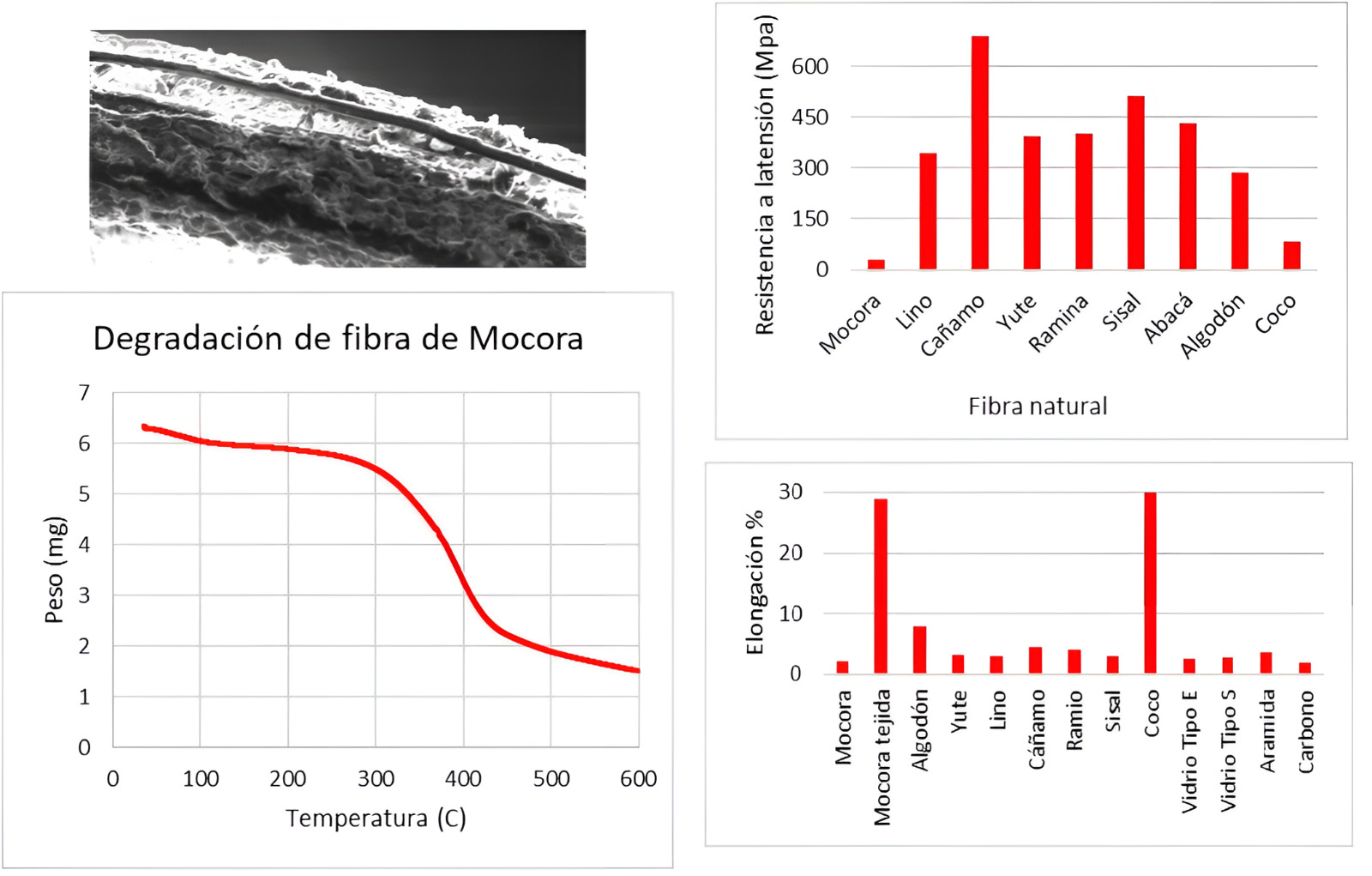
Industrias cómo la textil, construcción, empaquetamiento, automotriz y aviación, han sacado provecho de las características mecánicas y ambientales que brindan las fibras naturales. En este sentido, se ha explorado la caracterización mecánica de la fibra de mocora y su compatibilidad cómo material compuesto, considerando que esta fibra endémica del Ecuador tiene aplicaciones estructurales de manera artesanal. A este respecto, esta investigación busca caracterizar dicha fibra por medio de microscopia electrónica de barrido, utilizando un voltaje de aceleración de 15 kV y 20 kV y magnificación de 500x y 1.6Kx. De igual manera, se realizan pruebas mecánicas con normas ASTM-D 5034 para la fibra trenzada y ASTM D 2256-02 para el material compuesto mediante una máquina de prueba universal. Las propiedades térmicas son determinadas mediante análisis de termogravimetría, desarrolladas utilizando una temperatura inicial de 40 °C hasta alcanzar una temperatura límite de 600 °C con un escalón de 15 °C por minuto. Las pruebas de adherencia a resina poliéster insaturada se dan mediante una solución de resina con 20% estireno, 0,03% de peróxido de etil metil cetona y 12% de naftaleno de cobalto. Por medio de estos métodos, se encontró que la fibra presenta una distribución longitudinal con cuerpos aglomerados y tubulares sin concentradores de esfuerzos. Dentro de las características más destacables se encuentra el porcentaje de elasticidad, una propiedad importante en aplicaciones mecánicas. De igual manera, se halló una buena resistencia a la degradación por altas temperaturas, aunque también presentó falencias en la adherencia adecuada a la resina. La caracterización de este estudio permite demostrar que la fibra de mocora tiene ventajas sobre otras fibras de uso estructural y comparativamente se encuentra cercana al desempeño de la fibra de coco, lo que permite concluir que tiene un potencial importante de aplicación a la industria que busca materiales resistentes, dando soporte a la caracterización de fibras emergentes ecuatorianas para una industria competitiva y económicamente circular.
Descargas
Descargas
Detalles del artículo
Citas
AL-Oqla, F. M., & Omari, M. A. (2017). Sustainable Biocomposites: Challenges, Potential and Barriers for Development BT - Green Biocomposites: Manufacturing and Properties (M. Jawaid, S. M. Sapuan, & O. Y. Alothman, Eds.; pp. 13–29). Springer International Publishing. https://doi.org/10.1007/978-3-319-46610-1_2
Alves, C., Ferrão, P. M. C., Silva, A. J., Reis, L. G., Freitas, M., Rodrigues, L. B., & Alves, D. E. (2010). Ecodesign of automotive components making use of natural jute fiber composites. Journal of Cleaner Production, 18(4), 313–327. https://doi.org/10.1016/J.JCLEPRO.2009.10.022
Arumugam, S., Kandasamy, J., Venkatesan, S., Murugan, R., Lakshmi Narayanan, V., Sultan, M. T. H., Shahar, F. S., Shah, A. U. M., Khan, T., & Sebaey, T. A. (2022). A Review on the Effect of Fabric Reinforcement on Strength Enhancement of Natural Fiber Composites. Materials, 15(9), 3025. https://doi.org/10.3390/ma15093025
Ayrilmis, N., Jarusombuti, S., Fueangvivat, V., Bauchongkol, P., & White, R. H. (2011). Coir fiber reinforced polypropylene composite panel for automotive interior applications. Fibers and Polymers, 12(7), 919. https://doi.org/10.1007/s12221-011-0919-1
Baiardo, M., Zini, E., & Scandola, M. (2004). Flax fibre–polyester composites. Composites Part A: Applied Science and Manufacturing, 35(6), 703–710. https://doi.org/10.1016/J.COMPOSITESA.2004.02.004
Bajwa, D. S., & Bhattacharjee, S. (2016). Current Progress, Trends and Challenges in the Application of Biofiber Composites by Automotive Industry. Journal of Natural Fibers, 13(6), 660–669. https://doi.org/10.1080/15440478.2015.1102790
Balakrishnan, P., John, M. J., Pothen, L., Sreekala, M. S., & Thomas, S. (2016). Natural fibre and polymer matrix composites and their applications in aerospace engineering. Advanced Composite Materials for Aerospace Engineering, 365–383. https://doi.org/10.1016/B978-0-08-100037-3.00012-2
Barreno-Avila, E. M., Balladares-Pazmiño, M. D. L. Á., Barreno-Avila, A. F., & Espín-Lagos, S. M. (2021). Blackberry (Rubus Glaucus) Natural-Fiber Reinforced Polymeric Composites: An Overview of Mechanical Characteristics (pp. 300–315). https://doi.org/10.1007/978-3-030-72212-8_22
Bledzki, A. K., & Gassan, J. (1999). Composites reinforced with cellulose based fibres. Progress in Polymer Science, 24, 221–274.
Chand, N., & Fahim, M. (2008). Natural fibers and their composites. Tribology of Natural Fiber Polymer Composites, 1–58. https://doi.org/10.1533/9781845695057.1
Chokshi, S., Parmar, V., Gohil, P., & Chaudhary, V. (2020). Chemical Composition and Mechanical Properties of Natural Fibers. Journal of Natural Fibers, 1–12. https://doi.org/10.1080/15440478.2020.1848738
Cooke, T.F. (1990). Biodegradability of Polymers and Fibers - A Review of the Literature. Journal of Polymer Engineering, 9(3), 171–212. https://doi.org/doi:10.1515/POLYENG.1990.9.3.171
Cuesta, F., Peralvo, M., Merino-Viteri, A., Bustamante, M., Baquero, F., Freile, J. F., Muriel, P., & Torres-Carvajal, O. (2017). Priority areas for biodiversity conservation in mainland Ecuador. Neotropical Biodiversity, 3(1), 93–106. https://doi.org/10.1080/23766808.2017.1295705
Djafari Petroudy, S. R. (2017). Physical and mechanical properties of natural fibers. Advanced High Strength Natural Fibre Composites in Construction, 59–83. https://doi.org/10.1016/B978-0-08-100411-1.00003-0
Dorez, G. T. and fire behavior of natural fibers/PBS biocomposites, Taguet, A., Ferry, L., & Lopez-Cuesta, J. M. (2013). Thermal and fire behavior of natural fibers/PBS biocomposites. Polymer Degradation and Stability, 98(1), 87–95. https://doi.org/10.1016/J.POLYMDEGRADSTAB.2012.10.026
Drzal, L. T., Misra, M., & Mohanty, A. K. (2005). Natural Fibers, Biopolymers, and Biocomposites: An introduction. In A. K. Mohanty, M. Misra, & L. T. Drzal (Eds.), Natural Fibers, Biopolymers, and Biocomposites (1st ed., p. 896). Taylor & Francis. https://doi.org/https://doi.org/10.1201/9780203508206.ch1
Elkhaoulani, A., Arrakhiz, F. Z., Benmoussa, K., Bouhfid, R., & Qaiss, A. (2013). Mechanical and thermal properties of polymer composite based on natural fibers: Moroccan hemp fibers/polypropylene. Materials & Design, 49, 203–208. https://doi.org/10.1016/J.MATDES.2013.01.063
Fadiman, M. G. (2008). Use of Mocora, Astrocaryum Standleyanum (Arecaceae), by Three Ethnic Groups in Ecuador: Differences, Similarities and Market Potential. Journal of Ethnobiology, 28(1), 92–109. https://doi.org/10.2993/0278-0771_2008_28_92_uomasa_2.0.co_2
Faruk, O., Bledzki, A. K., Fink, H. P., & Sain, M. (2012). Biocomposites reinforced with natural fibers: 2000–2010. Progress in Polymer Science, 37(11), 1552–1596. https://doi.org/10.1016/J.PROGPOLYMSCI.2012.04.003
George, J., Sreekala, M. S., & Thomas, S. (2001). A review on interface modification and characterization of natural fiber reinforced plastic composites. Polymer Engineering & Science, 41(9), 1471–1485. https://doi.org/https://doi.org/10.1002/pen.10846
Gholampour, A., & Ozbakkaloglu, T. (2020). A review of natural fiber composites: properties, modification and processing techniques, characterization, applications. Journal of Materials Science, 55(3), 829–892. https://doi.org/10.1007/s10853-019-03990-y
Herrera Franco, P. J., & Valadez-González, A. (2005). Fiber-Matrix Adhesion in Natural Fiber Composites. In A. K. Mohanty, M. Misra, & L. T. Drzal (Eds.), Natural Fibers, Biopolymers, and Biocomposites (1st ed., p. 55). Taylor & Francis. https://doi.org/https://doi.org/10.1201/9780203508206.ch
Herrera-Franco, P. J., & Valadez-González, A. (2004). Mechanical properties of continuous natural fibre-reinforced polymer composites. Composites Part A: Applied Science and Manufacturing, 35(3), 339–345. https://doi.org/10.1016/J.COMPOSITESA.2003.09.012
Holbery, J., & Houston, D. (2006). Natural-fiber-reinforced polymer composites in automotive applications. JOM, 58(11), 80–86. https://doi.org/10.1007/s11837-006-0234-2
Huang, X., & Netravali, A. (2007). Characterization of flax fiber reinforced soy protein resin based green composites modified with nano-clay particles. Composites Science and Technology, 67(10), 2005–2014. https://doi.org/10.1016/J.COMPSCITECH.2007.01.007
Iturralde-Pólit, P., Dangles, O., Burneo, S. F., & Meynard, C. N. (2017). The effects of climate change on a mega-diverse country: predicted shifts in mammalian species richness and turnover in continental Ecuador. Biotropica, 49(6), 821–831. https://doi.org/https://doi.org/10.1111/btp.12467
Jácome, J., & Montúfar, R. (2013). Mocora: Astrocaryum standleyanum. In R. Valencia, R. Montúfar, H. Navarrete, & H. Balslev (Eds.), Palmas Ecuatorianas: biología y uso sostenible (1st ed., Issue January 2017, pp. 99–110). Herbario QCA de la Pontificia Universidad Católica del Ecuador.
Johnson, M. R., & Wang, M. H. (2002). Evaluation policies and automotive recovery options according to the European Union Directive on end-of-life vehicles (ELV). Proceedings of the Institution of Mechanical Engineers, Part D: Journal of Automobile Engineering, 216(9), 723–739. https://doi.org/10.1243/09544070260340826
Kahraman, N., & Karadag, R. (2017). Characterization of Sixteenth to Nineteenth Century Ottoman Silk Brocades by Scanning Electron Microscopy–Energy Dispersive X-Ray Spectroscopy and High-Performance Liquid Chromatography. Analytical Letters, 50(10), 1553–1567. https://doi.org/10.1080/00032719.2016.1236264
Kaluza, A., Kleemann, S., Fröhlich, T., Herrmann, C., & Vietor, T. (2017). Concurrent Design & Life Cycle Engineering in Automotive Lightweight Component Development. Procedia CIRP, 66, 16–21. https://doi.org/10.1016/J.PROCIR.2017.03.293
Keating, P. L. (2008). The Floristic Composition and Biogeographical Significance of A Megadiverse Páramo Site in The Southern Ecuadorian Andes. The Journal of the Torrey Botanical Society, 135(4), 554–570. https://doi.org/10.3159/08-RA-067.1
Kor, L., Homewood, K., Dawson, T. P., & Diazgranados, M. (2021). Sustainability of wild plant use in the Andean Community of South America. Ambio, 50(9), 1681–1697. https://doi.org/10.1007/s13280-021-01529-7
Kozlowski, R. M., Mackiewicz-Talarczyk, M., & Barriga-Bedoya, J. (2020). New emerging natural fibres and relevant sources of information. In Handbook of Natural Fibres (pp. 747–787). Elsevier. https://doi.org/10.1016/B978-0-12-818398-4.00022-0
Ku, H., Wang, H., Pattarachaiyakoop, N., & Trada, M. (2011). A review on the tensile properties of natural fiber reinforced polymer composites. Composites Part B: Engineering, 42(4), 856–873. https://doi.org/10.1016/J.COMPOSITESB.2011.01.010
Lessmann, J., Fajardo, J., Muñoz, J., & Bonaccorso, E. (2016). Large expansion of oil industry in the Ecuadorian Amazon: biodiversity vulnerability and conservation alternatives. Ecology and Evolution, 6(14), 4997–5012. https://doi.org/https://doi.org/10.1002/ece3.2099
Lin, F., Du, X., Li, W., Jiang, J., & Chen, N. (2020). Interfacial properties of high failure strain polyimide fiber/epoxy composites analyzed by a modified single fiber fragmentation test. Applied Surface Science, 513, 145869. https://doi.org/10.1016/j.apsusc.2020.145869
Maheshwaran, M. V, Hyness, N. R. J., Senthamaraikannan, P., Saravanakumar, S. S., & Sanjay, M. R. (2018). Characterization of natural cellulosic fiber from Epipremnum aureum stem. Journal of Natural Fibers, 15(6), 789–798. https://doi.org/10.1080/15440478.2017.1364205
Martin, A. R., Martins, M. A., Da Silva, O. R. R. F., & Mattoso, L. H. C. (2010). Studies on the thermal properties of sisal fiber and its constituents. Thermochimica Acta, 506(1–2), 14–19. https://doi.org/10.1016/J.TCA.2010.04.008
Mestanza-Ramón, C., Henkanaththegedara, S. M., Vásconez Duchicela, P., Vargas Tierras, Y., Sánchez Capa, M., Constante Mejía, D., Jimenez Gutierrez, M., Charco Guamán, M., & Mestanza Ramón, P. (2020). In-Situ and Ex-Situ Biodiversity Conservation in Ecuador: A Review of Policies, Actions and Challenges. Diversity, 12(8). https://doi.org/10.3390/d12080315
Mohanty, A. K., Misra, M., Drzal, L. T., Selke, S. E., Harte, B. R., & Hinrichsen, G. (2005). Natural Fibers, Biopolymers, and Biocomposites: An Introduction. In A. K. Mohanty, M. Misra, & L. T. Drzal (Eds.), Natural Fibers, Biopolymers, and Biocomposites (1st ed., p. 35). Taylor & Francis. https://doi.org/doi:10.1201/9780203508206.ch1
Mohd, N. F. A., Sahroni, T. R., & Abd Kadir, M. H. (2014). Feasibility Study of Casted Natural Fibre-LM6 Composites for Engineering Application. Advanced Materials Research, 903, 67–72. https://doi.org/10.4028/www.scientific.net/AMR.903.67
Monteiro, S. N., Calado, V., Rodriguez, R. J. S., & Margem, F. M. (2012). Thermogravimetric behavior of natural fibers reinforced polymer composites—An overview. Materials Science and Engineering: A, 557, 17–28. https://doi.org/10.1016/J.MSEA.2012.05.109
Mussig, J., & Graupner, N. (2021). Test Methods for Fibre/Matrix Adhesion in Cellulose Fibre-Reinforced Thermoplastic Composite Materials: A Critical Review. In Progress in Adhesion and Adhesives (pp. 69–130). Wiley. https://doi.org/10.1002/9781119846703.ch4
Neto, J., Queiroz, H., Aguiar, R., Lima, R., Cavalcanti, D., & Doina Banea, M. (2022). A Review of Recent Advances in Hybrid Natural Fiber Reinforced Polymer Composites. Journal of Renewable Materials, 10(3), 561–589. https://doi.org/10.32604/jrm.2022.017434
Orejuela-Escobar, L. M., Landázuri, A. C., & Goodell, B. (2021). Second generation biorefining in Ecuador: Circular bioeconomy, zero waste technology, environment and sustainable development: The nexus. Journal of Bioresources and Bioproducts, 6(2), 83–107. https://doi.org/10.1016/j.jobab.2021.01.004
Pedersen, H. B. (1994). Mocora palm-fibers: Use and management ofAstrocaryum standleyanum (Arecaceae) in Ecuador. Economic Botany, 48(3), 310–325. https://doi.org/10.1007/BF02862333
Rajesh, M., & Pitchaimani, J. (2017). Mechanical Properties of Natural Fiber Braided Yarn Woven Composite: Comparison with Conventional Yarn Woven Composite. Journal of Bionic Engineering, 14(1), 141–150. https://doi.org/10.1016/S1672-6529(16)60385-2
Rao, K. M. M., & Rao, K. M. (2007). Extraction and tensile properties of natural fibers: Vakka, date and bamboo. Composite Structures, 77(3), 288–295. https://doi.org/10.1016/J.COMPSTRUCT.2005.07.023
Salazar, V. L. P., Leão, A. L., Rosa, D. S., Gomez, J. G. C., & Alli, R. C. P. (2011). Biodegradation of Coir and Sisal Applied in the Automotive Industry. Journal of Polymers and the Environment, 19(3), 677. https://doi.org/10.1007/s10924-011-0315-3
San Andrés, G., Aguilar-Sierra, S., & Bernardo Graziella. (2023). Morphological, physical, and chemical characterization of coconut residues in Ecuador. Heliyon, 9(9), e19267. https://doi.org/10.1016/j.heliyon.2023.e19267
Scarponi, C., & Messano, M. (2015). Comparative evaluation between E-Glass and hemp fiber composites application in rotorcraft interiors. Composites Part B: Engineering, 69, 542–549. https://doi.org/10.1016/J.COMPOSITESB.2014.09.010
Smith, W. F., & Hashemi, J. (2014). Fundamentos de la ciencia e ingenieria de materiales (5ta ed.). McGraw Hill.
Suárez, S. G., Tuta, E. C., Jaimes, A. S., & Escobar, S. C. (2022). Manufacturing, Mechanical and Morphological Characterization of new Natural Hybrid Biocomposite Materials of Fique – Mulberry. Materials Research, 25. https://doi.org/10.1590/1980-5373-mr-2022-0097
Thygesen, L. G., Bilde-Sørensen, J. B., & Hoffmeyer, P. (2006). Visualisation of dislocations in hemp fibres: A comparison between scanning electron microscopy (SEM) and polarized light microscopy (PLM). Industrial Crops and Products, 24(2), 181–185. https://doi.org/10.1016/J.INDCROP.2006.03.009
Yao, F., Wu, Q., Lei, Y., Guo, W., & Xu, Y. (2008). Thermal decomposition kinetics of natural fibers: Activation energy with dynamic thermogravimetric analysis. Polymer Degradation and Stability, 93(1), 90–98. https://doi.org/10.1016/J.POLYMDEGRADSTAB.2007.10.012
Barra lateral del artículo
Barra lateral del artículo

Esta obra está bajo una licencia internacional Creative Commons Atribución-NoComercial-CompartirIgual 4.0.