

Eficacia de un Bioadsorbente Modificado a Base de Tallo de Rosa para la Eliminación de Cr (III) de Aguas Residuales de Curtiembres
##plugins.themes.bootstrap3.article.main##
Carlos Medina

Paúl Palmay
Jorge Silva
Alexis Debut
Santiago Carrera
Ana Flores
Resumen
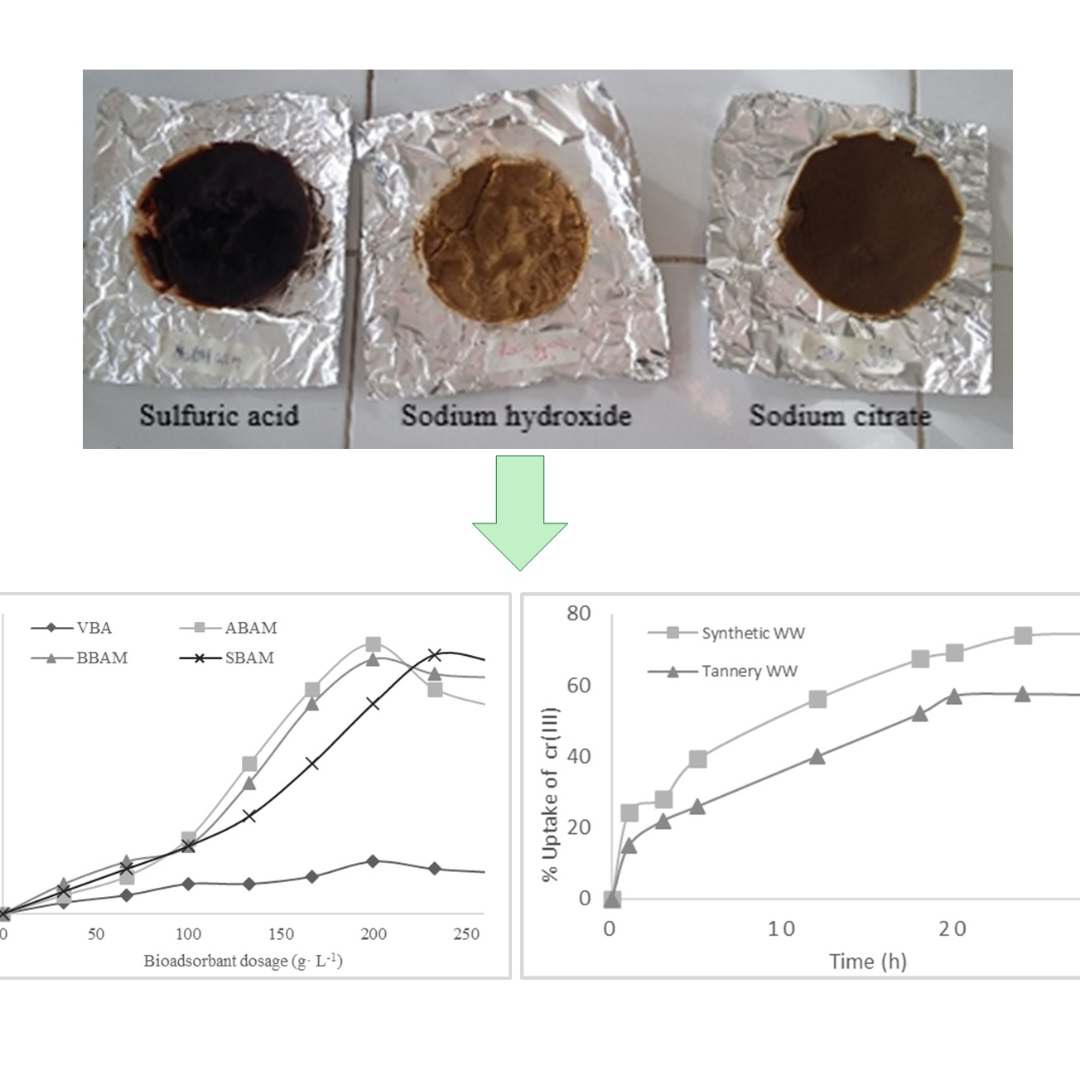
Se investigó la eliminación de Cr (III) de efluentes de curtidurías utilizando residuos de tallo de rosa como bioadsorbente (BA). En primer lugar, se realizaron experimentos de sorción con BA virgen para verificar su eficacia. Debido a la baja capacidad de retención del BA, se le modificó químicamente con H2SO4, NaOH y Na3C6H5O7, por separado. El BA fue caracterizado mediante espectrometría infrarroja por transformada de Fourier (FT-IR), y a continuación, fue utilizado en los estudios de sorción. En segundo lugar, se investigaron los efectos del pH (2 - 6), la dosis de adsorbente (33 – 300 g/L) y el tiempo de contacto (1 – 30 h) mediante experimentos por lotes. Para estudiar las variables indicadas, se utilizaron soluciones sintéticas (250 ppm) preparadas con Cr(OH)SO4. Posteriormente, se utilizó un efluente de curtiduría para aplicar las condiciones ideales seleccionadas para las soluciones sintéticas. Se empleó un espectrofotómetro de absorción atómica para determinar las concentraciones de Cr(III). Los resultados mostraron que la eficacia aumentaba con el incremento de la dosis de BA (200 g/L), el tiempo de contacto (20 h) y el pH 6. La eficacia del BA en la remoción del Cr(III) en el efluente real (57 %) fue inferior a la de las muestras sintéticas (72 %). El modelo cinético de pseudo-segundo orden y el equilibrio representado por la isoterma de Sips, con un rendimiento de 5,1 mg Cr/g BA, son los que mejor se ajustan a los datos experimentales.
Descargas
Descargas
Detalles del artículo
Citas
Abdulsalam, S. (2014a). Biosorption of Chromium (VI) Ion from Tannery Waste Water Using Two Novel Agricultural By-Products. International Journal of Innovation, Management and Technology, 5(2). https://doi.org/10.7763/ijimt.2014.v5.490
Abdulsalam, S. (2014b). Biosorption of Chromium (VI) Ion from Tannery Waste Water Using Two Novel Agricultural By-Products. International Journal of Innovation, Management and Technology, 5(2), 78–82. https://doi.org/10.7763/ijimt.2014.v5.490
Abiodun, O.-A. O., Oluwaseun, O., Oladayo, O. K., Abayomi, O., George, A. A., Opatola, E., Orah, R. F., Isukuru, E. J., Ede, I. C., Oluwayomi, O. T., Okolie, J. A., & Omotayo, I. A. (2023). Remediation of heavy metals using biomass-based adsorbents: Adsorption kinetics and isotherm models. Clean Technologies, 5(3), 934–960. https://doi.org/10.3390/cleantechnol5030047
Aguiar, A. B., Costa, J. M., Santos, G. E., Sancinetti, G. P., & Rodriguez, R. P. (2022). Removal of metals by biomass derived adsorbent in its granular and powdered forms: Adsorption capacity and kinetics analysis. Sustainable Chemistry, 3(4), 535–550. https://doi.org/10.3390/suschem3040033
AL-Othman, Z. A., Ali, R., & Naushad, M. (2012). Hexavalent chromium removal from aqueous medium by activated carbon prepared from peanut shell: Adsorption kinetics, equilibrium and thermodynamic studies. Chemical Engineering Journal, 184(March), 238–247. https://doi.org/10.1016/j.cej.2012.01.048
Balintova, M., & Estokova, A. (2024). Materials for heavy metals removal from waters. Materials, 17(9), Article 1935. https://doi.org/10.3390/ma17091935
Bhattacharya, K. G., & Sharma, A. (2005). Kinetics and thermodynamics of Methylene Blue adsorption on Neem (Azadirachta indica) leaf powder. Dyes and Pigments, 65(1), 51–59. https://doi.org/10.1016/j.dyepig.2004.06.016
Chi, Y., Yang, P., Ren, S., & Yang, J. (2020). Sorption of heavy metals from aqueous solution by biochar derived from anaerobically digested sludge: Kinetics and mechanism. Science of the Total Environment, 715, 138954. https://doi.org/10.1016/j.scitotenv.2020.138954
Chowdhury, M., Mostafa, M. G., Biswas, T. K., Mandal, A., & Saha, A. K. (2015). Characterization of the Effluents from Leather Processing Industries. Environmental Processes, 2(1), 173–187. https://doi.org/10.1007/s40710-015-0065-7
El Achaby, M., El Miri, N., Aboulkas, A., Zahouily, M., Bilal, E., Barakat, A., & Solhy, A. (2017). Processing and properties of eco-friendly bio-nanocomposite films filled with cellulose nanocrystals from sugarcane bagasse. International Journal of Biological Macromolecules, 96, 340–352. https://doi.org/10.1016/j.ijbiomac.2016.12.040
Eyvazi, B., Jamshidi-Zanjani, A., & Khodadadi Darban, A. (2019). Synthesis of nano-magnetic MnFe2O4 to remove Cr(III) and Cr(VI) from aqueous solution: A comprehensive study. Environmental Pollution, (xxxx), 113685. https://doi.org/10.1016/j.envpol.2019.113685
Fertu, D. I., Bulgariu, L., & Gavrilescu, M. (2022). Modeling and optimization of heavy metals biosorption by low-cost sorbents using response surface methodology. Processes, 10(3), Article 523. https://doi.org/10.3390/pr10030523
Guerrero-Coronilla, I., Morales-Barrera, L., Villegas-Garrido, T. L., & Cristiani-Urbina, E. (2014). Biosorption of amaranth dye from aqueous solution by roots, leaves, stems and the whole plant of E. crassipes. Environmental Engineering and Management Journal, 13(8), 1917–1926. https://doi.org/10.30638/eemj.2014.212
Ilyas, R. A., Sapuan, S. M., & Ishak, M. R. (2018). Isolation and characterization of nanocrystalline cellulose from sugar palm fibres (Arenga Pinnata). Carbohydrate Polymers, 181, 1038–1051. https://doi.org/10.1016/j.carbpol.2017.11.045
Javed, M. A., Bhatti, H. N., Hanif, M. A., & Nadeem, R. (2007). Kinetic and equilibrium modeling of Pb(II) and Co(II) sorption onto rose waste biomass. Separation Science and Technology, 42(16), 3641–3656. https://doi.org/10.1080/01496390701710794
Jiang, F., & Hsieh, Y. Lo. (2015). Cellulose nanocrystal isolation from tomato peels and assembled nanofibers. Carbohydrate Polymers, 122, 60–68. https://doi.org/10.1016/j.carbpol.2014.12.064
Kallel, F., Bettaieb, F., Khiari, R., García, A., Bras, J., & Chaabouni, S. E. (2016). Isolation and structural characterization of cellulose nanocrystals extracted from garlic straw residues. Industrial Crops and Products, 87, 287–296. https://doi.org/10.1016/j.indcrop.2016.04.060
Leite, A. L. M. P., Zanon, C. D., & Menegalli, F. C. (2017). Isolation and characterization of cellulose nanofibers from cassava root bagasse and peelings. Carbohydrate Polymers, 157, 962–970. https://doi.org/10.1016/j.carbpol.2016.10.048
Madela, M., & Skuza, M. (2021). Towards a circular economy: Analysis of the use of biowaste as biosorbent for the removal of heavy metals. Energies, 14(17), Article 5427. https://doi.org/10.3390/en14175427
Martín-Domínguez, A., Rivera-Huerta, M. L., Pérez-Castrejón, S., Garrido-Hoyos, S. E., Villegas-Mendoza, I. E., Gelover-Santiago, S. L., … Buelna, G. (2018). Chromium removal from drinking water by redox-assisted coagulation: Chemical versus electrocoagulation. Separation and Purification Technology, 200, 266–272. https://doi.org/10.1016/j.seppur.2018.02.014
Moriana, R., Vilaplana, F., & Ek, M. (2016). Cellulose Nanocrystals from Forest Residues as Reinforcing Agents for Composites: A Study from Macro- to Nano-Dimensions. Carbohydrate Polymers, 139, 139–149. https://doi.org/10.1016/j.carbpol.2015.12.020
Namasivayam, C., & Sureshkumar, M. V. (2008). Removal of chromium(VI) from water and wastewater using surfactant modified coconut coir pith as a biosorbent. Bioresource Technology, 99(7), 2218–2225. https://doi.org/10.1016/j.biortech.2007.05.023
Noah, N. F. M., Sulaiman, R. N. R., Othman, N., Jusoh, N., & Rosly, M. B. (2020). Extractive continuous extractor for chromium recovery: Chromium (VI) reduction to chromium (III) in sustainable emulsion liquid membrane process. Journal of Cleaner Production, 247(Vi), 119167. https://doi.org/10.1016/j.jclepro.2019.119167
Prabhakaran, S. K., Vijayaraghavan, K., & Balasubramanian, R. (2009). Removal of Cr(VI) ions by spent tea and coffee dusts: Reduction to Cr(III) and biosorption. Industrial and Engineering Chemistry Research, 48(4), 2113–2117. https://doi.org/10.1021/ie801380h
Rafati, L., Ehrampoush, M. H., Rafati, A. A., Mokhtari, M., & Mahvi, A. H. (2018). Removal of ibuprofen from aqueous solution by functionalized strong nano-clay composite adsorbent: kinetic and equilibrium isotherm studies. International Journal of Environmental Science and Technology, 15(3), 513–524. https://doi.org/10.1007/s13762-017-1393-0
Raji, Z., Karim, A., Karam, A., & Khalloufi, S. (2023). Adsorption of heavy metals: Mechanisms, kinetics, and applications of various adsorbents in wastewater remediation—A review. Waste, 1(3), 775–805. https://doi.org/10.3390/waste1030046
Salazar-Pinto, B. M., Zea-Linares, V., Villanueva-Salas, J. A., & Gonzales-Condori, E. G. (2021). Cd (Ii) and pb (ii) biosorption in aqueous solutions using agricultural residues of phaseolus vulgaris l.: Optimization, kinetics, isotherms and desorption. Revista Mexicana de Ingeniera Quimica, 20(1), 305–322. https://doi.org/10.24275/rmiq/IA1864
Saurabh, C. K., Mustapha, A., Masri, M. M., Owolabi, A. F., Syakir, M. I., Dungani, R., … Abdul Khalil, H. P. S. (2016). Isolation and characterization of cellulose nanofibers from gigantochloa scortechinii as a reinforcement material. Journal of Nanomaterials, 2016. https://doi.org/10.1155/2016/4024527
Simón, D., Palet, C., Costas, A., & Cristóbal, A. (2022). Agro-industrial waste as potential heavy metal adsorbents and subsequent safe disposal of spent adsorbents. Water, 14(20), Article 3298. https://doi.org/10.3390/w14203298
Singh, N. B., Nagpal, G., Agrawal, S., & Rachna. (2018). Water purification by using Adsorbents: A Review. Environmental Technology and Innovation, 11, 187–240. https://doi.org/10.1016/j.eti.2018.05.006
Wi´sniewska, M., Marciniak, M., Geca, M., Herda, K., Pietrzak, R., & Nowicki, P. (2022). Activated biocarbons obtained from plant biomass as adsorbents of heavy metal ions. Materials, 15(17), Article 5856. https://doi.org/10.3390/ma15175856
Wu, X., Zhu, H., Liu, Y., Chen, R., Qian, Q., & Van der Bruggen, B. (2020). Cr(III) recovery in form of Na2CrO4 from aqueous solution using improved bipolar membrane electrodialysis. Journal of Membrane Science, 604(January), 118097. https://doi.org/10.1016/j.memsci.2020.118097
hang, J. wei, Bi, F. zhi, Wang, Q. jia, Wang, W. lin, Liu, B., Lutts, S., … Han, R. ming. (2018). Characteristics and influencing factors of cadmium biosorption by the stem powder of the invasive plant species Solidago canadensis. Ecological Engineering, 121(October), 12–18. https://doi.org/10.1016/j.ecoleng.2017.10.001
Zhou, Z., Xu, Z., Feng, Q., Yao, D., Yu, J., Wang, D., … Zhong, M. e. (2018). Effect of pyrolysis condition on the adsorption mechanism of lead, cadmium and copper on tobacco stem biochar. Journal of Cleaner Production, 187, 996–1005. https://doi.org/10.1016/j.jclepro.2018.03.268
Barra lateral del artículo
Barra lateral del artículo

Esta obra está bajo una licencia internacional Creative Commons Atribución-NoComercial-CompartirIgual 4.0.