

Recuperación de Óxido Crómico a Partir de Aguas Residuales de Curtiduría y Aplicación como Colorante
##plugins.themes.bootstrap3.article.main##
Carlos Medina

Alexis Debut
Jorge Silva
Julio Gallegos
Kerly Vicuña
Paúl Palmay
Santiago Carrera
Resumen
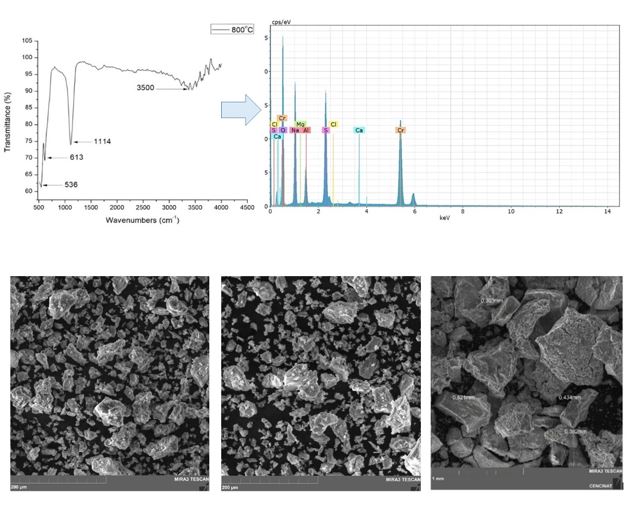
La industria del curtido de pieles utiliza grandes cantidades de cromo en su proceso, lo que da lugar a grandes volúmenes de aguas residuales con altas concentraciones de cromo. Éstas podrían ser una fuente para la recuperación de este metal tras su eliminación. El objetivo de este estudio es aprovechar estas aguas residuales para la extracción de óxido de cromo (Cr2O3), un material con una amplia gama de propiedades que puede utilizarse en numerosas aplicaciones. En el estudio, se utilizaron efluentes como fuente de cromo (III) e hidróxido de amonio (NH4OH) como precipitante hasta un pH de 10. El precipitado resultante se filtró, y se secó a 70°C y luego se calcinó a 400, 600 y 700°C durante 5 h. A continuación, el precipitado se molió para un análisis más detallado. El material se caracterizó por infrarrojo con transformada de Fourier (FT-IR), difracción de rayos X (DRX) y microscopía electrónica de barrido (SEM-EDX). El análisis FTIR reveló picos característicos de óxido de cromo (III). Los estudios de DRX confirmaron la formación de Cr2O3 con estructura hexagonal. Las imágenes SEM mostraron que las partículas no tenían una forma definida. El tamaño de los cristales variaba entre 25 y 97 um, con un tamaño medio de 78 nm. La presencia de óxido de cromo se confirmó mediante análisis de composición EDS.
Descargas
Descargas
Detalles del artículo
Citas
Abdullah, M. M., Rajab, F. M., & Al-Abbas, S. M. (2014). Structural and optical characterization of Cr2O3 nanostructures: Evaluation of its dielectric properties. AIP Advances, 4(2), 0–11. https://doi.org/10.1063/1.4867012
Afzal, A., Atiq, S., Saleem, M., Ramay, S. M., Naseem, S., & Siddiqi, S. A. (2016). Structural and magnetic phase transition of sol–gel-synthesized Cr2O3 and MnCr2O4 nanoparticles. Journal of Sol-Gel Science and Technology, 80(1), 96–102. https://doi.org/10.1007/s10971-016-4066-4
Cao, Z., & Zuo, C. (2017). Cr2O3/carbon nanosheet composite with enhanced performance for lithium ion batteries. RSC Advances, 7(64), 40243–40248. https://doi.org/10.1039/c7ra06188a
Chávez, A. (2010). Descripción de la nocividad del cromo proveniente de la industria curtiembre y de las posibles formas de removerlo. Revista Ingenierías, 9(17), 41–49. http://www.redalyc.org/articulo.oa?id=75017164003
Chua, L., Quan, S. Z., Yan, G., & Yoo, W. S. (2022). Investigating the Colour Difference of Old and New Blue Japanese Glass Pigments for Artistic Use. J. Conserv. Sci, 38(1), 1–13. https://doi.org/10.12654/JCS.2022.38.1.01
Engy, A., Hesham, A., Amr, M., & D, A. (2016). Remediation and recycling of chromium from tannery wastewater using combined chemical – biological treatment system. Process Safety and Environmental Protection, 104, 1–10. https://doi.org/10.1016/j.psep.2016.08.004
Gao, X.-Q., Lu, W.-D., Hu, S.-Z., Li, W.-C., & Lu, A.-H. (2019). Rod-shaped porous alumina-supported Cr2O3 catalyst with low acidity for propane dehydrogenation. Chinese Journal of Catalysis, 40(2), 184–191. https://doi.org/https://doi.org/10.1016/S1872-2067(18)63202-4
Gayo, G. X., & Lavat, A. E. (2018). Green ceramic pigment based on chromium recovered from a plating waste. Ceramics International, 44(18), 22181–22188. https://doi.org/https://doi.org/10.1016/j.ceramint.2018.08.336
Gibot, P. (2020). Centimetric-sized chromium (III) oxide object synthesized by means of the carbon template replication. Ceramics, 3(1), 92–100. https://doi.org/10.3390/ceramics3010010
Golosova, N. O., Kozlenko, D. P., Kichanov, S. E., Lukin, E. V., Liermann, H. P., Glazyrin, K. V., & Savenko, B. N. (2017). Structural and magnetic properties of Cr2O3 at high pressure. Journal of Alloys and Compounds, 722, 593–598. https://doi.org/10.1016/j.jallcom.2017.06.140
kirtiHuang, Z., Chen, C., Xie, J., & Wang, Z. (2016). The evolution of dehydration and thermal decomposition of nanocrystalline and amorphous chromium hydroxide. Journal of Analytical and Applied Pyrolysis, 118, 225–230. https://doi.org/10.1016/j.jaap.2016.02.006
Kadowaki, H., Katasho, Y., Yasuda, K., & Nohira, T. (2018). Electrolytic Reduction of Solid Al 2 O 3 to Liquid Al in Molten CaCl 2 . Journal of The Electrochemical Society, 165(2), D83–D89. https://doi.org/10.1149/2.1191802jes
Kamari, H. M., Al-Hada, N. M., Baqer, A. A., Shaari, A. H., & Saion, E. (2019). Comprehensive study on morphological, structural and optical properties of Cr2O3 nanoparticle and its antibacterial activities. Journal of Materials Science: Materials in Electronics, 30(8), 8035–8046. https://doi.org/10.1007/s10854-019-01125-2
Mella, B., Glanert, A. C. C., & Mariliz, G. (2013). Removal of chromium from tanning wastewater by chemical precipitation and electrocoagulation (Vol. 100). https://doi.org/10.1016/j.psep.2015.03.007
Minas, F., Singh Chandravanshi, B., & Leta, S. (2017). Chemical precipitation method for chromium removal and its recovery from tannery wastewater in Ethiopia. Chemistry International, 3(4), 291–305. Retrieved from www.bosaljournals/chemint/editorci@bosaljournals.com
Murgueitio, E., Pinto, W., & Landivar, J. (2015). REMOVAL FROM SYNTHETIC WATER LEVEL LABORATORY , USING LAYERED DOUBLE HYDROXIDES ( HDL ). Revista de La Sociedad Química Del Perú, 81(2).
Nashy, E. H. A., Osman, O., Mahmoud, A. A., & Ibrahim, M. (2012). Molecular spectroscopic study for suggested mechanism of chrome tanned leather. Spectrochimica Acta - Part A: Molecular and Biomolecular Spectroscopy, 88, 171–176. https://doi.org/10.1016/j.saa.2011.12.024
Rathore, D. S. (2015). Study of fungal Diversity on different types of Finished Leather and Leather Articles. Research Journal of Recent Sciences
Shahid, M., Shamshad, S., Rafiq, M., Khalid, S., Bibi, I., Niazi, N. K., … Rashid, M. I. (2017). Chromium speciation, bioavailability, uptake, toxicity and detoxification in soil-plant system: A review. Chemosphere, 178, 513–533. https://doi.org/10.1016/j.chemosphere.2017.03.074
Shore, L. S., & Shemesh, M. (2016). Estrogen as an Environmental Pollutant. Bulletin of Environmental Contamination and Toxicology, 97(4), 447–448. https://doi.org/10.1007/s00128-016-1873-9
Talavari, F., Shakeri, A., & Mighani, H. (2018). Synthesis of Cr2O3/TiO2 Nanocomposite and its Application as the Blocking Layer in Solar Cells. Journal of Environmental Analytical Chemistry, 05(01), 2–6. https://doi.org/10.4172/2380-2391.1000231
Tsegay, M. G., Gebretinsae, H. G., G.Welegergs, G., Maaza, M., & Nuru, Z. Y. (2022). Novel green synthesized Cr2O3 for selective solar absorber: Investigation of structural, morphological, chemical, and optical properties. Solar Energy, 236, 308–319. https://doi.org/https://doi.org/10.1016/j.solener.2022.03.011
Tumolo, M., Ancona, V., De Paola, D., Losacco, D., Campanale, C., Massarelli, C., & Uricchio, V. F. (2020). Chromium pollution in European water, sources, health risk, and remediation strategies: An overview. International Journal of Environmental Research and Public Health, 17(15), 1–25. https://doi.org/10.3390/ijerph17155438
Wang, F., He, N., Li, H., Ji, L., Liu, X., Ye, Y., … Chen, J. (2018). Mechanical and tribological properties of Cr/Cr2O3 multilayer films. Proceedings of the Institution of Mechanical Engineers, Part J: Journal of Engineering Tribology, 232(10), 1195–1202. https://doi.org/10.1177/1350650117743683
Wang, H., Han, W., Li, X., Liu, B., Tang, H., & Li, Y. (2019). Solution combustion synthesis of Cr2O3 nanoparticles and the catalytic performance for dehydrofluorination of 1,1,1,3,3-pentafluoropropane to 1,3,3,3-tetrafluoropropene. Molecules, 24(2), 1–12. https://doi.org/10.3390/molecules24020361
Wang, Xinyan, Ju, P., Lu, X., Chen, Y., & Wang, F. (2022a). Influence of Cr2O3 particles on corrosion, mechanical and thermal control properties of green PEO coatings on Mg alloy. Ceramics International, 48(3), 3615–3627. https://doi.org/https://doi.org/10.1016/j.ceramint.2021.10.142
Wang, Xuechuan, Lan, X., Zhu, X., & Sun, S. (2022b). Preparation of a ricinoleic acid modified amphoteric polyurethane for leather cleaner and simplifying production. Journal of Cleaner Production, 330, 129877. https://doi.org/https://doi.org/10.1016/j.jclepro.2021.129877
Yahyazadehfar, M., Ahmadi, S. A., Sheikhhosseini, E., & Ghazanfari, D. (2020). High-yielding strategy for microwave-assisted synthesis of Cr2O3 nanocatalyst. Journal of Materials Science: Materials in Electronics, 31(14), 11618–11623. https://doi.org/10.1007/s10854-020-03710-2
Yin, Y., Li, B., Yuan, Z., Qi, Y., & Zhang, Y. (2019). Microstructure and improved hydrogen storage properties of Mg85Zn5Ni10 alloy catalyzed by Cr2O3 nanoparticles. Journal of Physics and Chemistry of Solids, 134, 295–306. https://doi.org/https://doi.org/10.1016/j.jpcs.2019.06.015
Zhang, H. L., Liang, S. T., Luo, M. T., Ma, M. G., Fan, P. P., Xu, H. B., … Zhang, Y. (2014). Preparation and color performance control of Cr2O3 green pigment through thermal decomposition of chromium hydroxide precursor. Materials Letters, 117, 244–247. https://doi.org/10.1016/j.matlet.2013.12.010
Zhang, R., Chang, Q.-Y., Ma, F., Zeeshan, M., Yang, M.-L., Sui, Z.-J., … Zhu, Y.-A. (2022). Enhanced catalytic performance of transition metal-doped Cr2O3 catalysts for propane dehydrogenation: A microkinetic modeling study. Chemical Engineering Journal, 446, 136913. https://doi.org/https://doi.org/10.1016/j.cej.2022.136913
Zhao, C., & Chen, W. (2019). A review for tannery wastewater treatment: some thoughts under stricter discharge requirements. Environmental Science and Pollution Research, 26(25), 26102–26111. https://doi.org/10.1007/s11356-019-05699-6
Zhao, P., Zhao, H., Yu, J., Zhang, H., Gao, H., & Chen, Q. (2018a). Crystal structure and properties of Al2O3-Cr2O3 solid solutions with different Cr2O3 contents. Ceramics International, 44(2), 1356–1361. https://doi.org/https://doi.org/10.1016/j.ceramint.2017.08.195
Zhao, X., Zhang, Y., Qiu, P., Wen, P., Wang, H., Xu, G., & Han, Y. (2018b). C-doped Cr2O3/NaY composite membrane supported on stainless steel mesh with enhanced photocatalytic activity for cyclohexane oxidation. Journal of Materials Science, 53(9), 6552–6561. https://doi.org/10.1007/s10853-018-1997-x
Zhou, Y., Ma, J., Gao, D., Li, W., Shi, J., & Ren, H. (2018). A novel chrome-free tanning approach based on sulfonated tetraphenyl Calix[4]resorcinarene: Preparation and application. Journal of Cleaner Production, 201, 668–677. https://doi.org/https://doi.org/10.1016/j.jclepro.2018.07.196
Barra lateral del artículo
Barra lateral del artículo

Esta obra está bajo una licencia internacional Creative Commons Atribución-NoComercial-CompartirIgual 4.0.