

Predicción de Consumo y Demanda de Electricidad Mediante Redes Neuronales Artificiales y Algoritmo Iterativo
##plugins.themes.bootstrap3.article.main##
Reineris Montero Laurencio

Orlys Torres Breff
Secundino Marrero Ramirez
Diego Jiménez jiménez
Resumen
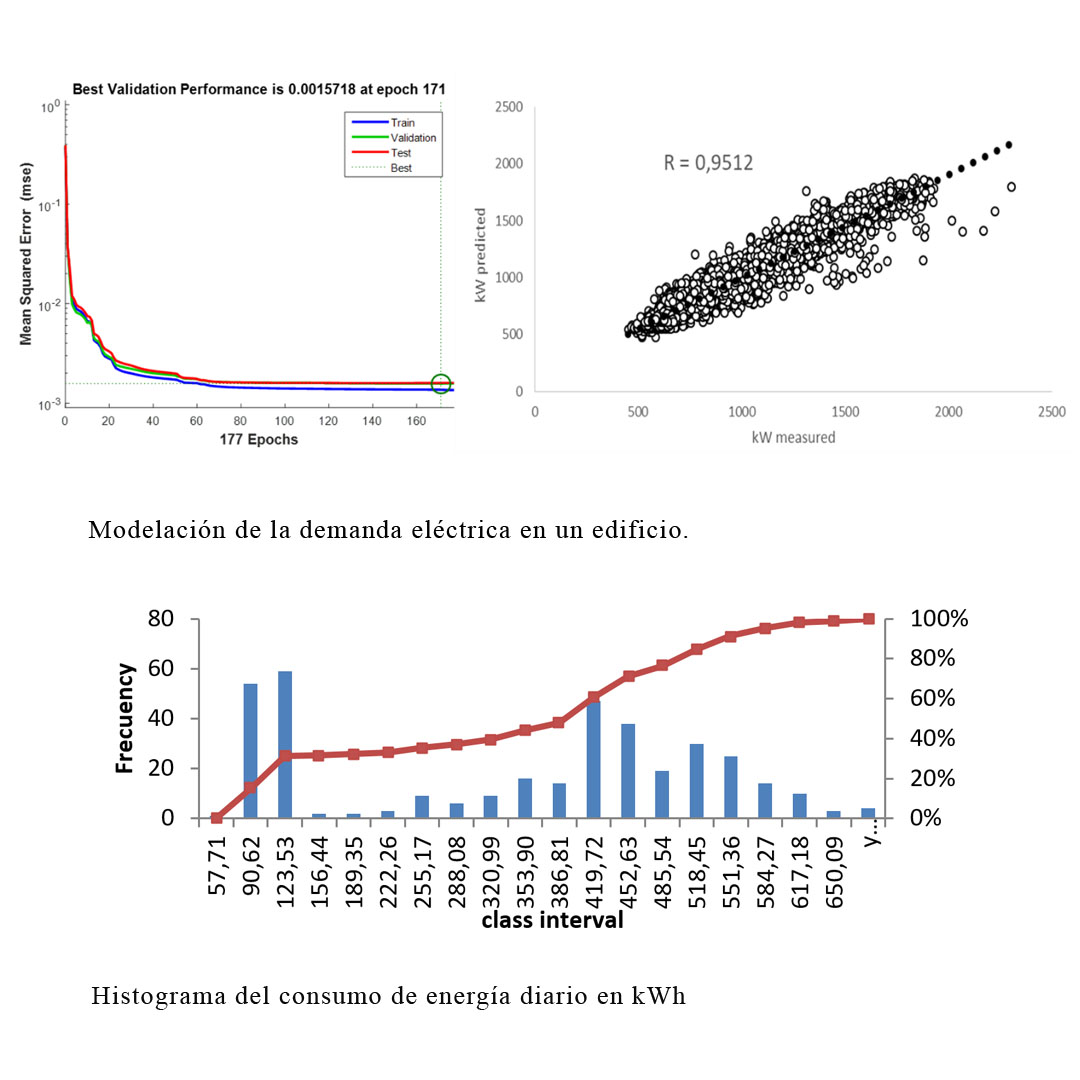
En los nuevos escenarios urbanos de generación y distribución de electricidad, con incidencia de las fuentes renovables de energía, resulta necesario conocer el comportamiento de la demanda y el pronóstico del consumo mediante modelos predictivos confiables para garantizar la operación eficaz y eficiente del sistema. La presente investigación se propone utilizar las redes neuronales artificiales (RNA) mediante aprendizaje automático basado en un algoritmo iterativo (ML). En el caso de la demanda se determinó el modelo predictivo de potencia activa de un circuito de distribución primaria, donde las cargas residenciales están localizadas en edificios multifamiliares y constituyen el 64 % de todo el consumo de electricidad. Para realizar la modelación de la demanda se utilizaron los datos recolectados por un dispositivo de protección y medición, y como entradas las variables estacionarias: estación del año, día del año, día de la semana y la hora del día. El ajuste del modelo fue del 94.5 %, mejorando los resultados logrados mediante modelación paramétrica y de regresión múltiple. Se utilizó el mismo algoritmo y los mismos pasos para modelar el consumo de energía eléctrica diario de una empresa de proyectos, constituida por un edificio, donde el mejor coeficiente de correlación obtenido entre los datos de salida medidos y los predichos es de 0.9435. Los resultados de la investigación reflejan la utilidad del aprendizaje iterativo automático basado en la determinación de modelos predictivos, lo cual favorece los procesos de toma decisiones en cuanto a operación de las redes eléctricas y la planificación energética.
Descargas
Descargas
Detalles del artículo
Citas
Ahmad, J., Larijani, H., Emmanuel, R., Mannion, M., Javed, A., & Phillipson, M. (2017). Energy demand prediction through novel random neural network predictor for large non-domestic buildings. Annual IEEE International Systems Conference (SysCon), (pp. 1-6). Montreal: Canada. https://doi.org/10.1109/SYSCON.2017.7934803
Akarslan, E., & Hocaoglu, F. O. (2018). Electricity demand forecasting of a micro grid using ANN. 9th International Renewable Energy Congress (IREC), 2018 (pp. 1-5). IEEE. https://doi.org/10.1109/IREC.2018.8362471
Alobaidi, M. H., Chebana, F., & Meguid, M. A. (2018). Robust ensemble learning framework for day-ahead forecasting of household based energy consumption. Applied energy, 212, 997-1012. https://doi.org/10.1016/j.apenergy.2017.12.054
Amber, K., Ahma, R., Aslam, M., Kousar, A., Usman, M., & Khan, M. (2018). Intelligent techniques for forecasting electricity consumption of buildings. Energy, 157, 886-893. https://doi.org/10.1016/j.energy.2018.05.155
Aurangzeb, K. (2019). Short Term Power Load Forecasting using Machine Learning Models for energy management in a smart community. International Conference on Computer and Information Sciences (ICCIS), 2019 (pp. 1-6). IEEE. https://doi.org/10.1109/ICCISci.2019.8716475
Azadeh, A., Ghaderi, S., Tarverdian, S., & Saberi, M. (2007). Integration of artificial neural networks and genetic algorithm to predict electrical energy consumption. Applied Mathematics and Computation, 186(2), 1731-1741. https://doi.org/10.1016/j.amc.2006.08.093
Barman, M., Choudhury, N. D., & Sutradhar, S. (2018). A regional hybrid GOA-SVM model based on similar day approach for short-term load forecasting in Assam, India. Energy, 145, 710-720. https://doi.org/10.1016/j.energy.2017.12.156
Beale, M. H., Hagan, M. T., & Demuth, H. B. (1992). Neural network toolbox user’s guide. Natick, Massachusetts: The MathWorks Inc.
Dash, S. K., & Patel, D. (2015). Short-term electric load forecasting using Extreme Learning Machine-a case study of Indian power market in 2015. IEEE Power, Communication and Information Technology Conference (PCITC), 2015 (pp. 961-966). IEEE. https://doi.org/10.1109/PCITC.2015.7438135
Deng, J. (2010). Modeling and prediction of China's electricity consumption using artificial neural network. Sixth International Conference on Natural Computation, IEEE, 2010, vol. 4 (pp. 1731-1733). Yantai: IEEE. https://doi.org/10.1109/ICNC.2010.5584347
Edwards, R. E., New, J., & Parker, L. E. (2012). Predicting future hourly residential electrical consumption: A machine learning case study. Energy and Buildings, 49, 591-603. https://doi.org/10.1016/j.enbuild.2012.03.010
Escrivá- Escrivá, G., Álvarez-Bel, C., Roldán-Blay, C., & Alcázar-Ortega, M. (2011). New artificial neural network prediction method for electrical consumption forecasting based on building end-uses. Energy and Buildings, 43(11), 3112-3119. https://doi.org/10.1016/j.enbuild.2011.08.008
Eseye, A. T., Lehtonen, M., Tukia, T., Uimonen, S., & Millar, R. J. (2019). Machine learning based integrated feature selection approach for improved electricity demand forecasting in decentralized energy systemspp. IEEE Access, 7, 91463-91475. https://doi.org/10.1016/j.enbuild.2015.08.052
Gonzalez, J. M., & Zamarreno, P. A. (2005). Prediction of hourly energy consumption in buildings based on a feedback artificial neural network. Energy and buildings, 37(6), 595-601. https://doi.org/10.1016/j.enbuild.2004.09.006
Hippert, H. S., Pedreira, C. E., & Souza, R. C. (2001). Neural networks for short-term load forecasting: A review and evaluation. IEEE Transactions on power systems, 16(1), 44-55. https://doi.org/10.1109/59.910780
Hossen, T., Plathottam, S. J., Angamuthu, R. K., Ranganathan, P., & Salehfar, H. (2017). Short-term load forecasting using deep neural networks (DNN). North American Power Symposium (NAPS), 2017 (pp. 1-6). IEEE. https://doi.org/10.1109/NAPS.2017.8107271
IEA. (12 de Diciembre de 2019a). International Energy Agency. Retrieved 2023, from Electricity Statistics: detailed, comprehensive annual data on electricity and heat: https://www.iea.org/statistics/electricity/.
IEA. (2019b, Septiembre 26). International Energy Agency. Retrieved 2023, from Key World Energy Statistics: key statistics on the supply, transformation and consumption of all major energy sources: https://www.iea.org/statistics/kwes/
Ismail, N., & Abdullah, S. (2016). Principal component regression with artificial neural network to improve prediction of electricity demand,. (I. A. J., Ed.) Inf. Technol, 13(1), 196-216. https://ccis2k.org/iajit/PDF/%20Vol%2013,%20No.%201A%20(Special%20Issue)/372.pdf
Jain, R. K., Smith, K. M., Culligan, P. J., & Taylor, J. E. (2014). Forecasting energy consumption of multi-family residential buildings using support vector regression: Investigating the impact of temporal and spatial monitoring granularity on performance accura. Applied Energy, 123, 168-178. https://doi.org/10.1016/j.apenergy.2014.02.057
Jaisumroum, N., & Teeravaraprug, J. (2017). Forecasting uncertainty of Thailand's electricity consumption compare with using artificial neural network and multiple linear regression methods. 12th IEEE Conference on Industrial Electronics and Application (ICIEA), (pp. 308-313). https://doi.org/10.1109/ICIEA.2017.8282862
Kalogirou, S. A. (2000). Applications of artificial neural-networks for energy systems. Applied energy, 67(1-2),17-35. https://doi.org/https://doi.org/10.1016/S0306-2619(00)00005-2
Karunathilake, S. L., & Nagahamulla, H. R. (2017). Artificial neural networks for daily electricity demand prediction of Sri Lanka. Seventeenth International Conference on Advances in ICT for Emerging Regions (ICTer) (pp. 1-6). IEEE. https://doi.org/10.1109/ICTER.2017.8257823
Kaysal, A., Köroglu, S., Oguz, Y., & Kaysal, K. (2018). Artificial Neural Networks and Adaptive Neuro-Fuzzy Inference Systems Approaches to Forecast the Electricity Data for Load Demand. 2nd International Symposium on Multidisciplinary Studies and Innovative Technologies (ISMSIT), 2018 (pp. 1-6). IEEE. https://doi.org/10.1109/ISMSIT.2018.8567270
Khan, G. M., Khattak, A. R., Zafari, F., & Mahmud, S. A. (2013). "Electrical load forecasting using fast learning recurrent neural networks. International Joint Conference on Neural Networks (IJCNN), 2013 (pp. 1-6). IEEE. https://doi.org/10.1109/IJCNN.2013.6706998
Kher, V., & Joshi, S. (2003). Short-Term Electrical Load Forecasting Using Artficial Neural Network,. University of Baroda, Department of Electrical Engineering. Badora: The Maharaja Sayajirao.
Kim J. Y., C. S. (2019). Electric energy consumption prediction by deep learning with state explainable autoencoder Energies, vol. 12, no. 4,. Energies, 12(4), 739. https://doi.org/10.3390/en12040739
Koprinska, I., Rana, M., Troncoso, A., & Martínez-Álvarez, F. (2013). Combining pattern sequence similarity with neural networks for forecasting electricity demand time series. The 2013 International Joint Conference on Neural Networks (IJCNN) (pp. 1-8). IEEE. https://doi.org/10.1109/IJCNN.2013.6706838
Kumar, R., Aggarwal, R., & Sharma, J. (2013). Energy analysis of a building using artificial neural network: A review vol. 65, pp. , 2013. Energy and Buildings, 65, 352-358. https://doi.org/10.1016/j.enbuild.2013.06.007
Laganathan, N., & Lakshmi, K. (2014). Demand side energy management system using ANN based linear programming approach. IEEE International Conference on Computational Intelligence and Computing Research (pp. 1-5). IEEE. https://doi.org/10.1109/ICCIC.2014.7238322
Li, C., Tao, Y., Ao, W., Yang, S., & Bai., Y. (2018). Improving forecasting accuracy of daily enterprise electricity consumption using a random forest based on ensemble empirical mode decomposition. Energy, 165, 1220-1227. https://doi.org/10.1016/j.energy.2018.10.113
Li, D., Tan, Z., Zhou, J., Zhang, J., & Wei, Y.-M. (2018). Short term electricity load forecasting using a hybrid model. Energy, 158, 774-781. https://doi.org/10.1016/j.energy.2018.06.012
Li, K., Hu, C., Liu, G., & Xue, W. (2015). Building's electricity consumption prediction using optimized artificial neural networks and principal component analysis," , vol. 108,. Energy and Buildings, 108, 106-113,. https://doi.org/10.1016/j.enbuild.2015.09.002
Li, K., Su, H., & Chu, J. (2011). Forecasting building energy consumption using neural networks and hybrid neuro-fuzzy system: A comparative study. Energy and Buildings, 43(10), 2893-2899. https://doi.org/10.1016/j.enbuild.2011.07.010
Mosavi, A., & Bahmani, A. (2019). Energy consumption prediction using machine learning: A review, Preprints. Energies, 11.
ONEI. (2019, Diciembre). Oficina Nacional de Estadística e Información. Electricidad en Cuba: Indicadores Seleccionados: http://www.one.cu/semestralelectricidad.htm.
Ray, P., Mishra, D. P., & Lenka, R. K. (2016). Short term load forecasting by artificial neural network. International Conference on Next Generation Intelligent Systems (ICNGIS), 2016 (pp. 1-6). IEEE. https://doi.org/10.1109/ICNGIS.2016.7854003
Romero, F. T., Hernandez, J. C., & Lopez, W. G. (2011). Predicting Electricity Consumption Using Neural Networks. IEEE Latin America Transactions, vol. 9, no. 7 (pp. 1066-1072). IEEE Xplorer. https://doi.org/10.1109/TLA.2011.6129704
Russel, S. J., & Norvig, P. (2016). Artificial intelligence: a modern approach. Malaysia. Pearson Education Limited.
Salam, A., & Hibaoui, A. E. (2018). Comparison of Machine Learning Algorithms for the Power Consumption Prediction:-Case Study of Tetouan city. 6th International Renewable and Sustainable Energy Conference (IRSEC), 2018 (págs. 1-5). IEEE. https://doi.org/10.1109/IRSEC.2018.8703007
Sandels, C., Widén, J., Nordström, L., & Andersson, E. (2015). Day-ahead predictions of electricity consumption in a Swedish office building from weather, occupancy, and temporal data. Energy and Buildings, 108, 279-290. https://doi.org/10.1016/j.enbuild.2015.08.052
Saravanan, S., Kannan, S., & Thangaraj, C. (2012). Forecasting India's electricity demand using artificial neural network. IEEE-International Conference On Advances In Engineering, Science And Management (ICAESM-2012) (págs. 79-83). IEEE. https://www.researchgate.net/publication/259005414
Seyedzadeh, S., Rahimian, F. P., Glesk, I., & Roper, M. (2018). Machine learning for estimation of building energy consumption and performance: a review. Visualization in Engineering, 6(1), 5. https://doi.org/10.1186/s40327-018-0064-7
Singh, R. P., Gao, P. X., & Lizotte, D. J. (2012). On hourly home peak load prediction IEEE Third International Conference on Smart Grid Communications (SmartGridComm. IEEE Third International Conference on Smart Grid Communications (SmartGridComm) (pp. 163-168). IEEE. https://doi.org/10.1109/SmartGridComm.2012.6485977
Sobrino, E. M., Santiago, A. V., & González., A. M. (2019). Forecasting the Electricity Hourly Consumption of Residential Consumers with Smart Meters using Machine Learning Algorithms. PowerTech, 2019, (pp. 1-6). Milan: IEEE. https://doi.org/10.1109/PTC.2019.8810902
Stein, B. V., Wang, H., & Bäck, T. (2019). Automatic Configuration of Deep Neural Networks with Parallel Efficient Global Optimization. International Joint Conference on Neural Networks (IJCNN), 2019 (pp. 1-7). Budapest: IEEE. https://doi.org/10.1109/IJCNN.2019.8851720
Tso, G. K., & Yau, K. K. (2007). Predicting electricity energy consumption: A comparison of regression analysis, decision tree and neural networks. Energy, 32(9), 1761-1768. https://doi.org/10.1016/j.energy.2006.11.010
Tümer, A. E., Koçer, S., & Koca, A. (2016). Estimation of the electricity consumption of Turkey trough artificial neural networks. IEEE 17th International Symposium on Computational Intelligence and Informatics (CINTI), 2016 (pp. 000315-000318). IEEE. https://doi.org/10.1109/CINTI.2016.7846425
United Nation. (2019). UN, Sustainable Development Goal 7: Ensure access to affordable, reliable, sustainable and modern energy for all. Retrieved marzo 2, 2023, from https://sustainabledevelopment.un.org/sdg7
Yang, B., & Sun., Y. (2008). An improved neural network prediction model for load demand in day-ahead electricity market. 7th World Congress on Intelligent Control and Automation (pp. 4425-4429). IEEE.
Yang, J., Rivard, H., & Zmeureanu, R. (2005). On-line building energy prediction using adaptive artificial neural networks vol. 37, no. 12, pp. , 2005. Energy and buildings, 37(12), 1250-1259.
Yuan, J., Farnham, C., Azuma, C., & Emura, K. (2018). Predictive artificial neural network models to forecast the seasonal hourly electricity consumption for a University Campus. Sustainable Cities and Society, 42, 82-92. https://doi.org/10.1109/WCICA.2008.4593635
Zhao, H.-x., & Mogoules, F. (2012). A review on the prediction of building energy consumption. Renewable and Sustainable Energy Reviews, 16(6), 3586-3592. https://doi.org/10.1016/j.rser.2012.02.049
Barra lateral del artículo
Barra lateral del artículo

Esta obra está bajo una licencia internacional Creative Commons Atribución-NoComercial-CompartirIgual 4.0.