

Modelo NARX para el Perfil Térmico de Postcombustión en un Horno Industrial
##plugins.themes.bootstrap3.article.main##
Deynier Montero-Góngora

Mauro Darío Albarracín Álvarez
Rafael Arturo Trujillo Codorniú
Resumen
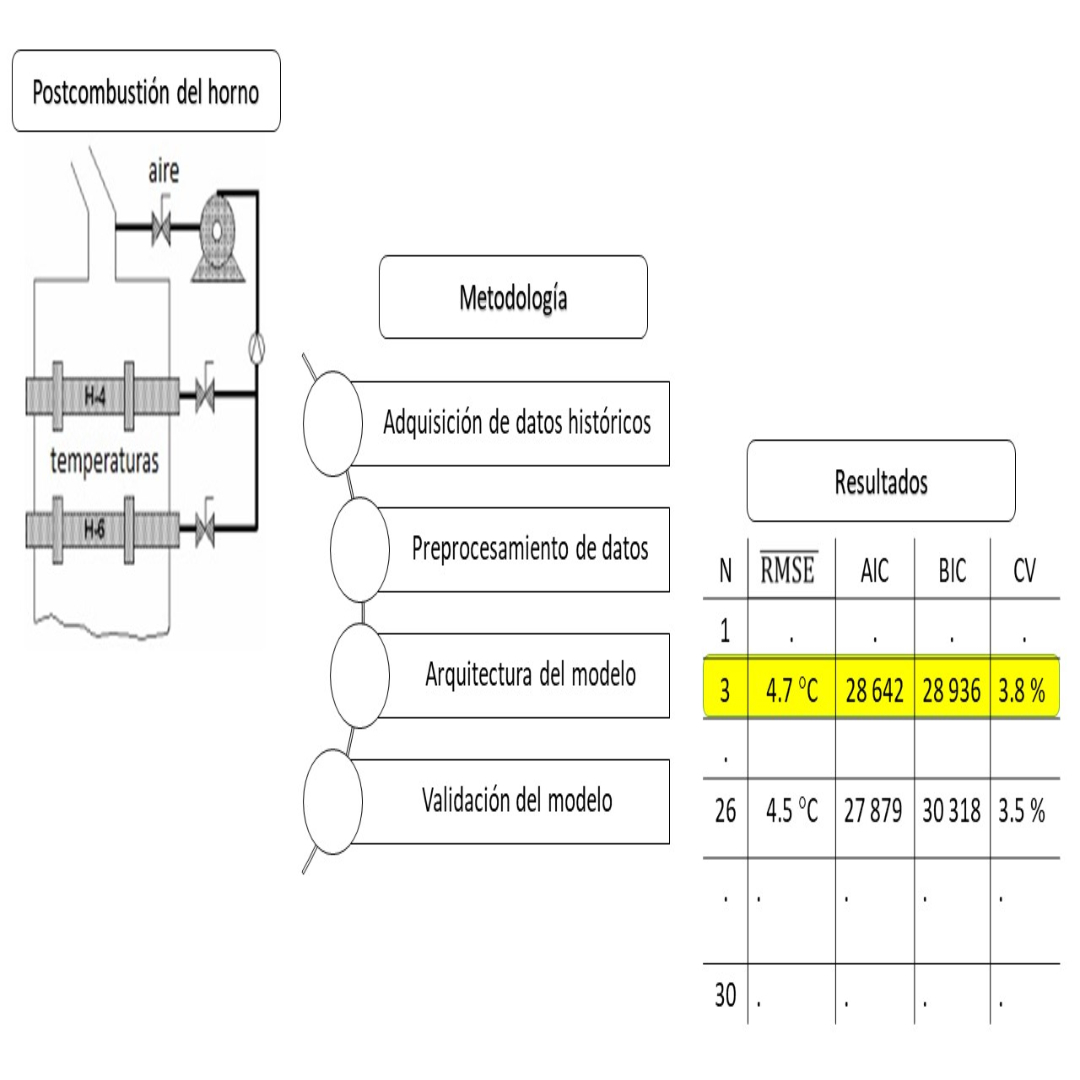
En los hornos de soleras múltiples, ocurren procesos físicos-químicos multivariables, no lineales y con dinámicas que varían en el tiempo. La automatización de la postcombustión se realiza mediante controladores Proporcional-Integral-Derivativo (PID), sin tener en cuenta modelos matemáticos que relacionen las variables de interés. Este artículo presenta modelos de redes neuronales artificiales (RNA) que se evalúan mediante los criterios de información de Akaike (AIC) y Bayesiano (BIC), y relacionan el perfil térmico de postcombustión respecto a la regulación de flujos de aire. El modelo propuesto por BIC de tres neuronas en la capa oculta, obtuvo una predicción de error de 4.7 °C con un paso delante (120 s); y puede emplearse en el diseño de estrategias de control con su consecuente impacto en la industria cubana del níquel.
Descargas
Descargas
Detalles del artículo
Citas
Akaike, H. (1974). A new look at the statistical model identification. IEEE Transactions on automatic control, 19(6), 716-723. https://doi.org/10.1109/TAC.1974.1100705
Aljojo, N., Alshutayri, A., Aldhahri, E., Almandeel, S., & Zainol, A. (2021). A Nonlinear Autoregressive Exogenous (NARX) Neural Network Model for the Prediction of Timestamp Influence on Bitcoin Value. IEEE Access, 9, 148611-148624. https://doi.org/10.1109/ACCESS.2021.3124629
Amellas, Y., Bakkali, O.E., Djebil, A., & Echchelh, A. (2020). Short-term wind speed prediction based on MLP and NARX network models. Indonesian Journal of Electrical Engineering and Computer Science, 18(1), 150-157. https://doi.org/10.11591/ijeecs.v18.i1
Boussaada, Z., Curea, O., Remaci, A., Camblong, H., & Mrabet, N. (2018). A Nonlinear Autoregressive Exogenous (Narx) Neural Network Model for the Prediction of the Daily Direct Solar Radiation. Energies, 11(3), 1-21. https://doi.org/10.3390/en11030620
Castellanos, J., Casto, R., & García, I. (1986). Elaboración de minerales oxidados de níquel por el esquema carbonato amoniacal. Minería y Geología, 4(2), 77-91.
https://1library.co/document/y818494z-elaboracion minerales-oxidados-niquel-esquema-carbonato amoniacal.html
Chang, A. R. (1999). Una visión sobre las reservas estratégicas de eficiencia metalúrgica en la tecnología carbonato-amoniacal. Minería y Geología, 16(1), 76-82. https://biblat.unam.mx/es/revista/mineria-y geologia/articulo/una-vision-sobre-las-reservas-estrategicas-de-eficiencia-metalurgica-en-la-tecnologia-carbonato-amoniacal
Devijver, P. A., & Kittler, J. (1982). Pattern Recognition: A Statistical Approach. Englewood Cliffs, N.J. : Prentice/Hall International
Diaconescu, E. (2008). The Use of Narx Neural Networks to Predict Chaotic Time Series. Wseas Trans. Comput. Res., 3, 182-191.
http://www.wseas.us/elibrary/transactions/research/2008/27-464.pdf
Dziak, J. J., Coffman, D. L., Lanza, S. T., Li, R., & Jermiin, L. S. (2020). Sensitivity and specificity of information criteria. Briefings in Bioinformatics, 21(2), 553-565, https://doi.org/10.1093/bib/bbz016
Fraser, E. D., Dougill, A. J., Mabee, W. E., Reed, M., & McAlpine, P. (2006). Bottom up and top down: Analysis of participatory processes for sustainability indicator identification as a pathway to community empowerment and sustainable environmental management. Journal of Environmental Management, 78(2), 114-127. https://doi.org/10.1016/j.jenvman.2005.04.009
Ghahari, S., Queiroz, C., Labi, S., & McNeil, S. (2021). Cluster Forecasting of Corruption Using Nonlinear Autoregressive Models with Exogenous Variables (NARX)—An Artificial Neural Network Analysis. Sustainability, 13(20), 1-20. https://doi.org/10.3390/su132011366
Góngora, D., Van Caneghem, J., Haeseldonckx, D., Leyva, E., Mendoza, M., & Dutta, A. (2020). Post-combustion artificial neural network modeling of nickel-producing multiple hearth furnace. International Journal of Chemical Reactor Engineering, 18(7), 1-14, Article 20190191. https://doi.org/10.1515/ijcre-2019-0191
Habashi, F. (1997). Handbook of Extractive Metallurgy. In Wiley-VCH (Ed.), (Vol. II).
Hayder, G., Solihin, M. I., & Najwa, M. R. N. (2022); Multi-step-ahead prediction of river flow using NARX neural networks and deep learning LSTM. H2Open Journal, 5 (1), 43-60. https://doi.org/10.2166/h2oj.2022.134
Hurvich, C. M., & Tsai, C. L. (1989). Regression and time series model selection in small samples. Biometrika, 76(2), 297-307. https://doi.org/10.2307/2336663
Louzazni, M., Mosalam, H., Khouya, A., & Amechnoue, K. (2020) A non-linear auto-regressive exogenous method to forecast the photovoltaic power output. Sustainable Energy Technologies and Assessments, 38, 1-15. https://doi.org/10.1016/j.seta.2020.100670
Miranda, J., Chaviano, R., & Miranda, J. R. (2002). Nuevas Interpretaciones químico-mineralógicas de las menas lateríticas y serpentínicas, a través del proceso pirometalúrgico, en la tecnología carbonato-amoniacal. Revista Cubana de Química, 14(2), 42-50. https://kohatest.itson.edu.mx/cgi-bin/koha/opac-detail.pl?biblionumber=177228
Montero, D., Columbié, Á., Montero, R., Trujillo, R., & Vázquez, L. (2022). Modelo NARX de la postcombustión en un horno de reducción de mineral laterítico. RIELAC, 43(3), 1-14. http://scielo.sld.cu/scielo.php?script=sci_arttext&pid=S1815-59282022000300015
Montero, D., Góngora, E., & Ramírez, M. (2019). Identification OF Post-Combustion Sub-Process Using Artificial Neural Networks. Biomed J Sci & Tech Res, 21(4),16031-16039. https://doi.org/10.26717/BJSTR.2019.21.003633
Montero, D., Ramírez, M., Gilbert, A., & Perdices, S. (2015). Modelación matemática para el control de la postcombustión en un horno de reducción de níquel. RIELAC, XXXVI(3), 21-34.
http://scielo.sld.cu/pdf/eac/v36n3/eac03315.pdf
Murari, A., Rossi, R., Spolladore, L., Lungaroni, M., Gaudio, P., & Gelfusa, M. (2023). A practical utility-based but objective approach to model selection for regression in scientific applications. Artif Intell Rev, 56(2), 2825-2859. https://doi.org/10.1007/s10462-023-10591-4
Nekoee, M., & Hosseini, R.S. (2020). Thermal anomaly detection using NARX neural network method to estimate the earthquake occurrence time. Earth Observation and Geomatics Engineering, 4(2), 98-108. https://doi.org/10.22059/eoge.2021.292253.1067
Paul, R. K., & Sinha, K. (2016). Forecasting Crop Yield: A Comparitive Assessment of Arimax and Narx Model. RASHI, 1, 77-85.
Purnomo, L. A. A., & Biyanto, T. R. (2019, March 29). Neural network model for profile temperature of nickel kiln AIP Conference Proceedings,
https://sci-hub.st/10.1063/1.5095267
Quade, M., Abel, M., Nathan, J., & Brunton, S. (2018). Sparse identification of nonlinear dynamics for rapid model recovery. Chaos, 28(063116), 1-10. https://doi.org/10.1063/1.5027470
Ramírez, I. M., & Ramírez, B. (2021). Efecto de la postcombustión sobre los principales índices técnico-económicos en un horno Herreshoff para la producción de níquel. Minería y Geología, 37(4), 426-444.
https://www.redalyc.org/journal/2235/223569573004/223569573004.pdf
Ramírez, M. (2001). Identificación experimental del subproceso de postcombustión en un horno de reducción de níquel. Minería y Geología, 18(2), 61-66.
https://revista.ismm.edu.cu/index.php/revistamg/article/view/207/194
Ramírez, M. (2002). Modelado del proceso de post-combustión en un horno de reducción de níquel. Revista de Metalurgia, 38(2), 150-157.
https://revistademetalurgia.revistas.csic.es/index.php/revistademetalurgia/article/view/396/402
Reed, M. S., Stringer, L. C., Fazey, I., Evely, A. C., & Kruijsen, J. H. J. (2014). Five principles for the practice of knowledge exchange in environmental management. Journal of Environmental Management, 146, 337-345. https://doi.org/10.1016/j.jenvman.2014.07.021
Rodríguez, L., Marrero, Y., & Reynaldo, C. L. (2022). Evaluation of efficiency in the nickel mining in Cuba. MIAB. Mining Inf. Anal. Bull, 10(1), 128-135.
https://www.elibrary.ru/item.asp?id=50167349
Schwarz, G. (1978). Estimating the dimension of a model. The Annals of Statistics, 6(2), 461-464. https://doi.org/10.1214/aos/1176344136
Song, Q.C., Tang, C., & Wee, S. (2021). Making Sense of Model Generalizability: A Tutorial on Cross-Validation in R and Shiny. Advances in Methods and Practices in Psychological Science, 4(1), 1-17. https://doi.org/10.1177/2515245920947067
Taqvi, S. A., Tufa, L. D., Zabiri, H., Maulud, A. S., & Uddin, F. (2020). Fault Detection in Distillation Column Using Narx Neural Network. Neural Comput. Appl., 32, 3503-3519.
https://link.springer.com/article/10.1007/s00521-018-3658-z
Tredennick, A. T., Hooker, G., Ellner, S. P., & Adler, P. B. (2021). A practical guide to selecting models for exploration, inference, and prediction in ecology. Ecology, 102(6), 1-16. https://doi.org/10.1002/ecy.3336
Tseng, S. C., & Hung, S. W. (2014). A strategic decision-making model considering the social costs of carbon dioxide emissions for sustainable supply chain management. Journal of Environmental Management, 133,315-322. https://doi.org/10.1016/j.jenvman.2013.11.023
Yu, X., Chen, Z., & Qi, L. ( 2019). Comparative Study of Sarima and Narx Models in Predicting the Incidence of Schistosomiasis in China. Math. Biosci. Eng. MBE, 16, 2266-2276. https://www.aimspress.com/fileOther/PDF/MBE/mbe-16-04-112.pdf
Yuanlin, G., Hua-Liang, W., & Balikhin, M. (2018). Nonlinear predictive model selection and model averaging using information criteria. Systems Science & Control Engineering, 6(1), 319-328. https://doi.org/10.1080/21642583.2018.1496042
Zayas, F., Quintián, H., Jove, E., Casteleiro, J. L., & Calvo, J. L. (2020). Diseño de controladores PID. https://doi.org/10.17979/spudc.9788497497855
Barra lateral del artículo
Barra lateral del artículo

Esta obra está bajo una licencia internacional Creative Commons Atribución-NoComercial-CompartirIgual 4.0.