

Diseño de Sistemas Fotovoltaicos Aislados con Inclinación Óptima Fija de los Paneles para el Mes Crítico
##plugins.themes.bootstrap3.article.main##
Mónica Chinchilla Sánchez

Jorge Martínez Crespo
Ulpiano Ruiz-Rivas Hernando
Resumen
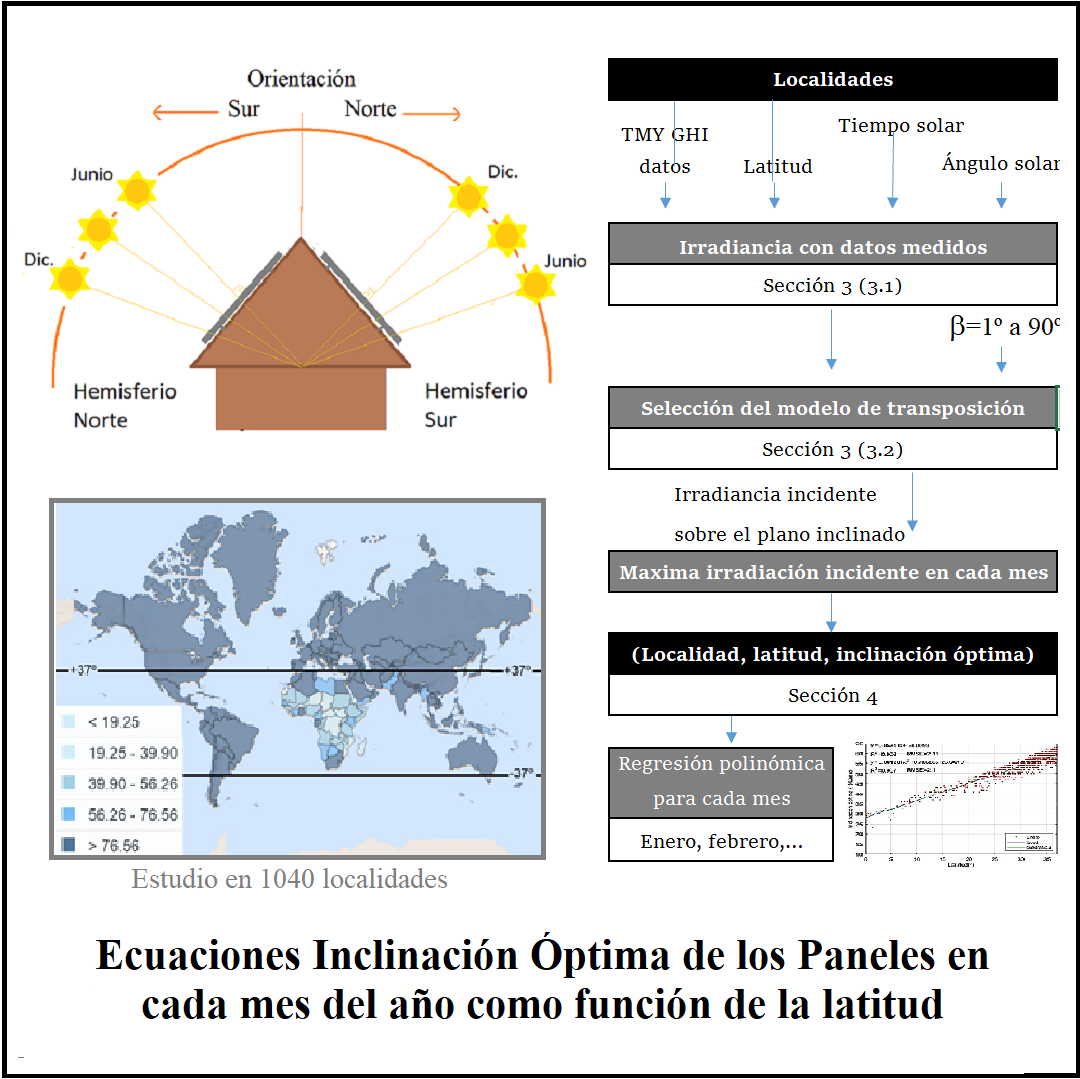
El uso de sistemas fotovoltaicos aislados de la red se utiliza cada vez más como el principal método de suministro de electricidad en zonas rurales de muchos países en desarrollo. El estudio se centra en determinar el ángulo de inclinación de los paneles fotovoltaicos que maximice la irradiancia solar capturada cada mes del año con el objetivo de conocer la inclinación óptima para el mes crítico. El objetivo es encontrar ecuaciones simples para relacionar la inclinación óptima mensual de los paneles solares y la latitud, para latitudes entre ±37º. Estas ecuaciones pueden ser muy útiles cuando los datos de irradiancia y las herramientas informáticas avanzadas no están disponibles para proporcionar la inclinación óptima mensual en ese sitio. Al optimizar la captura solar en el mes crítico y diseñar el sistema para satisfacer la demanda eléctrica máxima de ese mes, si se deja todo el año el panel con esa inclinación, habrá suficiente generación en el resto de los meses del año.
Descargas
Descargas
Detalles del artículo
Citas
Abdallah, R., Juaidi, A., Abdel-Fattah, S., & Manzano-Agugliaro, F. (2020). Estimating the optimum tilt angles for south-facing surfaces in Palestine. Energies, 13 (623); 25-37. https://doi.org/10.3390/en13030623
Banco mundial (2023). Acceso a la electricidad. https://datos.bancomundial.org/indicador/EG.ELC.ACCS.ZS.
Chang, T. P. (2008). Stud& on the optimal tilt angle of solar collector according to different radiation types. International Journal of Applied Science and Engineering, 6(2). https://gigvvy.com/journals/ijase/articles/ijase-200811-6-2-151
Chinchilla Sánchez, M. D., Santos-Martín, M., Carpintero-Rentería, S., & Lemon, S. (2021). Worldwide annual optimum tilt angle model for solar collectors and photovoltaic systems in the absence of site meteorological data. Applied Energy, 281, 116007. https://doi.org/10.1016/j.apenergy.2020.116007
Chinchilla Sánchez, M., Gaona, J. L. S., Crespo, J. M., & Ruiz-Rivas Hernando, U. (2023). Optimal off-grid photovoltaic production in developing countries during critical months b& using optimum tilt. In 2023 IEEE International Conference on Environment and Electrical Engineering and 2023 IEEE Industrial and Commercial Power Systems Europe (EEEIC / I&CPS Europe) (pp. 1-6). IEEE. https://ieeexplore.ieee.org/document/10194755
David, M., Lauret, P., & Boland, J. (2013). Evaluating tilted plane models for solar radiation using comprehensive testing procedures, at a southern hemisphere location. Renewable Energy, 51, 124-131. https://doi.org/10.1016/j.renene.2012.09.027.
Demain, C., Journée, M., & Bertrand, C. (2013). Evaluation of different models to estimate the global solar radiation on inclined surfaces. Renewable Energy, 50, 710-721. https://doi.org/10.1016/j.renene.2012.08.007
Energyplus “Weather Data”, Energyplus, (2020, 1 de febrero). https://energyplus.net/weather.
Gueymard, C. A. (1987). An anisotropic solar irradiance model for tilted surfaces and its comparison with selected engineering algorithms. Solar Energy, 38(5), 367-386. https://doi.org/10.1016/0038-092X(87)90009-0
Gueymard, C. A. (2009). Direct and indirect uncertainties in the prediction of tilted irradiance for solar engineering applications. Solar Energy, 83(3), 432-444. https://doi.org/10.1016/j.solener.2008.11.004
Hay, J. E. (1993). Calculating solar radiation for inclined surfaces. Practical approaches. Renewable Energy, 3(4-5), 373-380. https://doi.org/10.1016/0960-1481(93)90104-O
IDAE.(2009,septiembre). “Pliego de condiciones técnicas de instalaciones aisladas de red”, pliego de condiciones Departamento de energía Solar del IDAE. https://www.idae.es/uploads/documentos/documentos_5654_FV_Pliego_aisladas_de_red_09_d5e0a327.pdf
Ivanova, S. M., & Gueymard, C. A. (2019). Simulation and applications of cumulative anisotropic sky radiance patterns. Solar Energy, 178, 278-294. https://doi.org/10.1016/j.solener.2018.12.026
Khalil, S. A., & Shaffie, A. M. (2013). A comparative stud& of total, direct and diffuse solar irradiance b& using different models on horizontal and inclined surfaces for Cairo, Egypt. Renewable and Sustainable Energy Reviews, 27, 853-863. https://doi.org/10.1016/j.rser.2013.06.038
Klein, S. A., and Theilacker, J. C. (February, 1981). "An Algorithm for Calculating Monthly-Average Radiation on Inclined Surfaces." ASME. J. Sol. Energy Eng. February 1981; 103(1); 29–33. https://doi.org/10.1115/1.3266201
Liu, B. Y. H., & Jordan, R. C. (1960). The interrelationship and characteristic distribution of direct, diffuse and total solar radiation. Solar Energy, 4, 1-19. https://doi.org/10.1016/0038-092X(60)90062-1
Loutzenhiser, P. G., Manz, H., Felsmann, C., Strachan, P. A., Frank, T., & Maxwell, G. M. (2007). Empirical validation of models to compute solar irradiance on inclined surfaces for building energy simulation. Solar Energy, 81(2), 254-267. https://doi.org/10.1016/j.solener.2006.03.009
Ma, C. C. Y., & Iqbal, M. (1983). Statistical comparison of models for estimating solar radiation on inclined surfaces. Solar Energy, 3(3), 313-317. https://doi.org/10.1016/0038-092X(83)90019-1
Muneer, T. (1990). Solar radiation model for Europe. Building Services Engineering Research & Technology, 11(4), 153-163. https://doi.org/10.1177/014362449001100405
Nicolás-Martín, C., Santos-Martín, D., Chinchilla-Sánchez, M., & Lemon, S. (2020). A global annual optimum tilt angle model for photovoltaic generation to use in the absence of local meteorological data. Renewable Energy, 161, 722-735. https://doi.org/10.1016/j.renene.2020.07.098
Nijegorodov, N., & Jain, P. K. (1997). Optimum slope of a north-south aligned absorber plate from the north to the south poles. Renewable Energy, 11(1), 107-118. https://doi.org/10.1016/S0960-1481(96)00112-7
Notton, G., Cristofari, C., Muselli, M., & Poggi, P. (2004). Calculation on an hourly basis of solar diffuse irradiations from global data for horizontal surfaces in Ajaccio. Energy Conversion and Management, 45(18-19), 2849-2866. https://doi.org/10.1016/j.enconman.2004.01.003
Pérez, R., Seals, R., Stewart, P., & Menucucci, D. (1987). A new simplified version of the Perez diffuse irradiance model for tilted surfaces. Solar Energy, 39(3), 221-231. https://doi.org/10.1016/S0038-092X(87)80031-2
Pérez, R., Stewart, R., Seals, R., & Guertin, T. (1988). The development and verification of the Pérez diffuse radiation model. Sandia National Labs, Estados Unidos, informe técnico. https://doi.org/10.2172/7024029
Pérez, R., Seals, R., Michalsky, J., Ineichen, P., & Stewart, R. (1990). Modeling daylight availability and irradiance components from direct and global irradiance. Solar Energy, 44(5), 271-289. https://doi.org/10.1016/0038-092X(90)90055-H
PVGIS (2020). Solar Energy Calculator and Mapping Tool. https://pvgis.com/
Reindl, D. T., Beckman, W. A., & Duffie, J. A. (1990). Diffuse fraction correlations. Solar Energy, 45(1), 1-7. https://doi.org/10.1016/0038-092X(90)90060-P
Santos, R. D., Fernández, M. C., Fuentefría, A. S., & Llanes, M. V. (2018). Análisis de la influencia de inclinación en la generación de una central fotovoltaica. Revista de Ingeniería Energética, 39(3), 146-156. http://scielo.sld.cu/scielo.php?pid=S1815-59012018000300002&script=sci_arttext&tlng=en
Skartveit, A., & Olseth, J. A. (1986). Modelling slope irradiance at high latitudes. Solar Energy, 36(4), 333-344. https://doi.org/10.1016/0038-092X(86)90151-9
Talebizadeh, P., Mehrabian, M. A., & Abdolzadeh, M. (2011). Determination of optimum slope angles of solar collectors based on new correlations. Energy Sources, 27(13), 1567-1580. https://doi.org/10.1080/15567036.2010.551253
Utrillas, M. P., & Lozano, J. A. M. (1994). Performance evaluation of several versions of the Perez tilted diffuse irradiance model. Solar Energy, 53(2), 155-162. https://doi.org/10.1080/15567036.2010.551253
Yakup, M. A., & Malik, A. Q. (2001). Optimum tilt angle and orientation for solar collector in Brunei Darussalam. Renewable Energy, 24(2), 223-234. https://doi.org/10.1016/S0960-1481(00)00168-3
Yang, D., Ye, Z., Nobre, A. M., Du, H., Walsh, W. M., Lim, L. I., & Reindl, T. (2014). Bidirectional irradiance transposition based on the Perez model. Solar Energy, 110, 768-780. https://doi.org/10.1016/j.solener.2014.10.006
Yang, D. (2016). Solar radiation on inclined surfaces: Corrections and benchmarks. Solar Energy, 136, 288-302. https://doi.org/10.1016/j.solener.2016.06.062
Barra lateral del artículo
Barra lateral del artículo

Esta obra está bajo una licencia internacional Creative Commons Atribución-NoComercial-CompartirIgual 4.0.