

Extracción Enzimática vs. Prensado: Contenido de Antioxidantes en el Aceite de Palma Africana (Elaeis guineensis)
##plugins.themes.bootstrap3.article.main##
Patricia Gutiérrez-Rueda

Patricio Delgado-Salgado
Eliana Champutiz Ortiz
Resumen
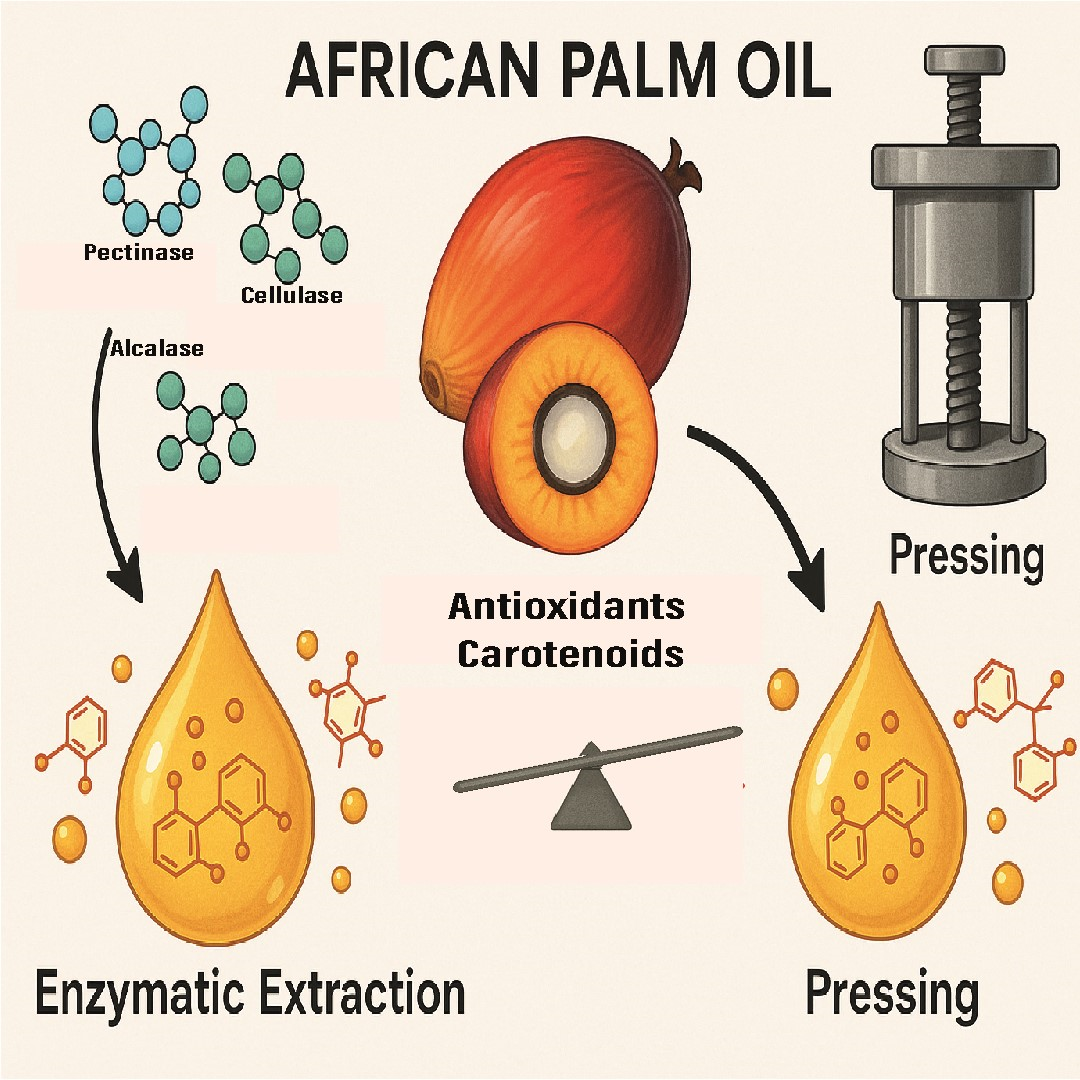
El presente estudio aborda la optimización del proceso de extracción de aceite de palma africana (Elaeis guineensis), con prioridad en el contenido antioxidante como parámetro de calidad. La extracción tradicional por prensado, aunque ampliamente utilizada, compromete la integridad de compuestos antioxidantes. Se plantea como problema la necesidad de procesos más eficientes y sostenibles que maximicen el rendimiento de aceite y conserven sus propiedades funcionales. El objetivo fue comparar el rendimiento y calidad del aceite obtenido mediante tratamiento enzimático (celulasa, pectinasa y proteasa) frente al prensado convencional, a partir de la evaluación de variables operacionales: temperatura, concentración enzimática y tiempo. Se utilizó un diseño experimental compuesto central rotacional (DCCR), y se aplicaron metodologías validadas para cuantificar carotenoides, compuestos fenólicos, capacidad antioxidante (ABTS) y estabilidad oxidativa. Los resultados mostraron que la extracción enzimática incrementó significativamente el rendimiento de aceite y la concentración de antioxidantes. La pectinasa mostró el mayor rendimiento (88.78%), mientras que la proteasa proporcionó la mayor concentración de carotenoides (1174.86 ppm) y capacidad antioxidante (168.65 µmol Trolox/g). Las muestras tratadas enzimáticamente sin prensar (DSP) superaron consistentemente a las prensadas (DP) en todas las variables analizadas. La validación del modelo estadístico confirmó la robustez de las condiciones experimentales. Se concluye que la extracción enzimática acuosa representa una estrategia tecnológica efectiva para mejorar la calidad nutricional del aceite de palma, al preservar su perfil antioxidante, y así minimizar impactos térmicos y químicos. Esta investigación respalda su aplicación industrial como una alternativa sustentable y funcional para aceites vegetales de alta calidad.
Descargas
Descargas
Detalles del artículo
Citas
American Oil Chemists Society (AOCS). (2002). Official Methods and Recommended Practices of the American Oil Chemists’ Society (5th ed.). Champaign.
Apar, D., & Özbek, B. (2008). Corn gluten hydrolysis by Alcalase: Effects of process parameters on hydrolysis solubilization and enzyme inactivation. Chemical and Biochemical Engineering Quarterly, 22(2), 203-212. https://hrcak.srce.hr/24796
Balvardi, M., Rezaei K., Mendiola, JA & Ibáñez, E. (2015). Optimization of the aqueous enzymatic extraction of oil from Iranian wild almond. Journal of the American Oil Chemists´Society, 92(7), 985-992. https://doi.org/10.1007/s11746-015-2671-y
Bandura, V. & Fialkovska, L. (2023). Quality indicators of extracted sunflower and rapeseed oil obtained with hexane and ethyl alcohol solvents. Animal Science and Food Technology, 14(1), 9-25. https://doi.org/10.31548/animal.1.2023.9.
Berger, K. G. (2005). The use of palm oil in frying. Frying Oil Series. Malaysian Palm Oil Promotion Council (MPOPC). https://doi.org/10.1002/ejlt.200690061
Campos Espinosa, G. Y., Udenigwe, C. C., & Tsopmo, A. (2022). Inhibition of low-density lipoprotein oxidation, antioxidative and bile acid-binding capacities of hydrolyzed proteins from carbohydrase-treated oat bran.Journal of Food Biochemistry, 46(3), e13675. https://doi.org/10.1111/jfbc.13675
Chodar, H., Rezaei, K. (2017). Laboratory-Scale Optimization of Roasting Conditions Followed by Aqueous Extraction of Oil from Wild Almond. Journal of the American Oil Chemists´Society, 94, 867–876. https://doi.org/10.1007/s11746-017-2995-x
Chong, K. L., Kanniah, K. D., Pohl, C., & Tan, K. P. (2017). A review of remote sensing applications for oil palm studies. Geo-Spatial Information Science, 20(2), 184–200. https://doi.org/10.1080/10095020.2017.1337317
Choo, Y. M. (1994). Palm oil carotenoids. Food Nutrition Bulletin, 15(2), 130-137. https://doi.org/10.1177/156482659401500212
Edem, D. O. (2002). Palm oil: Biochemical, physiological, nutritional, hematological, and toxicological aspects: A review. Plant Foods for Human Nutrition, 57(3-4), 319-341. https://doi.org/10.1023/A:1021828132707
Es-Sai B., Wahnou H., Benayad S., Rabbaa S., Laazioues Y, El Kebbaj R, & Limami Y. (2025). Gamma-Tocopherol: A Comprehensive Review of Its Antioxidant, Anti-Inflammatory, and Anticancer Properties. Molecules, 30(3), 653. https://doi.org/10.3390/molecules30030653
Ghorbanzadeh, R. & Rezaei, K. (2017). Optimization of an Aqueous Extraction Process for Pomegranate Seed Oil. Journal of the American Oil Chemists´ Society, 94(12), 1491-1501. https://doi.org/10.1007/s11746-017-3045-4
Goncalves, C. B., Rodríguez, C. E. C., Marcon, E. C., & Meirelles, A. J. A. (2016). Deacidification of palm oil by solvent extraction. Separation and Purification Technology, 160(2), 106-111. https://doi.org/10.1016/j.seppur.2016.01.016
Gross, J. (1991). Pigments in vegetables: Chlorophylls and carotenoids. New York: AVI Book. https://doi.org/10.1007/978-1-4615-2033-7
Gunstone, F. D. (2011). Vegetable oils in food technology: Composition, properties and uses (2nd ed., pp. 25–133). West Sussex, UK: Blackwell Publishing Ltd. Disponible en: https://onlinelibrary.wiley.com/doi/pdf/10.1002/9781444339925.fmatter
Hamzah, N., Tokimatsu, K., & Yoshikawa, K. (2019). Solid Fuel Oil Palm Biomass Residues and Municipal Solid Waste by Hydrothermal Treatment for Electrical Power Generation in Malaysia: A review. Sustainability, 11(4). https://doi.org/10.3390/su11041060.
Hendler, S. S., & Rorvik, D. (2008). PDR for nutritional supplements (2nd ed.). Montvale, NJ: Thomson Reuters, Physicians’ Desk Reference.
Kumar, S.P.J., Prasad, S.R., Banerjee, R., Agarwal, D., Kalyani, S., & Ramesh, K. Green solvents and technologies for oil extraction from oilseeds. Chemistry Central Journal, 11(9) (2017). https://doi.org/10.1186/s13065-017-0238-8
Mat Hassan, N., Sohrab, M., Balakrishnan, V., Harris, M., Mustaner M., Mat A., Al-Gheethi A. & Ahmad A. (2021). Influence of Fresh Palm Fruit Sterilization in the Production of Carotenoid-Rich Virgin Palm Oil. Foods, 10(11), 22-26. https://doi.org/10.3390/foods10112838
Montgomery, D.C. (2017). Design and Analysis of Experiments (9th ed.). Wiley. Disponible en: https://www.academia.edu/65675640/The_Design_and_Analysis_of_Experiments?utm_source=chatgpt.com
Neo, Y. P., Ariffin, A., Tan, C. P., & Tan, Y. A. (2010). Phenolic acid analysis and antioxidant activity assessment of oil palm (E. guineensis) fruit extracts. Food Chemistry, 122(1), 353-359. https://doi.org/10.1016/j.foodchem.2010.02.046
Rahban, M., Zolghadri, S., Salehi, N., Ahmad, F., Haertlé, T., Rezaei-Ghaleh, N. & Saboury, A. A. (2022). Thermal stability enhancement: Fundamental concepts of protein engineering strategies to manipulate the flexible structure. International journal of biological macromolecules, 214, 642-654. https://doi.org/10.1016/j.ijbiomac.2022.06.154
Rathi, C. L., Pradhan, S., Javvadi, S., & Wani, A. (2012). An enzyme composition and process for extracting oil from oil palm fruits. WO2012/011130. Disponible en: https://patentimages.storage.googleapis.com/88/46/70/0970051e9f46b6/WO2012011130A2.pdf
Rufino, M. S., Alves, R. E., Brito, E. S., Morais, S. M., Sampaio, C. G., Perez-Jimenez, J., & Saura-Calixto, F. D. (2007). Metodología científica: Determinação da atividade antioxidante total em frutas pela captura do radical livre ABTS. Embrapa Agroindústria Tropical: Comunicado Técnico 127. Fortaleza-CE. Disponible en: https://ainfo.cnptia.embrapa.br/digital/bitstream/CNPAT/10225/1/Cot_128.pdf
Silvamany, H., & Jahim J. (2015). Enhancement of palm oil extraction using cell wall degrading enzyme formulation. Malaysian Journal of Analytical Sciences, 19(1), 77-87. https://mjas.analis.com.my/wp-content/uploads/2018/11/Silvamany_19_1_10.pdf
Singleton, J.A., Stikeleather, L.F. A solvent extractor system for the rapid extraction of lipids and trace bioactive micronutrients in oilseeds. J Amer Oil Chem Soc 76, 1461–1466 (1999). https://doi.org/10.1007/s11746-999-0185-1
Texeira, C. B., Macedo, G. A., Macedo, J. A., Da Silva, H. M., & Rodríguez, A. M. (2013). Simultaneus extraction of oil and antioxidant compounds from oil palm fruit (Elaeis guineensis) by an aqueous enzymatic process. Bioresource Technology. 129:575-581. https://doi.org/10.1016/j.biortech.2012.11.057
Vovk, H., Karnpakdee, K., Ludwig, R. & Nosenko, T. (2023). Enzymatic Pretreatment of Plant Cells for Oil Extraction. Food technology and biotechnology, 61(2), 160-178. https://doi.org/10.17113/ftb.61.02.23.7896
Yusoff, M., Gordon, M.H., & Niranjan, K. (2015). Aqueous enzyme assisted oil extraction from oilseeds and emulsion de-emulsifyng methods: a review. Trends in Food Science & Technology, 41(1), 60-82. https://doi.org/10.1016/j.tifs.2014.09.003
Zahedifar, M. Assesing alteration of oil quality, degradation and resistance indices under different land uses through network and factor analysis. Catena, 222. https://doi.org/10.1016/j.catena.2022.106807
Barra lateral del artículo
Barra lateral del artículo

Esta obra está bajo una licencia internacional Creative Commons Atribución-NoComercial-CompartirIgual 4.0.