

Propuesta y Comparación de Algoritmos de Balanceo Pasivo de Celdas NMC para una Batería de Iones de Litio
##plugins.themes.bootstrap3.article.main##
Roberto de la Vega

Santiago Andréu Lamperti
Silvano Rossi
Marcelo Spina
Nicolás Brizzio
Roberto Leegstra
Resumen
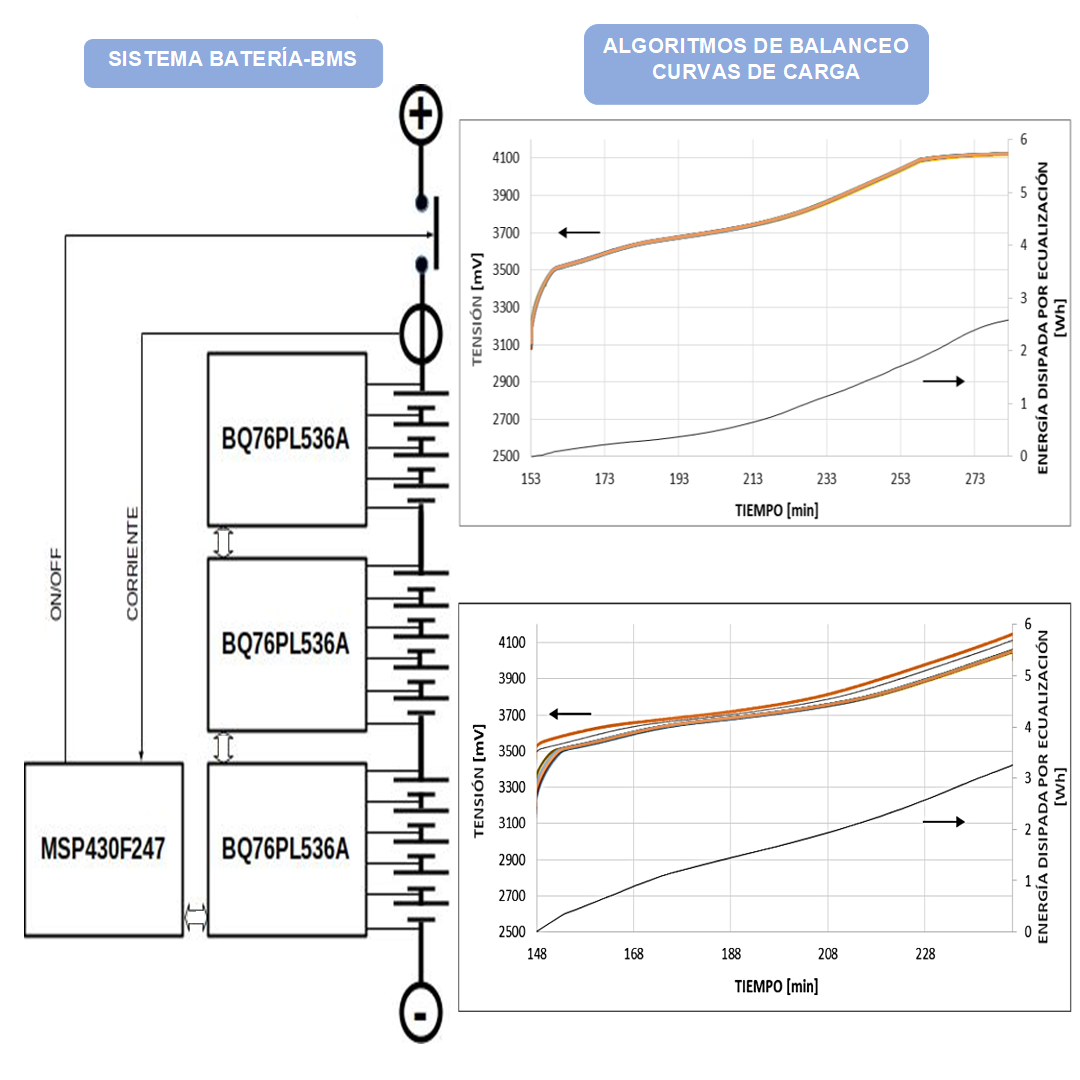
En este trabajo se proponen, prueban y comparan tres algoritmos de balanceo pasivo, basados en tensión, de celdas de batería con tecnología de cátodo óxido de litio-níquel-manganeso-cobalto (NMC), como parte del desarrollo de un sistema de manejo de batería (BMS) para una batería de iones de litio. El enfoque del trabajo está orientado a la aplicación de dichos algoritmos en BMS de vehículos eléctricos. Se realizó un software para llevar adelante el ensayo el cual permite modificar parámetros de forma sencilla y flexible, para adaptarse a baterías de iones de litio con otros tipos de celdas. En particular, los ensayos se realizaron sobre una batería en configuración 14S1P, definiéndose tres pruebas diferentes, sin balancear, balanceando, partiendo de celdas balanceadas y balanceando, partiendo de celdas desbalanceadas. Se muestran los resultados obtenidos a partir de los ensayos realizados, concluyendo sobre cual algoritmo presenta mejores resultados, considerando la capacidad del pack de celdas utilizado, el balanceo logrado y la energía disipada por ecualización.
Descargas
Descargas
Detalles del artículo
Citas
Aizpuru, I., Iraola, U., Canales, J. M., Echeverria, M., & Gil, I. (2013). Passive balancing design for Li-ion battery packs based on single cell experimental tests for a CCCV charging mode. Proc. 2013 International Conference on Clean Electrical Power (ICCEP), Alghero, Italy, 93-98. htpps://dx.doi.org/10.1109/ICCEP.2013.6586973
Aizpuru, I., Iraola, U., Canales, J. M., Goikoetxea, A. & Garayalde, E. (2017). Balancing current and efficiency modelling of single switch active balancing systems for energy storage systems. International Journal of Scientific and Research Publications, 7(3), 467-478.
Amin, Ismail, K., Nugroho, A. & Kaleg, S. (2017). Passive balancing battery management system using MOSFET internal resistance as balancing resistor. Proc. 2017 International Conference on Sustainable Energy Engineering and Application (ICSEEA), Jakarta, Indonesia, 151-155. https://dx.doi.org/ 10.1109/ICSEEA.2017.8267701
Brand, M., Gläser, S., Geder, J., Menacher, S., Obpacher, S., Jossen, A. & Quinger, D. (2013). Electrical safety of commercial Li-ion cells based on NMC and NCA technology compared to LFP technology. Proc. 2013 World Electric Vehicle Symposium and Exhibition (EVS27), Barcelona, Spain, 1-9. https://dx.doi.org/ 10.1109/EVS.2013.6914893
Castano, S., Serrano-Jimenez, D. & Sanz, J. (2016). BMS influence on Li-ion packs characterization and modeling. Proc. 2016 IEEE 16th International Conference on Environment and Electrical Engineering (EEEIC), Florence, Italy, 2016, 1-6. https://dx.doi.org/10.1109/EEEIC.2016.7555760
Cueva, E., Lucero, J., Guzmán, A., Rocha, J. & Espinoza, L. (2018). Review of the state of the art of batteries in automotive applications. Enfoque UTE, 9(1), 166-176. https://dx.doi.org/10.29019/enfoqueute.v9n1.202
Di Rienzo, R., Zeni, M., Baronti, F., Roncella, R. & Saletti, R. (2020). Passive balancing algorithm for charge equalization of series connected battery cells. Proc 2020 2nd IEEE International Conference on Industrial Electronics for Sustainable Energy Systems (IESES), Cagliari, Italy, 2020, 73-79. https://dx.doi.org/10.1109/IESES45645.2020.9210643
Garaventta, G. y Actis, M. (2018). Desarrollos tecnológicos de baterías en base a litio. En F. J. Díaz (Ed.), El litio en Argentina: visiones y aportes multidisciplinarios desde la UNLP (156-165). Editorial: UNLP.
Gupta, P. P., Kumar, N. & Nangia, U. (2022). Passive cell balancing and battery charge controller with CCCV topology. Proc. 2022 3rd International Conference for Emerging Technology (INCET), Belgaum, India, 1-5. https://dx.doi.org/10.1109/INCET54531.2022.9825104
Hannan, M. A., Hoque M. M., Hussain, A., Yusof, Y. & Ker, P. J. (2018). State-of-the-art and energy management system of lithium-ion batteries in electric vehicle applications: issues and recommendations. IEEE Access, 6, 19362-19378. https://dx.doi.org/10.1109/ACCESS.2018.2817655
Hussein, A. A-H. & Batarseh, I. (2011). An overview of generic battery models. 2011 IEEE Power and Energy Society General Meeting, Detroit, MI, USA, 1-6. https://dx.doi.org/10.1109/PES.2011.6039674
Incell Academy (n.d.). Comparison common lithium technologies. International AB. Obtenido de: http://www.incellint.com (Junio, 2019).
Kurpiel, W., Deja, P., Polnik, B., Skóra, M., Miedzinski, B., Habrych, M., Debita, G., Zamlynska, M., and Falkowski-Gilski, P. (2021).
Performance of passive and active balancing systems of lithium batteries in onerous mine environment. Energies, 14(22), 7624. https://dx.doi.org/10.3390/en14227624
Lee, Y., Jeon, S., Lee, H. & Bae, S. (2016). Comparison on cell balancing methods for energy storage applications. Indian Journal of Science and Technology, 9(17), 1-7. https://dx.doi.org/10.17485/ijst/2016/v9i17/92316
Lu, L., Han, X., Li, J., Hua, J. & Ouyang, M. (2013). A review on the key issues for lithium-ion battery management in electric vehicles. Journal of Power Sources, 226, 272-288. https://dx.doi.org/10.1016/j.jpowsour.2012.10.060
Nitta, N., Wu, F., Lee, J. T. & Yushin, G. (2015). Li-ion battery materials: present and future. Materials Today, 18(5), 252–264. https://dx.doi.org/10.1016/j.mattod.2014.10.040
Omariba, Z. B., Zhang, L. & Sun, D. (2019). Review of battery cell balancing methodologies for optimizing battery pack performance in electric vehicles. IEEE Access, 7, 129335-129352. https://dx.doi.org/ 10.1109/ACCESS.2019.2940090
Quintero, V., Che, O., Ching, E., Auciello, O. & de Obaldía E. (2021). Baterías de ion litio: características y aplicaciones. Revista de I+D Tecnológico, 17(1), 14-22.
Reddy, R.C.K., Lin, X., Zeb, A. et al. (2022). Metal–organic frameworks and their derivatives as cathodes for lithium-ion battery applications: a review. Electrochemical Energy Reviews, 5, 312–347. https://dx.doi.org/10.1007/s41918-021-00101-x
Rodríguez Patarroyo, D., Gómez, R. & Campos, A. (2015). Sistemas de gestión de baterías (BMS) y su importancia para los sistemas de almacenamiento de baterías (BESS). Revista Tecnura, 19, 51-56. https://dx.doi.org/10.14483/udistrital.jour.tecnura.2015.ICE.a05
Song, H. & Lee, S. (2023). Study on the systematic design of a passive balancing algorithm applying variable voltage deviation. Electronics, 12, 1-19. https://dx.doi.org/10.3390/electronics12122587
Stroe, D. -I., Swierczynski, M., Kær S. K. & Teodorescu, R. (2018). Degradation behavior of lithium-ion batteries during calendar ageing - The case of the internal resistance increase. IEEE Transactions on Industry Applications, 54(1), 517-525. https://dx.doi.org/10.1109/TIA.2017.2756026
Texas Instruments (2016). bq76PL536A 3-to-6 Series Cell Lithium-Ion Battery Monitor and Secondary Protection IC for Applications. Disponible en: https://www.ti.com/product/BQ76PL536A
Tyrpekl, M., Zavrel, M. and Kindl, V. (2022). Comparison of active and passive battery balancing. 2022 20th International Conference on Mechatronics - Mechatronika (ME), Pilsen, Czech Republic, 1-6. https://dx.doi.org/10.1109/ME54704.2022.9983462
Vitols, K. (2015). Efficiency of LiFePO4 battery and charger with passive balancing. 2015 IEEE 3rd Workshop on Advances in Information, Electronic and Electrical Engineering (AIEEE), Riga, Latvia, pp. 1-4. https://dx.doi.org/ 10.1109/AIEEE.2015.7367295
Voloskyi, V., Leshchyshyn, Y., Romanyshyn, N., Palamar, A. and Tarasenko, L. (2024). Method and algorithm for efficient cell balancing in the lithium-ion battery control system. 1st International Workshop on “Bioinformatics and applied information technologies”, Zboriv, Ukraine, 1-10.
Wei, L., Jie, L., Wenji, S. & Ziping, F. (2017). Study on passive balancing characteristics of serially connected lithium-ion battery string. Proc. 2017 13th IEEE International Conference on Electronic Measurement & Instruments (ICEMI), Yangzhou, China, 489-495. https://dx.doi.org/ 10.1109/ICEMI.2017.8265862
Xing, Y., He, W., Pecht, M. & Tsui, K. L. (2014). State of charge estimation of lithium-ion batteries using the open-circuit voltage at various ambient temperatures. Applied Energy, 113, 106-115. https://doi.org/10.1016/j.apenergy.2013.07.008
Youssef, R., Hosen, M. S., He, J., Jaguemont, J., De Sutter, L., Van Mierlo, J. and Berecibar, M. (2021). Effect analysis on performance enhancement of a novel and environmental evaporative cooling system for lithium-ion battery applications. Journal of Energy Storage, 37, 102475. https://dx.doi.org/10.1016/j.est.2021.102475
Zachmann, N., Petranikova, M. & Ebin, B. (2023). Electrolyte recovery from spent Lithium-Ion batteries using a low temperature thermal treatment process. Journal of Industrial and Engineering Chemistry, 118, 351-361. https://dx.doi.org/10.1016/j.jiec.2022.11.020
Zhang, X., Li, Z., Luo, L., Fan, Y. and Du, Z. (2022). A review on thermal management of lithium-ion batteries for electric vehicles. Energy, 238, Part A, 121652. https://dx.doi.org/10.1016/j.energy.2021.121652.
Zheng, L., Zhu, J. & Wang, G. (2016). A comparative study of battery balancing strategies for different battery operation processes. 2016 IEEE Transportation Electrification Conference and Expo (ITEC), Dearborn, MI, USA, 1-5. https://dx.doi.org/10.1109/ITEC.2016.7520204
Barra lateral del artículo
Barra lateral del artículo

Esta obra está bajo una licencia internacional Creative Commons Atribución-NoComercial-CompartirIgual 4.0.