

Influencia del Amortiguamiento en la Respuesta Dinámica del Modelo Computacional de una Torre Autosoportada
##plugins.themes.bootstrap3.article.main##
Katia Luis Garcia

Vivian Beatriz Elena Parnás
Resumen
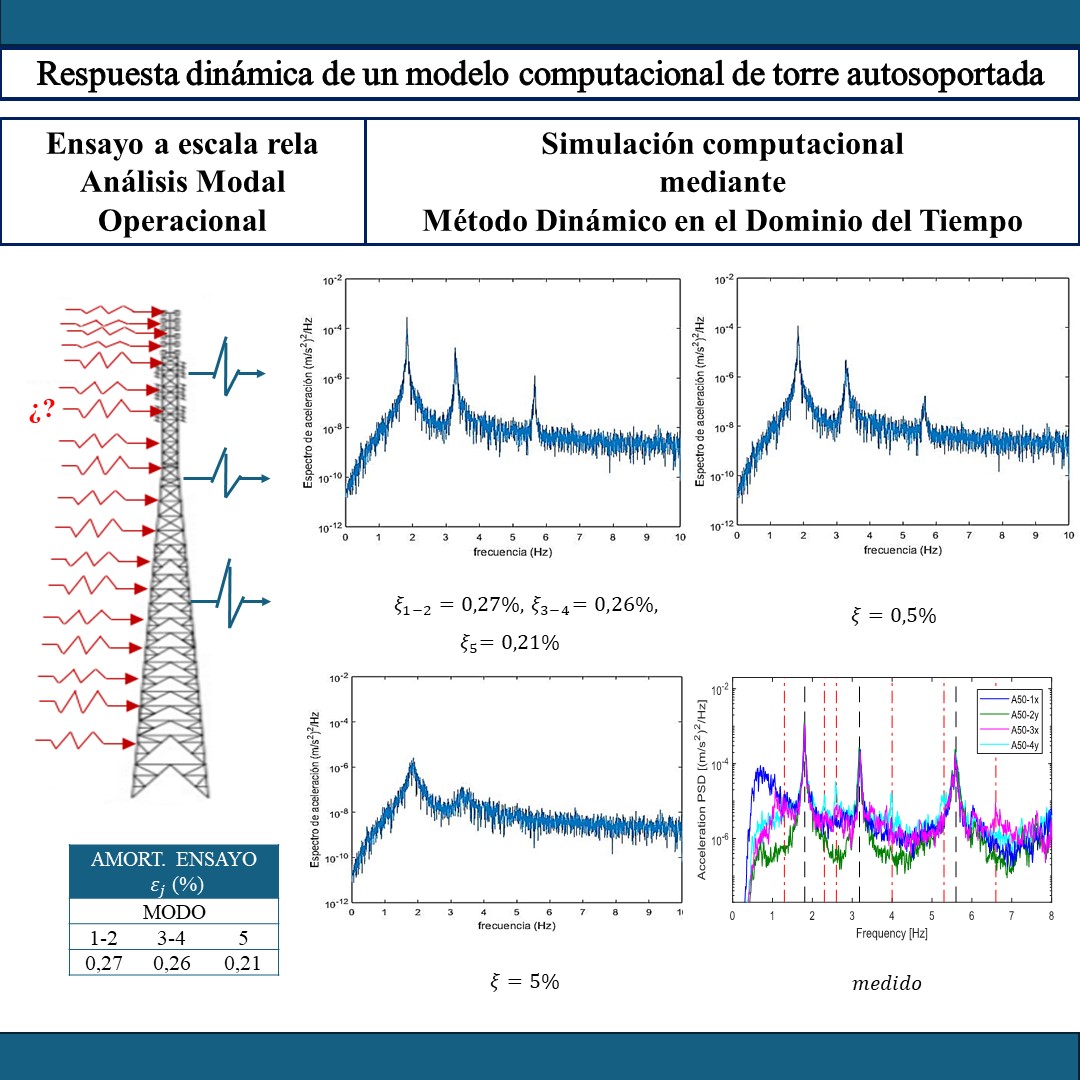
Las torres de celosía son estructuras vulnerables ante la acción del viento por lo que han sido objeto de diversos estudios en las últimas décadas. Para el análisis del comportamiento de las torres se utilizan los modelos computacionales los cuales pueden ser calibrados a partir de las características dinámicas obtenidas de ensayos a escala real. Los parámetros que permiten caracterizar la respuesta dinámica de una estructura son la frecuencia natural, las formas modales y la razón de amortiguamiento, esta última es la característica de mayor incertidumbre en su estimación. El objetivo de este trabajo es evaluar la influencia del amortiguamiento en la respuesta dinámica de un modelo computacional de torre autosoportada. Los valores de amortiguamiento se obtuvieron mediante la técnica del análisis modal operacional y se compararon con los valores de amortiguamientos sugeridos en los códigos internacionales. Los resultados muestran que no existe diferencia en los valores máximos de solicitaciones en término de aceleraciones, desplazamientos y fuerza axial cuando se usa el Método Dinámico en el dominio del tiempo.
Descargas
Descargas
Detalles del artículo
Citas
Aloisioa, A., Pasca, D., Tomasi, R., & Fragiacomo, M. (2020). Dynamic identifcation and model updating of an eight-storey CLT building. Engineering Structures, 213. https://doi.org/10.1016/j.engstruct.2020.110593
ASCE7-10. (2010). American Society of Civil Engineers, Minimum Design Loads for Buildings and Other Structures. In. https://ascelibrary.org/doi/book/10.1061/9780784412916
Ballio, G., Maberini, F., & Solari, G. (1992). A 60 year old, 100 m high steel tower: .limit states under wind actions. Journal of Wind Engineering and IndustrialAerodynamics, 41, 2089-2100. https://doi.org/10.1016/0167-6105(92)90639-R
Calotescu, I., Bitca, D., & Solari, G. (2019). Aerodynamic damping of telecommunication lattice towers. Paper presented at the The 15th International Conference on Wind Engineering, Beijing, China. https://www.academia.edu/83241272/Aerodynamic_damping_of_telecommunication_lattice_towers
Cauberghe. (2004). Applied frequency-domain system identification in the field of experimental and operational modal analysis. (PhD), Brussels, Belgium. https://researchportal.vub.be/en/publications/applied-frequency-domain-system-identification-in-the-field-of-ex
Cheng, X. X., Wu, G., Zhang, L., & Ma, F. B. (2021). A New Damage Detection Method for Special-Shaped Steel Arch Bridges Based on Fractal Theory and the Model Updating Technique. International Journal of Structural Stability and Dynamics, 21(03), 2150030. https://doi.org/10.1142/S0219455421500309
Chopra. (1995). Dynamics of structures. New Jersey. https://www.google.com.cu/books/edition/Dynamics_of_Structures/eRcvAAAAQBAJ?hl=es-419
EN1991-1-4. (2004). Eurocode 1: Actions on structures — General actions — Part 1-4: Wind actions. In. https://www.phd.eng.br/wp-content/uploads/2015/12/en.1991.1.4.2005.pdf
ESDU. (2012). Calculation Methods for along Wind Loading Part 2: Response of Line-like Structures to Atmospheric Turbulence. https://www.esdu.com/cgi-bin/ps.pl?t=doc&p=esdu_87035b-r1
Fernández Lorenzo, I., Clavelo Elena, B., Martín Rodríguez, P., & Elena Parnás, V. B. (2020). Dynamic analysis of self-supported tower under hurricane wind conditions. Journal of Wind Engineering and Industrial Aerodynamics, 197, 104078. https://doi.org/10.1016/j.jweia.2019.104078
Glanville, M., & Kwok, K. (1995). Dynamic characteristics and wind induced response of a steel frame tower. Journal of Wind Engineering and Industrial Aerodynamics, 54, 133-149. https://doi.org/10.1016/0167-6105(94)00037-E
Jimenez Capilla, J. A., Wang, J., & Brownjohn, J. M. W. (2022). Damping estimation using free decays response in short telecom structures. Advances in Structural Engineering, 25(1), 212-228. https://doi.org/10.1177/13694332211042780
Kazemi Amiri, A., & Bucher, C. (2017). A procedure for in situ wind load reconstruction from structural response only based on field testing data. Journal of Wind Engineering and Industrial Aerodynamics, 167 75-86. https://doi.org/10.1016/j.jweia.2017.04.009
Luis García, K., Maes, K., Elena Parnás, V. B., & Lombaert, G. (2021). Operational modal analysis of a self-supporting antenna mast. Journal of Wind Engineering and Industrial Aerodynamics, 209. https://doi.org/10.1016/j.jweia.2020.104490
Maes, K., Iliopoulos, A., Weijtjens, W., Devriendt, C., & Lombaert, G. (2016). Dynamic strain estimation for fatigue assessment of an offshore monopile wind turbine using filtering and modal expansion algorithms. Mechanical Systems and Signal Processing, 76, 592-611. https://doi.org/10.1016/j.ymssp.2016.01.004
Maes, K., & Lombaert, G. (2023). Validation of virtual sensing for the reconstruction of stresses in a railway bridge using field data of the KW51 bridge. Mechanical Systems and Signal Processing, 190. https://doi.org/10.1016/j.ymssp.2023.110142
Mursi, M., & Papangelis, J. (2024). Full scale testing of modular steel footbridge. Paper presented at the 7th International Conference on Geotechnics, Civil Engineering and Structures, CIGOS, Ho Chi Minh City, Vietnam. https://doi.org/10.1007/978-981-97-1972-3_47
Peeters, B. (2000). System Identification and Damage Detection in Civil Engineering. (PhD.), KU Leuven. https://www.scirp.org/reference/referencespapers?referenceid=795700
Peeters, B., & De Roeck, G. (1999). Reference-based stochastic subspace identification for output-only modal analysis. Mechanical Systems and Signal Processing, 13(6), 855-878. https://doi.org/10.1006/mssp.1999.1249
Reynders, E. (2021). Uncertainity quantification in data-driven stochastic subspace identification. Mechanical Systems & Signal Processing, 151, 1-18. https://doi.org/10.1016/j.ymssp.2020.107338
Reynders, E., Schevenels, M., & De Roeck, G. (2021). MACEC 3.4: The MATLAB toolbox for experimental and operational modal analysis. Leuven, Belgium: KU Leuven. https://doi.org/10.13140/RG.2.2.12984.70401
Romanian Code. (2012). Codde proiectare. Evaluarea actiunii vantului asupra constructiilor. Romanian. https://ugir.ro/wp-content/uploads/2012/06/CR-1-1-4-2012.pdf
Roque Rodriguez, A., Niebla Sosa, Y., Carrasco Diaz, M., & Reyes Martínez, P. (2015). Perfil vertical del viento en la capa superficial atmosférica sobre Cuba. Aplicación al estudio del viento como fuente de energía. Revista Cubana de Meteorología, 21(1), 31-48. https://doi.org/10.13140/RG.2.1.1117.3842
Saudi, G. (2014). Structural assessment of a guyed mast through measurement of natural frequencies. Engineering Structures, 59, 104-112. https://doi.org/10.1016/j.engstruct.2013.09.049
Solari, G., & Martín Rodríguez, P. (2021). Gust Buffeting and Aerodynamic Admittance of Structures with Arbitrary Mode Shapes. I: Enhanced Equivalent Spectrum Technique. Journal of Engineering Mechanics, 147(1). https://doi.org/10.1061/(ASCE)EM.1943-7889.0001872
Yang, X. M., Qu, C. X., Yi, T. H., Li, H. N., & Liu, H. (2020). Modal Analysis of a Bridge During High-Speed Train Passages by Enhanced Variational Mode Decomposition. International Journal of Structural Stability and Dynamics, 20(13), 2041002. https://doi.org/10.1142/S0219455420410023
Barra lateral del artículo
Barra lateral del artículo

Esta obra está bajo una licencia internacional Creative Commons Atribución-NoComercial-CompartirIgual 4.0.