

Comportamiento a Flexión de Hormigón Reforzado con Macrofibras de Polipropileno Expuesto a Altas Temperaturas
##plugins.themes.bootstrap3.article.main##
Ariel Murillo

Wladimir Ramírez
Resumen
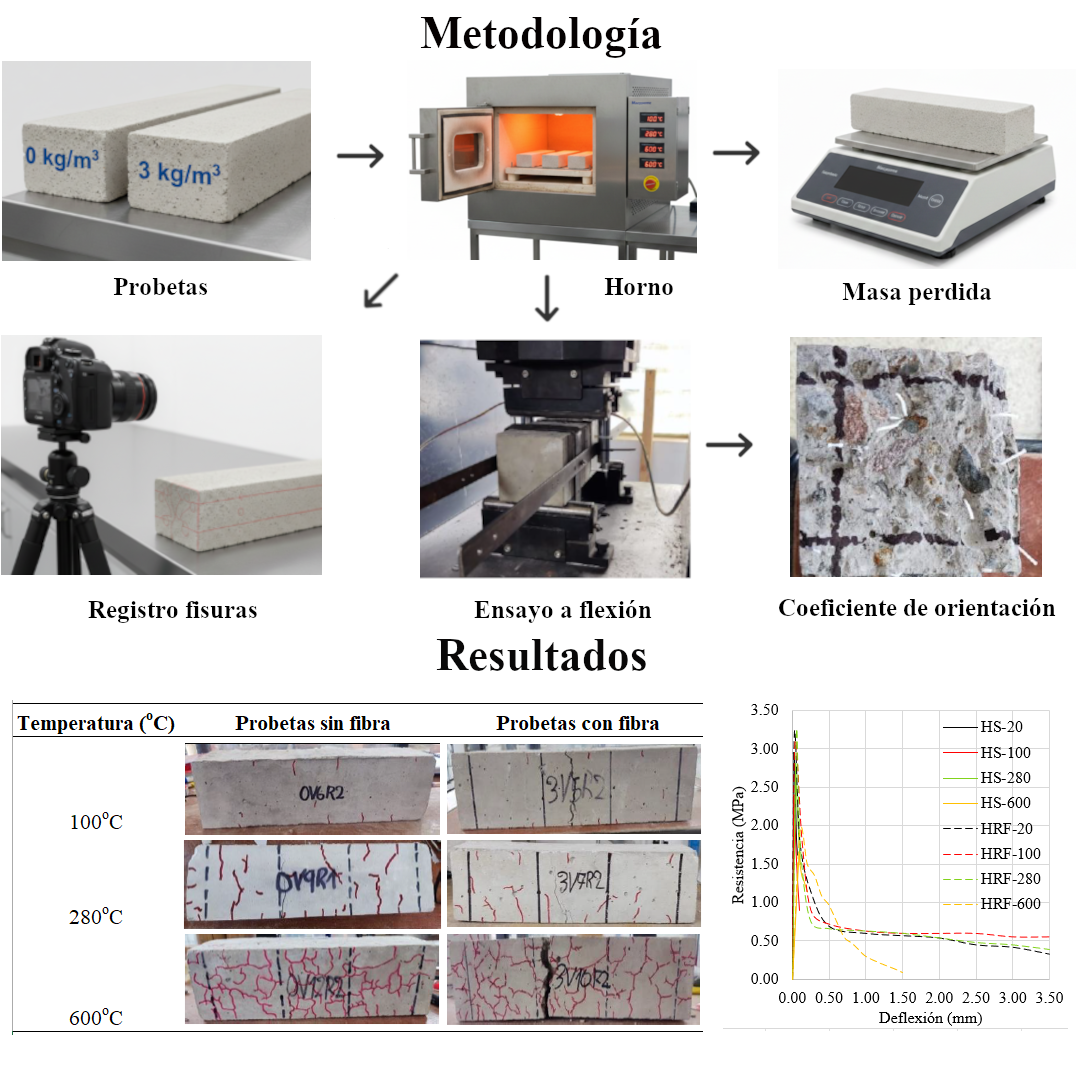
Los elementos de hormigón sufren una pérdida significativa de resistencia cuando se exponen a altas temperaturas. Como alternativa, en las últimas décadas se ha investigado la incorporación de fibras metálicas y sintéticas, entre ellas las microfibras destacan como lañs más estudiadas, mientras que el uso de macrofibras de polipropileno ha sido poco explorado. Las macrofibras pueden sustituir parcial o totalmente al acero de refuerzo, pero su eficacia frente a altas temperaturas aún no ha sido ampliamente evaluada. La presente investigación analiza el comportamiento a flexión de hormigón reforzado con macrofibras de polipropileno (HRF) expuesto a altas temperaturas. Se elaboraron probetas prismáticas tipo viga de hormigón reforzado con macro fibras de polipropileno de dimensiones 100x100x350 mm, para una resistencia de 25 MPa y dosificaciones de 0 y 3 kg/m³ de fibras. Las probetas fueron sometidas a distintas temperaturas: 20 °C, 100 °C, 280 °C y 600 °C, con una exposición constante de 2 horas a la máxima temperatura, posteriormente se realizaron ensayos de flexión a cuatro puntos. Como parte del análisis, se evaluó la pérdida de masa, las fisuras superficiales, la resistencia a flexión y el coeficiente de orientación. Los resultados indican que la incorporación de macrofibras de polipropileno al hormigón aumenta la ductilidad, reduce la pérdida de resistencia y la aparición de fisuras superficiales debido a la acción de altas temperaturas.
Descargas
Descargas
Detalles del artículo
Citas
American Concrete Institute. (2018). Guide to design with fiber-reinforced concrete (ACI 544.4R-18).
Alberti, M. G., Enfedaque, A., & Gálvez, J. C. (2015). Improving the Reinforcement of Polyolefin Fiber Reinforced Concrete for Infrastructure Applications. Fibers 2015, Vol. 3, Pages 504-522, 3(4), 504–522. https://doi.org/10.3390/FIB3040504
Alberti, M. G., Enfedaque, A., Gálvez, J. C., & Agrawal, V. (2016). Fibre distribution and orientation of macro-synthetic polyolefin fibre reinforced concrete elements. Construction and Building Materials, 122, 505–517. https://doi.org/10.1016/J.CONBUILDMAT.2016.06.083
Alberti, M. G., Gálvez, J. C., Enfedaque, A., & Castellanos, R. (2021). Influence of high temperature on the fracture properties of polyolefin fibre reinforced concrete. Materials, 14(3), 601. https://doi.org/https://doi.org/10.3390/ma14030601
Alberti, M. G., Gálvez, J. C., Enfedaque, A., Picazo, A., & Ramírez, W. J. (2022). Mixed mode fracture of polyolefin fibre reinforced concrete. Theoretical and Applied Fracture Mechanics, 122, 103560. https://doi.org/10.1016/J.TAFMEC.2022.103560
American Society for Testing and Materials. (2010). ASTM C78-09 Standard Test Method for Flexural Strength of Concrete (Using Simple Beam with Third-Point Loading). https://www.astm.org/standards/c78
American Society for Testing and Materials. (2019). ASTM C31 / C31M Standard Test Practice for Making and Curing Concrete Test Specimens in the Field. In American Society for Testing and Materials. https://www.astm.org/astm-tpt-167.html
American Society for Testing and Materials. (2024). ASTM C1609/C1609M Standard Test Method for Flexural Performance of Fiber-Reinforced Concrete (Using Beam With Third-Point Loading).
Arioz, O. (2007). Effects of elevated temperatures on properties of concrete. Fire Safety Journal, 42(8), 516–522. https://doi.org/10.1016/J.FIRESAF.2007.01.003
Ashkezari, G. D., & Razmara, M. (2020). Thermal and mechanical evaluation of ultra-high performance fiber-reinforced concrete and conventional concrete subjected to high temperatures. Journal of Building Engineering, 32, 101621. https://doi.org/10.1016/J.JOBE.2020.101621
Aslani, F., Hamidi, F., & Ma, Q. (2019). Fire Performance of Heavyweight Self-Compacting Concrete and Heavyweight High Strength Concrete. Materials 2019, Vol. 12, Page 822, 12(5), 822. https://doi.org/10.3390/MA12050822
Asociación Española de Normalización. (2008). UNE-EN 14889-2:2008 Fibras para hormigón.
Bangi, M. R., & Horiguchi, T. (2012). Effect of fibre type and geometry on maximum pore pressures in fibre-reinforced high strength concrete at elevated temperatures. Cement and Concrete Research, 42(2), 459–466. https://doi.org/10.1016/J.CEMCONRES.2011.11.014
Bentur, A., & Mindess, S. (1990). Fibre reinforced cementitious composites (Taylor and Francis Group, Ed.; 2nd ed., Vol. 1).
Britez, C., Carvalho, M., Helene, P., Britez, C., Carvalho, M., & Helene, P. (2020). Ações e efeitos deletérios do fogo em estruturas de concreto. Uma breve revisão. Revista ALCONPAT, 10(1), 1–21. https://doi.org/10.21041/RA.V10I1.421
Caetano, H., Rodrigues, J. P. C., & Pimienta, P. (2019). Flexural strength at high temperatures of a high strength steel and polypropylene fibre concrete. Construction and Building Materials, 227, 116721. https://doi.org/10.1016/J.CONBUILDMAT.2019.116721
Chemistry World. (2008). The concrete conundrum. Chemistry World, 1–66.
Choumanidis, D., Badogiannis, E., Nomikos, P., & Sofianos, A. (2016). The effect of different fibres on the flexural behaviour of concrete exposed to normal and elevated temperatures. Construction and Building Materials, 129, 266–277. https://doi.org/10.1016/J.CONBUILDMAT.2016.10.089
De Oliveira Dias, A. R., Amancio, F. A., de Carvalho Rafael, M. F., & Cabral, A. E. B. (2020). Comportamento do concreto submetido a elevadas temperaturas. Matéria (Rio de Janeiro), 25(2), e-12629. https://doi.org/10.1590/S1517-707620200002.1029
Dias, D. M., Calmon, J. L., & Vieira, G. L. (2020). Polymeric fiber reinforced concrete exposed to fire. Revista ALCONPAT, 10(1), 36–52. https://doi.org/10.21041/RA.V10I1.426
Dupont, D., & Vandewalle, L. (2005). Distribution of steel fibres in rectangular sections. Cement and Concrete Composites, 27(3), 391–398. https://doi.org/10.1016/J.CEMCONCOMP.2004.03.005
Ergun, A., Kurklu, G., Serhat Baspinar, M., & Mansour, M. Y. (2013). The effect of cement dosage on mechanical properties of concrete exposed to high temperatures. Fire Safety Journal, 55, 160-167. https://doi.org/10.1016/J.FIRESAF.2012.10.016
European Committee For Standardization. (2023). EN 1992-1-2:2004: Eurocode 2 - Design of concrete structures - Part 1-2: Structural fire design.
Ibrahim, E. A., Goff, D., Keyvanfar, A., & Jonaidi, M. (2025). Assessing post-fire damage in concrete structures: A comprehensive review. Buildings, 15(3), 485. https://doi.org/10.3390/BUILDINGS15030485
Kasu, S. R., Mitra, N., & Muppireddy, A. R. (2021). Influence of polyester microfiber reinforcement on flexural fatigue characteristics of concrete. Road Materials and Pavement Design, 22(12), 2866–2882. https://doi.org/10.1080/14680629.2020.1808521
Lau, A., & Anson, M. (2006). Effect of high temperatures on high performance steel fibre reinforced concrete. Cement and Concrete Research, 36(9), 1698–1707. https://doi.org/10.1016/J.CEMCONRES.2006.03.024
Lawler, J. S., Zampini, D., & Shah, S. P. (2005). Microfiber and Macrofiber Hybrid Fiber-Reinforced Concrete. Journal of Materials in Civil Engineering, 17(5), 595–604. https://doi.org/10.1061/(ASCE)0899-1561(2005)17:5(595)/ASSET/F927AC2F-317D-49A6-90BD-B450086AAD68/ASSETS/GRAPHIC/12.JPG

Mahmud, I. H., Raju, B. K. M., & Hosen, L. M. (2021). The effect of fire on the strength of concrete material. Journal of Engineering Science, 12(1), 63–68. https://doi.org/10.3329/jes.v12i1.53103
Marcos García Alberty. (2015). Polyolefin fibre-reinforced concrete: from meterial behaviour to numerical and design considerations. Universidad Politécnica de Madrid.
Martinie, L., Lataste, J.-F., & Roussel, N. (2015). Fiber orientation during casting of UHPFRC: electrical resistivity measurements, image analysis and numerical simulations. Materials and Structures, 48(4), 947–957. https://doi.org/10.1617/s11527-013-0205-3
Martinie, L., & Roussel, N. (2011). Simple tools for fiber orientation prediction in industrial practice. Cement and Concrete Research, 41(10), 993–1000. https://doi.org/10.1016/J.CEMCONRES.2011.05.008
Sarmiento, E., Zirgulis, G., … S. S.-B. R., & 2012, undefined. (2012). Influence of concrete flow on fibre distribution, orientation and mechanical properties of fibre reinforced concrete. Rilem.Net. https://www.rilem.net/gene/main.php?base=500218&id_publication=419&id_papier=8659
Servicio Ecuatoriano de Normalización. (2017). NTE INEN 3124 Hormigón. Elaboración y curado de especímenes de ensayo en el laboratorio.
SIKA. (2018). Ambitions a dive into Sika’s world. Sika Services AG, 1–43.
Song, C., Zhang, G., Lu, Z., Li, X., & Zhao, X. (2023). Fire resistance tests on polypropylene-fiber-reinforced prestressed concrete box bridge girders. Engineering Structures, 282, 115800. https://doi.org/10.1016/J.ENGSTRUCT.2023.115800
Soroushian, P., Elyamany, H., Tlili, A., & Ostowari, K. (1998). Mixed-mode fracture properties of concrete reinforced with low volume fractions of steel and polypropylene fibers. Cement and Concrete Composites, 20(1), 67–78. https://doi.org/10.1016/S0958-9465(97)87390-8
Vega, A., Gálvez, J., & García, M. (2018). Estudio del efecto de tamaño en el comportamiento en flexión de elementos de hormigón reforzado con fibras de poliolefina. Universidad Politécnica De Madrid.
Wu, X., Huang, T., Au, F. T. K., & Li, J. (2020). Posttensioned Concrete Bridge Beams Exposed to Hydrocarbon Fire. Journal of Structural Engineering, 146(10), 04020210. https://doi.org/10.1061/(ASCE)ST.1943-541X.0002791
Zhou, Y., Xiao, Y., Gu, A., & Lu, Z. (2018). Dispersion, Workability and Mechanical Properties of Different Steel-Microfiber-Reinforced Concretes with Low Fiber Content. Sustainability 2018, Vol. 10, Page 2335, 10(7), 2335. https://doi.org/10.3390/SU10072335
Zollo, R. F. (1997). Fiber-reinforced concrete: an overview after 30 years of development. Cement and Concrete Composites, 19(2), 107–122. https://doi.org/https://doi.org/10.1016/S0958-9465(96)00046-7
Barra lateral del artículo
Barra lateral del artículo

Esta obra está bajo una licencia internacional Creative Commons Atribución-NoComercial-CompartirIgual 4.0.