

Uso de Redes de Transición de Partición Ordinal para Analizar el Índice de Precios al Consumidor
##plugins.themes.bootstrap3.article.main##
Juan Riofrío

Saba Infante
Resumen
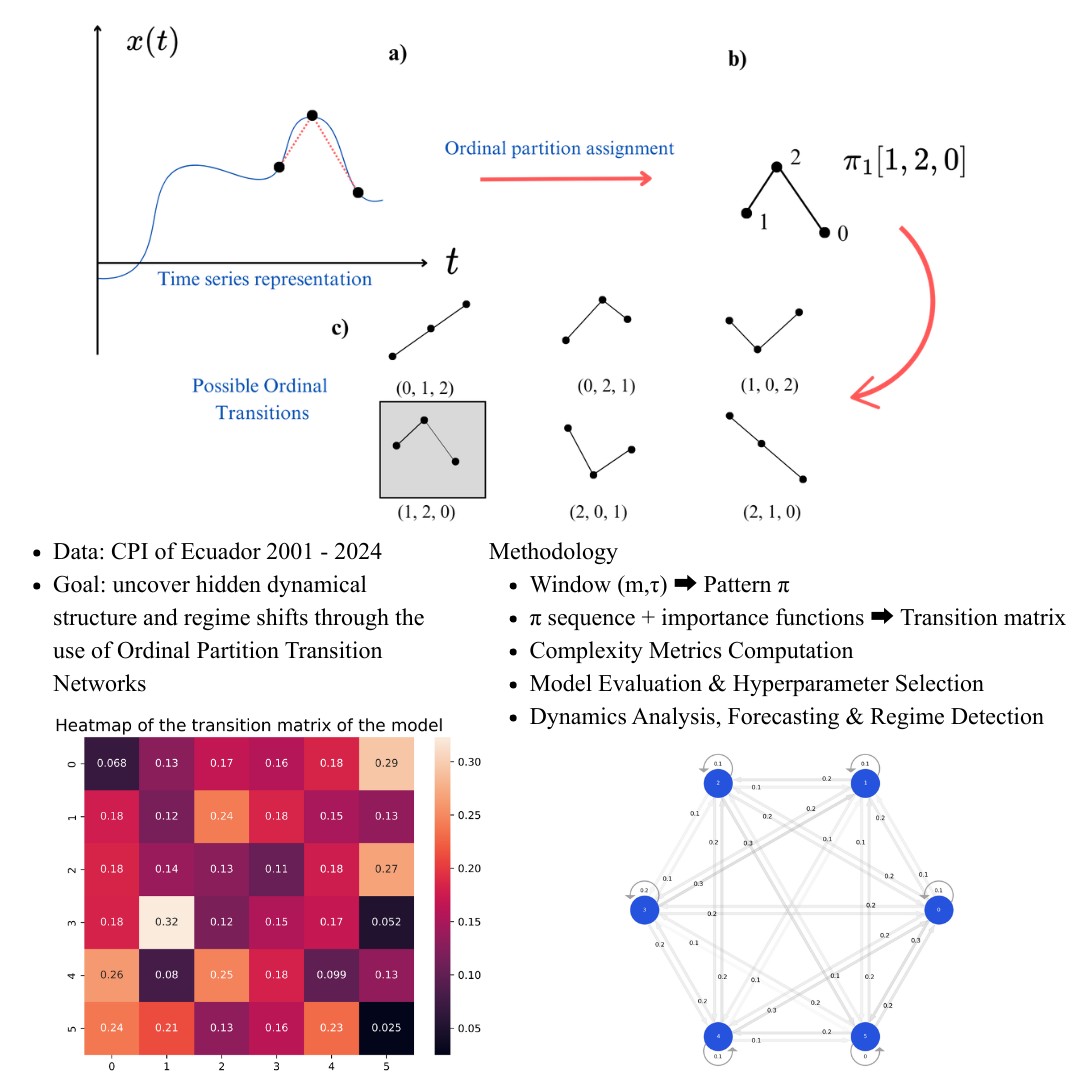
El Índice de Precios al Consumidor (IPC) es un indicador económico clave; sin embargo, los métodos tradicionales de pronóstico a menudo tienen dificultades para capturar su comportamiento complejo y no lineal. Este trabajo aplica Redes de Transición de Partición Ordinal (OPTN) al IPC de Ecuador desde enero de 2001 hasta diciembre de 2024. Al convertir los datos del IPC en cadenas de Markov mediante particiones ordinales, construimos matrices de transición que revelan la dinámica subyacente y utilizamos la Entropía de Permutación Ordinal, la Entropía de Transición Ordinal y la Divergencia de Kullback-Leibler para medir la complejidad y detectar valores atípicos. Reducimos la brecha en el análisis de series de tiempo económicas al integrar métricas de complejidad de alto nivel y alineamiento específico de secuencia dentro de un único marco basado en redes. Al examinar sistemáticamente 480 configuraciones de modelo, encontramos que las dimensiones de incrustación más pequeñas producen pronósticos del IPC más precisos con altos valores de entropía y divergencia moderada, mientras que las dimensiones más altas muestran una mayor sensibilidad a eventos fuera de distribución. De este modo, las OPTN capturan la estructura predictiva y resaltan comportamientos raros, brindando a los responsables de las políticas y a los analistas una herramienta sólida para descubrir patrones económicos
complejos y guiar decisiones basadas en datos.
Descargas
Descargas
Detalles del artículo
Citas
Almendral, J. A., Leyva, I., & Sendiña–Nadal, I. (2023). Unveiling the connectivity of complex networks using
ordinal transition methods. Entropy, 25(7), 1079. https://doi.org/10.3390/e25071079
Amigó, J. M., Dale, R., & Tempesta, P. (2021). A generalized permutation entropy for noisy dynamics and random processes.
Chaos, 31(1), 013115. https://doi.org/10.1063/5.0023419
Bandt, C., & Pompe, B. (2002). Permutation entropy: A natural complexity measure for time series. Physical Review Letters, 88(17), 174102. https://doi.org/10.1103/PhysRevLett.88.174102
Bergroth, L., Hakonen, H., & Raita, T. (2000). A survey of longest common subsequence algorithms. En Proceedings of the Seventh International Symposium on String Processing and Information Retrieval (SPIRE 2000) (pp. 39–48). IEEE. https://doi.org/10.1109/SPIRE.2000.878178
Calvo, G. A. (1983). Staggered prices in a utility–maximizing framework. Journal of Monetary Economics, 12(3), 383–398.
https://doi.org/10.1016/0304-3932(83)90060-0
Daw, C. S., Finney, C. E. A., & Tracy, E. R. (2003). A review of symbolic analysis of experimental data.
Review of Scientific Instruments, 74(2), 915–930. https://doi.org/10.1063/1.1531823
Farmer, J. D., & Foley, D. (2009). The economy needs agent-based modelling. Nature, 460(7256), 685–686.
https://doi.org/10.1038/460685a
Febriyanti, S., Pradana, W. A., Muhammad, J. S., & Widodo, E. (2021). Forecasting the consumer price index in Yogyakarta by using the double exponential smoothing method. Parameter: Journal of Statistics, 2(1), 1–7. https://doi.org/10.22487/27765660.2021.v2.i1.15641
Goldani, M. (2024). Evaluating feature selection methods for macro–economic forecasting, applied for inflation indicator of Iran. arXiv Preprint. https://doi.org/10.48550/arXiv.2406.03742
Golosov, M., & Lucas, R. E. (2007). Menu costs and Phillips curves. Journal of Political Economy, 115(2), 171–199. https://doi.org/10.1086/512625
Gusfield, D. (1997). Algorithms on strings, trees, and sequences: Computer science and computational biology. Cambridge, Reino Unido: Cambridge University Press. https://dl.acm.org/doi/pdf/10.1145/270563.571472
Hamilton, J. D. (1989). A new approach to the economic analysis of nonstationary time series and the business cycle. Econometrica,
(2), 357–384. https://doi.org/10.2307/1912559
Hirata, Y., & Amigó, J. M. (2023). A review of symbolic dynamics and symbolic reconstruction of dynamical systems. Chaos,
(5), 052101. https://doi.org/10.1063/5.0146022
Jackson, M. O. (2014). Networks in the understanding of economic behaviors. Journal of Economic Perspectives, 28(4), 3–22. https://doi.org/10.1257/jep.28.4.3
Kantz, H., & Schreiber, T. (2003). Nonlinear time series analysis (2. ed.). Cambridge, Reino Unido: Cambridge University
Press.
Keller, K., Sinn, M., & Emonds, J. (2007). Time series from the ordinal viewpoint. Stochastics and Dynamics, 7(2), 247–272.
https://doi.org/10.1142/S0219493707002025
Midrigan, V. (2011). Menu costs, multiproduct firms, and aggregate fluctuations. Econometrica, 79(4), 1139–1180. https://doi.org/10.3982/ECTA6735
McCullough, M., Sakellariou, K., Stemler, T., & Small, M. (2017). Regenerating time series from ordinal networks. Chaos,
(3), 035814. https://doi.org/10.1063/1.4978743
McCullough, M., Small, M., Stemler, T., & Iu, H. H.-C. (2015). Time–lagged ordinal partition networks for capturing dynamics
of continuous dynamical systems. Chaos, 25(5), 053101. https://doi.org/10.1063/1.4919075
Nakamura, E., & Steinsson, Jón (2008). Five facts about prices: A reevaluation of menu cost models. Quarterly
Journal of Economics, 123(4), 1415–1464. https://doi.org/10.1162/qjec.2008.123.4.1415
Riofrio, J., Infante, S., & Hernández, A. (2023). Forecasting the consumer price index of Ecuador using classical and advanced
time series models. En Information and Communication Technologies of Ecuador (pp. 128–144). Springer.
https://doi.org/10.1007/978-3-031-45438-7_9
Rotemberg, J. J. (1982). Sticky prices in the United States. American Economic Review, 72(3), 393–403.
https://doi.org/10.1257/aer.72.3.393
Ruan, Y., Donner, R. V., Guan, S., & Zou, Y. (2019). Ordinal partition transition network–based complexity measures for inferring
coupling direction and delay from time series. Chaos, 29(4), 043111. https://doi.org/10.1063/1.5086527
Sakellariou, K., Small, M., Stemler, T., & Judd, K. (2015). Complex network transformations of nonlinear time series: The
ordinal partitions method. IEICE Proceedings Series, 47, A3L-A-4. https://doi.org/10.34385/proc.47.A3L-A-4
Sakellariou, K., Stemler, T., & Small, M. (2019). Markov modeling via ordinal partitions: An alternative
paradigm for network–based time–series analysis. Physical Review E, 100(6), 062307. https://doi.org/10.1103/PhysRevE.100.062307
Shahriari, Z., Nazarimehr, F., Rajagopal, K., Jafari, S., Perc, M., & Svetec, M. (2022). Cryptocurrency price analysis with ordinal partition networks. Applied Mathematics and Computation, 430, 127237. https://doi.org/10.1016/j.amc.2022.127237
Small, M. (2013). Complex networks from time series: Capturing dynamics. En 2013 IEEE International Symposium
on Circuits and Systems (ISCAS) (pp. 2509–2512). IEEE. https://doi.org/10.1109/ISCAS.2013.6572389
Takens, F. (2006). Detecting strange attractors in turbulence. En D. A. Rand & L. S. Young (Eds.), Dynamical systems
and turbulence, Warwick 1980 (pp. 366–381). Springer. https://doi.org/10.1007/BFb0091924
Unakafova, V. A., & Keller, K. (2013). Efficiently measuring complexity on the basis of real–world data. Entropy, 15(10),
–4415. https://doi.org/10.3390/e15104392
Wen, T., Chen, H., & Cheong, K. H. (2022). Visibility graph for time series prediction and image classification: A review. Nonlinear Dynamics, 110(4), 2979–2999. https://doi.org/10.1007/s11071-022-08002-4
Yamano, T., Sato, K., Kaizoji, T., Rost, J.-M., & Pichl, L. (2008). Symbolic analysis of indicator time series by quantitative sequence alignment. Computational Statistics & Data Analysis, 53(2), 486–495. https://doi.org/10.1016/j.csda.2008.08.033
Zhang, Y., Pan, J., Li, L. K., Liu, W., Chen, Z., Liu, X., & Wang, J. (2023). On the properties of Kullback–Leibler divergence between multivariate Gaussian distributions. En Advances in Neural Information Processing Systems, 36 (pp. 58152–58165).
Barra lateral del artículo
Barra lateral del artículo

Esta obra está bajo una licencia internacional Creative Commons Atribución-NoComercial-CompartirIgual 4.0.