

Efecto de la Fermentación del Café con Candida sphaerica y Lactiplantibacillus plantarum en el Desarrollo de Características Sensoriales
##plugins.themes.bootstrap3.article.main##
Claudia Milena Amorocho-Cruz

Maria Paula Quevedo Villamil
María del Pilar Cortés-Gaona
Nelson Gutiérrez-Guzmán
Resumen
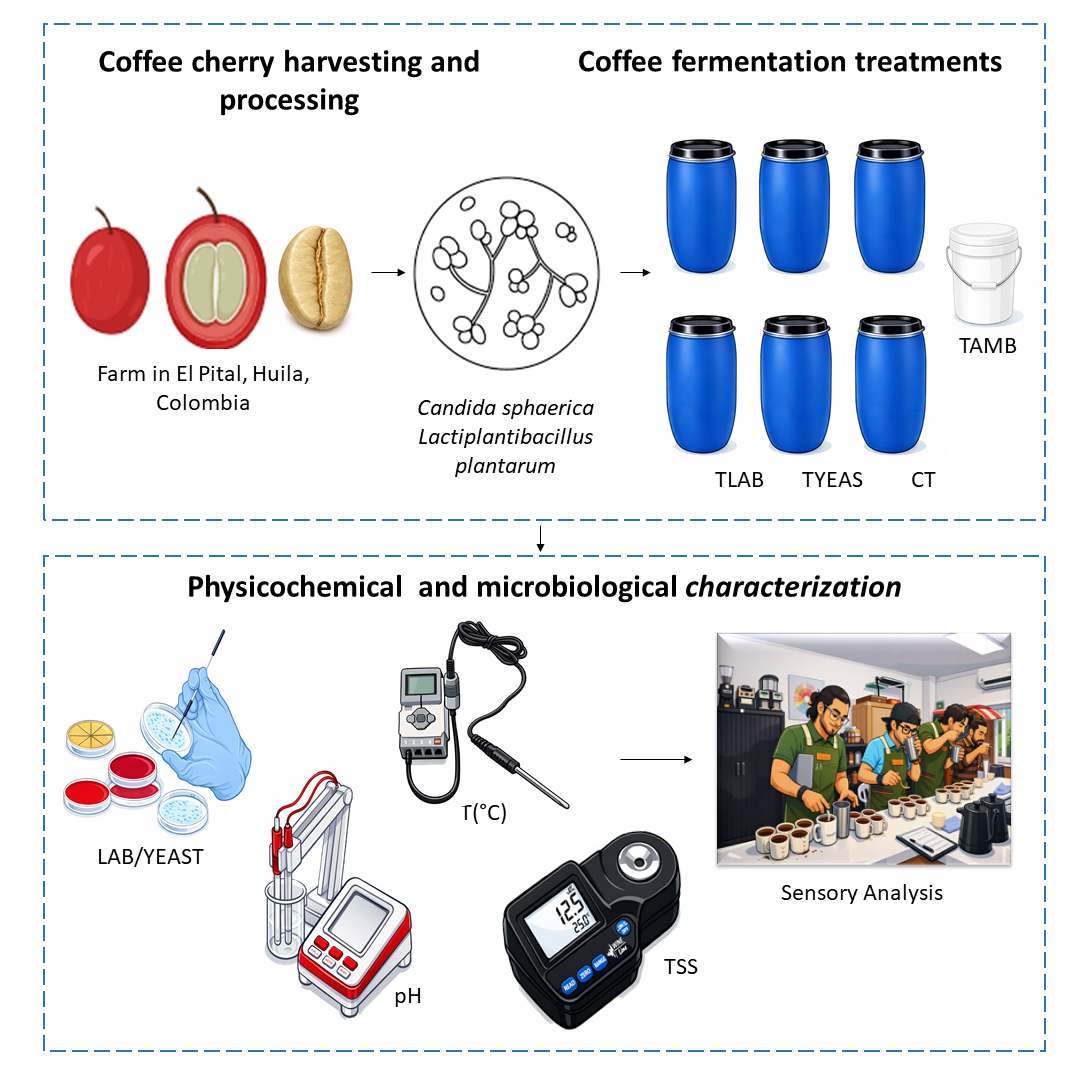
El uso de cultivos iniciadores como levaduras y bacterias ácido lácticas (BAL) durante la fermentación del café puede mejorar la calidad en taza al diversificar sus perfiles sensoriales. Este estudio evaluó el efecto de la inoculación de Candida sphaerica y Lactiplantibacillus plantarum en la fermentación de café variedad Colombia, mediante beneficio semi-seco, en dos zonas agroecológicas del Huila, Colombia (FZA 1 y FZA 3). Se aplicaron cuatro tratamientos: I) TLEV (adición de levadura), II) TBAL (adición de BAL), III) TC (sin microorganismos) y IV) TAMB (ambiente), todos por duplicado. La fermentación duró 24 horas. Las poblaciones finales de BAL variaron en FZA 1 entre 8.45 y 9.08 log UFC/ml y las de levaduras entre 7.34 y 8.13 log UFC/ml. En FZA 3, las BAL variaron entre 8.57 y 9.23 log UFC/ml y las levaduras entre 7.75 y 8.17 log UFC/ml. Las temperaturas de fermentación variaron entre 23.02 °C y 26.52 °C, el pH entre 4.07 y 5.18, y los sólidos solubles entre 8.27 y 11.83 °Brix. Todos los tratamientos alcanzaron puntajes SCA superiores a 80, clasificándolos como cafés de especialidad. La inoculación y el proceso semi-seco favorecieron perfiles sensoriales complejos, con énfasis en notas afrutadas y dulces como como miel, melaza, panela, caramelo, azúcar morena, dátiles, frutas amarillas, frutas rojas, cítricos y guanábana. Estos resultados indican que el uso de C. sphaerica y L. plantarum es una estrategia eficaz para intensificar y diversificar los perfiles sensoriales del café, mejorando su calidad y diferenciación comercial.
Descargas
Descargas
Detalles del artículo
Citas
Alan, Y. (2024). Chemical changes of potential probiotic Lactiplantibacillus plantarum and Lactobacillus pentosus starter cultures in natural Gemlik type black olive fermentation. Food Chemistry, 434, 137472. https://doi.org/10.1016/j.foodchem.2023.137472
Alan, Y., Keskin, A.-O., & Sönmez, M. (2025). Probiotic and functional characterization of newly isolated Lactiplantibacillus plantarum strains from human breast milk and proliferative inhibition potential of metabolites. Enzyme and Microbial Technology, 182, 110545. https://doi.org/10.1016/j.enzmictec.2024.110545
Aswathi, K. N., Shankar, S. R., Seenivasan, K., Prakash, I., & Murthy, P. S. (2022). Metagenomics and metabolomic profiles of Coffea canephora processed by honey/pulped natural technique. Innovative Food Science & Emerging Technologies, 79, 103058. https://doi.org/10.1016/j.ifset.2022.103058
Barrea, L., Pugliese, G., Frias-Toral, E., El Ghoch, M., Castellucci, B., Chapela, S. P., Carignano, M. de los A., Laudisio, D., Savastano, S., Colao, A., & Muscogiuri, G. (2023). Coffee consumption, health benefits and side effects: a narrative review and update for dietitians and nutritionists. Critical Reviews in Food Science and Nutrition, 63(9), 1238–1261. https://doi.org/10.1080/10408398.2021.1963207
Batista da Mota, M. C., Batista, N. N., Dias, D. R., & Schwan, R. F. (2022a). Impact of microbial self-induced anaerobiosis fermentation (SIAF) on coffee quality. Food Bioscience, 47, 101640. https://doi.org/10.1016/j.fbio.2022.101640
Binati, R. L., Salvetti, E., Bzducha-Wrobel, A., Basinskiene, L., Cizeikiene, D., Bolzonella, D., & Felis, G. E. (2021). Non-conventional yeasts for food and additives production in a circular economy perspective. FEMS Yeast Research, 21(7). https://doi.org/10.1093/femsyr/foab052
Borém, F. M., Rabelo, M. H. S., de Carvalho Alves, A. P., Santos, C. M., Pieroni, R. S., Nakajima, M., & Sugino, R. (2024). Fermentation of coffee fruit with sequential inoculation of Lactiplantibacillus plantarum and Saccharomyces cerevisiae: effect on sensory attributes and chemical composition of the beans. Food Chemistry, 446, 138820. https://doi.org/10.1016/j.foodchem.2024.138820
Bressani, A. P. P., Martinez, S. J., Sarmento, A. B. I., Borém, F. M., & Schwan, R. F. (2021). Influence of yeast inoculation on the quality of fermented coffee (Coffea arabica var. Mundo Novo) processed by natural and pulped natural processes. International Journal of Food Microbiology, 343, 109107. https://doi.org/10.1016/j.ijfoodmicro.2021.109107
Cai, Z., Guo, Y., Zheng, Q., Liu, Z., Zhong, G., Zeng, L., Huang, M., Pan, D., & Wu, Z. (2024). Screening of a potential probiotic Lactiplantibacillus plantarum NUC08 and its synergistic effects with yogurt starter. Journal of Dairy Science, 107(5), 2760–2773. https://doi.org/10.3168/jds.2023-24113
Centro Nacional de Investigaciones de Café CENICAFE. (2019). Aplicación de ciencia tecnología e innovación en el cultivo del café ajustado a las condiciones particulares del Huila (Vol. 1). Cenicafé. https://doi.org/10.38141/cenbook-0005
Córdoba Castro, N. M., & Guerrero Fajardo, J. esteban. (2016). Caracterización de los procesos tradicionales de fermentación de café en el departamento de Narino. Biotecnoloía En El Sector Agropecuario y Agroindustrial, 14(2), 75. https://doi.org/10.18684/BSAA(14)75-83
Da Costa, M. S., Pontes, K. S. S., Guedes, M. R., Silva, M. I. B., Klein, M. R. S. T., & et al. (2023). Association of habitual coffee consumption with obesity, sarcopenia, bone mineral density and cardiovascular risk factors: A two-year follow-up study in kidney transplant recipients. Clinical Nutrition, 42(10),1889–1900.https://doi.org/10.1016/j.clnu.2023.08.004
Da Mota, M. C. B., Batista, N. N., Rabelo, M. H. S., Ribeiro, D. E., Borém, F. M., & Schwan, R. F. (2020). Influence of fermentation conditions on the sensorial quality of coffee inoculated with yeast. Food Research International, 136, 109482. https://doi.org/10.1016/j.foodres.2020.109482
De Bruyn, F., Zhang, S. J., Pothakos, V., Torres, J., Lambot, C., Moroni, A. V., Callanan, M., Sybesma, W., & Weckx, S. (2017). Exploring the impacts of postharvest processing on the microbiota and metabolite profiles during green coffee bean production. Applied and Environmental Microbiology, 83(1), e02398-16. https://doi.org/10.1128/AEM.02398-16
De Carvalho Neto, D. P., de Melo Pereira, G. V., Finco, A. M. O., Letti, L. A. J., da Silva, B. J. G., Vandenberghe, L. P. S., & Soccol, C. R. (2018). Efficient coffee beans mucilage layer removal using lactic acid fermentation in a stirred-tank bioreactor: Kinetic, metabolic and sensorial studies. Food Bioscience, 26, 80–87. https://doi.org/10.1016/j.fbio.2018.10.005
De Melo Pereira, G., Maske, B., de Carvalho Neto, D., Karp, S., De Dea Lindner, J., Martin, J., de Oliveira Hosken, B., & Soccol, C. (2022). What Is Candida Doing in My Food? A Review and Safety Alert on Its Use as Starter Cultures in Fermented Foods. Microorganisms, 10(9), 1855. https://doi.org/10.3390/microorganisms10091855
De Melo Pereira, G. V., Beux, M., Pagnoncelli, M. G. B., Soccol, V. T., Rodrigues, C., & Soccol, C. R. (2016). Isolation, selection and evaluation of antagonistic yeasts and lactic acid bacteria against ochratoxigenic fungus Aspergillus westerdijkiae on coffee beans. Letters in Applied Microbiology, 62(1), 96–101. https://doi.org/10.1111/lam.12520.
De Melo Pereira, G. V., Soccol, V. T., Pandey, A., Medeiros, A. B. P., Andrade Lara, J. M. R., Gollo, A. L., & Soccol, C. R. (2014). Isolation, selection and evaluation of yeasts for use in fermentation of coffee beans by the wet process. International Journal of Food Microbiology, 188, 60–66. https://doi.org/10.1016/j.ijfoodmicro.2014.07.008
Dias, S. R., Bressani, A. P. P., Batista, N. N., Dias, D. R., & Schwan, R. F. (2025). Increasing the quality and complexity of pulped coffee fermentation with Lactiplantibacillus plantarum and selected yeasts. European Food Research and Technology, 251(2), 283–297. https://doi.org/10.1007/s00217-024-04640-7
El Menyawi, I., Wögerbauer, M., Sigmund, H., Burgmann, H., & Graninger, W. (2000). Identification of yeast species by fatty acid profiling as measured by gas-liquid chromatography. Journal of Chromatography B: Biomedical Sciences and Applications, 742(1), 13–24. https://doi.org/10.1016/S0378-4347(00)00044-X
Elhalis, H., Cox, J., & Zhao, J. (2023). Coffee fermentation: Expedition from traditional to controlled process and perspectives for industrialization. Applied Food Research, 3(1), 100253. https://doi.org/10.1016/j.afres.2022.100253
Evangelista, S. R., da Cruz Pedrozo Miguel, M. G., de Souza Cordeiro, C., Silva, C. F., Marques Pinheiro, A. C., & Schwan, R. F. (2014). Inoculation of starter cultures in a semi-dry coffee (Coffea arabica) fermentation process. Food Microbiology, 44, 87–95. https://doi.org/10.1016/j.fm.2014.05.013
Ezekiel, O. O., Oguntoye, M. A., & Salami, N. O. (2024). Solid-state fermentation with Bacillus subtillis co-cultured with probiotic Lactobacillus spp. enhances the bioactive peptides, nutritional and antioxidative potentials of tamarind seed. Biocatalysis and Agricultural Biotechnology, 61, 103368. https://doi.org/10.1016/j.bcab.2024.103368
FAO. (1997). FAO. (1997). Zonificación Agroecológica, Guía general. Roma: https://www.fao.org/4/w2962s/w2962s00.htm
Galarza, G., & Figueroa, J. G. (2022). Volatile Compound Characterization of Coffee (Coffea arabica) Processed at Different Fermentation Times Using SPME–GC–MS. Molecules, 27(6), 2004. https://doi.org/10.3390/molecules27062004
Guluarte, C., Reyes-Becerril, M., Gonzalez-Silvera, D., Cuesta, A., Angulo, C., & Esteban, M. Á. (2019). Probiotic properties and fatty acid composition of the yeast Kluyveromyces lactis M3. In vivo immunomodulatory activities in gilthead seabrea (Sparus aurata). Fish & Shellfish Immunology, 94, 389–397. https://doi.org/10.1016/j.fsi.2019.09.024
Guo, J., Liu, X., Wang, Y., Zeng, T., Leng, J., Han, D., Imran, M., Lü, X., & Yi, Y. (2024). Co-cultivation of selected Lactiplantibacillus plantarum strains with starter cultures under osmotic stress increases folate content and enhances product quality in fermented dairy. LWT, 211, 116934. https://doi.org/10.1016/j.lwt.2024.116934
Helena Sances Rabelo, M., Meira Borém, F., Paula de Carvalho Alves, A., Soares Pieroni, R., Mendes Santos, C., Nakajima, M., & Sugino, R. (2024). Fermentation of coffee fruit with sequential inoculation of Lactiplantibacillus plantarum and Saccharomyces cerevisiae: Effects on volatile composition and sensory characteristics. Food Chemistry, 444, 138608. https://doi.org/10.1016/j.foodchem.2024.138608
Henn, M., Babio, N., Romaguera, D., Vázquez-Ruiz, Z., Konieczna, J., Vioque, J., Torres-Collado, L., Razquin, C., Buil-Cosiales, P., Fitó, M., Schröder, H., Hu, F. B., Abete, I., Zulet, M. Á., Fernández-Villa, T., Martín, V., Estruch, R., Vidal, J., Paz-Graniel, I., … Martínez-González, M. A. & Ruiz-Canela, M. (2023). Increase from low to moderate, but not high, caffeinated coffee consumption is associated with favourable changes in body fat. Clinical Nutrition, 42(4), 477-485. https://doi.org/10.1016/j.clnu.2023.02.004.
Hernández, J. A., Heyd, B., & Trystram, G. (2008). On-line assessment of brightness and surface kinetics during coffee roasting. Journal of Food Engineering, 87(3), 314–322. https://doi.org/10.1016/j.jfoodeng.2007.12.009
Holguín-Sterling, L., Pedraza-Claros, B., Pérez-Salinas, R., Ortiz, A., Navarro-Escalante, L., & Góngora, C. E. (2023). Physical–Chemical and Metataxonomic Characterization of the Microbial Communities Present during the Fermentation of Three Varieties of Coffee from Colombia and Their Sensory Qualities. Agriculture, 13(10), 1980. https://doi.org/10.3390/agriculture13101980
Janne Carvalho Ferreira, L., de Souza Gomes, M., Maciel de Oliveira, L., & Diniz Santos, L. (2023). Coffee fermentation process: A review. Food Research International, 169, 112793. https://doi.org/10.1016/j.foodres.2023.112793
Janne Carvalho Ferreira, L., Luiz Lima Bertarini, P., Rodrigues do Amaral, L., Souza Gomes, M. de, Maciel de Oliveira, L., & Diniz Santos, L. (2024). Coinoculation of Saccharomyces cerevisiae and Bacillus amyloliquefaciens in solid-state and submerged coffee fermentation: Influences on chemical and sensory compositions. LWT, 202, 116299. https://doi.org/10.1016/j.lwt.2024.116299
Jimenez, E. J. M., Martins, P. M. M., Vilela, A. L. de O., Batista, N. N., Rosa, S. D. V. F. da, Dias, D. R., & Schwan, R. F. (2023). Influence of anaerobic fermentation and yeast inoculation on the viability, chemical composition, and quality of coffee. Food Bioscience, 51, 102218. https://doi.org/10.1016/j.fbio.2022.102218
Krijger, J.-J., Baumann, J., Wagner, M., Schulze, K., Reinsch, C., Klose, T., Onuma, O. F., Simon, C., Behrens, S.-E., & Breunig, K. D. (2012). A novel, lactase-based selection and strain improvement strategy for recombinant protein expression in Kluyveromyces lactis. Microbial Cell Factories, 11(1), 112. https://doi.org/10.1186/1475-2859-11-112
Kumar, V., Ahluwalia, V., Saran, S., Kumar, J., Patel, A. K., & Singhania, R. R. (2021). Recent developments on solid-state fermentation for production of microbial secondary metabolites: Challenges and solutions. Bioresource Technology, 323, 124566. https://doi.org/10.1016/j.biortech.2020.124566
Li, S., Meng, L., Wang, M., Zhang, Y., Chen, Q., & Li, X. (2024). Application of microbial fermentation in caffeine degradation and flavor modulation of coffee beans. Foods, 14(15), 2606. https://doi.org/10.3390/foods14152606.
Liu, Y., Castagnini, J. M., Berrada, H., & Barba, F. J. (2025). High-added-value compounds recovery from supercritical fluid extraction-defatted European sea bass (Dicentrarchus labrax) viscera by lactic acid bacteria (L. plantarum and L. casei) assisted fermentation. Food Chemistry, 473, 143085. https://doi.org/10.1016/j.foodchem.2025.143085
Martinez, S. J., Bressani, A. P. P., Dias, D. R., Simão, J. B. P., & Schwan, R. F. (2019). Effect of Bacterial and Yeast Starters on the Formation of Volatile and Organic Acid Compounds in Coffee Beans and Selection of Flavors Markers Precursors During Wet Fermentation. Frontiers in Microbiology, 10. https://doi.org/10.3389/fmicb.2019.01287
Marwati, T., Djaafar, T. F., Hatmi, R. U., Kobarsih, M., Indrasari, S. D., Fitrotin, U., Fajariyah, A., Wibowo, N. A., Anantama, M. S., Wikandari, R., Tunjung Sari, A. B., Sutardi, Laksono, P., Widodo, S., & Rahayu, E. S. (2024). Alternative fermentation method of cocoa beans: The use of Lactiplantibacillus plantarum subsp. plantarum HL-15 as starter culture and valorization of cocoa pulp by-product. Journal of Agriculture and Food Research, 18, 101398. https://doi.org/10.1016/j.jafr.2024.101398
Masoud, W., Bjørg Cesar, L., Jespersen, L., & Jakobsen, M. (2004). Yeast involved in fermentation of Coffea arabica in East Africa determined by genotyping and by direct denaturating gradient gel electrophoresis. Yeast, 21(7), 549–556. https://doi.org/10.1002/yea.1124
Nakyinsige, K., Mugerwa, F., Tabula, A., Mugampoza, D., Matovu, M., & Bamuwamye, M. (2025). The influence of spontaneous microbial fermentation isolates on physicochemical properties and cup quality of wet processed arabica coffee (Coffea arabica). LWT, 216, 117343. https://doi.org/10.1016/j.lwt.2025.117343
Nansen, C., Singh, K., Mian, A., Allison, B. J., & Simmons, C. W. (2016). Using hyperspectral imaging to characterize consistency of coffee brands and their respective roasting classes. Journal of Food Engineering, 190, 34–39. https://doi.org/10.1016/j.jfoodeng.2016.06.010
Ostos-Ortíz, O. L. , Rosas-Arango, S. M., & González-Devia, J. L. (2019). Aplicaciones biotecnológicas de los microorganismos. Nova, 17(31). http://www.scielo.org.co/scielo.php?script=sci_arttext&pid=S1794-24702019000100129
Parra Huertas, R. A. (2010). Review lactic acid bacteria: functional role in the foods. Biotecnología En El Sector Agropecuario y Agroindustrial, 8(1). http://www.scielo.org.co/scielo.php?script=sci_arttext&pid=S1692-35612010000100012&lng=en.
Peñuela-Martínez, A. E., Zapata-Zapata, A. D., & Durango-Restrepo, D. L. (2018). Performance of different fermentation methods and the effect on coffee quality (Coffea arabica L.). Coffee Science, 13(4), 465. https://doi.org/10.25186/cs.v13i4.1486
Pereira, G. V. de M., de Carvalho Neto, D. P., Medeiros, A. B. P., Soccol, V. T., Neto, E., Woiciechowski, A. L., & Soccol, C. R. (2016). Potential of lactic acid bacteria to improve the fermentation and quality of coffee during on-farm processing. International Journal of Food Science & Technology, 51(7), 1689–1695. https://doi.org/10.1111/ijfs.13142
Pimpley, V., Patil, S., Srinivasan, K., Desai, N., & Murthy, P. S. (2020). The chemistry of chlorogenic acid from green coffee and its role in attenuation of obesity and diabetes. Preparative Biochemistry & Biotechnology, 50(10), 969–978. https://doi.org/10.1080/10826068.2020.1786699
Pires, F. de C., Pereira, R. G. F. A., Baqueta, M. R., Valderrama, P., & Alves da Rocha, R. (2021). Near-infrared spectroscopy and multivariate calibration as an alternative to the Agtron to predict roasting degrees in coffee beans and ground coffees. Food Chemistry, 365, 130471. https://doi.org/10.1016/j.foodchem.2021.130471
Ponnusamy, V., & Sankaranarayanan, M. (2023). Targeted gene manipulation of Leloir pathway genes for the constitutive expression of beta-galactosidase and its transgalactosylation product galacto-oligosaccharides from Kluyveromyces lactis GG799 and knockout strains. Enzyme and Microbial Technology, 169, 110263. https://doi.org/10.1016/j.enzmictec.2023.110263
Prakash, I., R, S. S., P, S. H., Kumar, P., Om, H., Basavaraj, K., & Murthy, P. S. (2022). Metabolomics and volatile fingerprint of yeast fermented robusta coffee: A value added coffee. LWT, 154, 112717. https://doi.org/10.1016/j.lwt.2021.112717
Qin, S., Hu, F., Yang, N., Li, L., Yang, H., Suo, Y., & He, F. (2024). Influence of native coffee yeast fermentation on phenolic content, organic acids, and volatile compounds in cascara. LWT, 210, 116860. https://doi.org/10.1016/j.lwt.2024.116860
Ribeiro, L. S., da Cruz Pedrozo Miguel, M. G., Martinez, S. J., Bressani, A. P. P., Evangelista, S. R., Silva e Batista, C. F., & Schwan, R. F. (2020). The use of mesophilic and lactic acid bacteria strains as starter cultures for improvement of coffee beans wet fermentation. World Journal of Microbiology and Biotechnology, 36(12), 186. https://doi.org/10.1007/s11274-020-02963-7
Salazar, S., Hoyos, J., Quiroga-Mosquera, A., & García-López, J. C. (2019). Zonas agroecológicas. In Aplicación de ciencia tecnología e innovación en el cultivo del café ajustado a las condiciones particulares del Huila (pp. 08–31). Cenicafé. https://doi.org/10.38141/10791/0005_1
Schenker, S., & Rothgeb, T. (2017). The Roast—Creating the Beans’ Signature. In The Craft and Science of Coffee (pp. 245–271). Elsevier. https://doi.org/10.1016/B978-0-12-803520-7.00011-6
Shen, X., Wang, B., Zi, C., Huang, L., Wang, Q., Zhou, C., Wen, W., Liu, K., Yuan, W., & Li, X. (2023). Interaction and Metabolic Function of Microbiota during the Washed Processing of Coffea arabica. Molecules, 28(16), 6092. https://doi.org/10.3390/molecules28166092
Souza, M. L., Passamani, F. R. F., Ávila, C. L. da S., Batista, L. R., Schwan, R. F., & Silva, C. F. (2017). Use of wild yeasts as a biocontrol agent against toxigenic fungi and OTA production. Acta Scientiarum. Agronomy, 39(3), 349. https://doi.org/10.4025/actasciagron.v39i3.32659
Spohner, S. C., Schaum, V., Quitmann, H., & Czermak, P. (2016). Kluyveromyces lactis: An emerging tool in biotechnology. Journal of Biotechnology, 222, 104–116. https://doi.org/10.1016/j.jbiotec.2016.02.023
Sun, X., Liu, H., Duan, C., & Yan, G. (2023). Effects of mixed starters of plant- and wine-derived L. plantarum on hawthorn juice fermentation: Physicochemical properties, phenolic and volatile profiles. Food Bioscience, 56, 103363. https://doi.org/10.1016/j.fbio.2023.103363
Tirado-Kulieva, V., Quijano-Jara, C., Avila-George, H., & Castro, W. (2024). Predicting the evolution of pH and total soluble solids during coffee fermentation using near-infrared spectroscopy coupled with chemometrics. Current Research in Food Science, 9, 100788. https://doi.org/10.1016/j.crfs.2024.100788
Viesser, J. A., de Melo Pereira, G. V., de Carvalho Neto, D. P., Rogez, H., Góes-Neto, A., Azevedo, V., Brenig, B., Aburjaile, F., & Soccol, C. R. (2021). Co-culturing fructophilic lactic acid bacteria and yeast enhanced sugar metabolism and aroma formation during cocoa beans fermentation. International Journal of Food Microbiology, 339, 109015. https://doi.org/10.1016/j.ijfoodmicro.2020.109015
Vinícius de Melo Pereira, G., Soccol, V. T., Brar, S. K., Neto, E., & Soccol, C. R. (2017). Microbial ecology and starter culture technology in coffee processing. Critical Reviews in Food Science and Nutrition, 57(13), 2775–2788. https://doi.org/10.1080/10408398.2015.1067759
Wang, C., Sun, J., Lassabliere, B., Yu, B., & Liu, S. Q. (2020). Coffee flavour modification through controlled fermentation of green coffee beans by Lactococcus lactis subsp. cremoris. LWT, 120, 108930. https://doi.org/10.1016/j.lwt.2019.108930
Xu, H., Feng, L., Deng, Y., Chen, L., Li, Y., Lin, L., Liang, M., Jia, X., Wang, F., Zhang, X., & Sun, Z. (2023). Change of phytochemicals and bioactive substances in Lactobacillus fermented Citrus juice during the fermentation process. LWT, 180, 114715. https://doi.org/10.1016/j.lwt.2023.114715
Yergenson, N., & Aston, D. E. (2020). Online determination of coffee roast degree toward controlling acidity. Journal of Near Infrared Spectroscopy, 28(4), 175–185. https://doi.org/10.1177/0967033520924493
Barra lateral del artículo
Barra lateral del artículo

Esta obra está bajo una licencia internacional Creative Commons Atribución-NoComercial-CompartirIgual 4.0.