

Efecto de la Microencapsulación por Atomización en el Contenido de Compuestos Fenólicos y Capacidad Antioxidante de Extractos de Hojas de Guanábana y Arándano
##plugins.themes.bootstrap3.article.main##
Alejandro Tapia-Ibargüen

Oscar Jordán-Suárez
Resumen
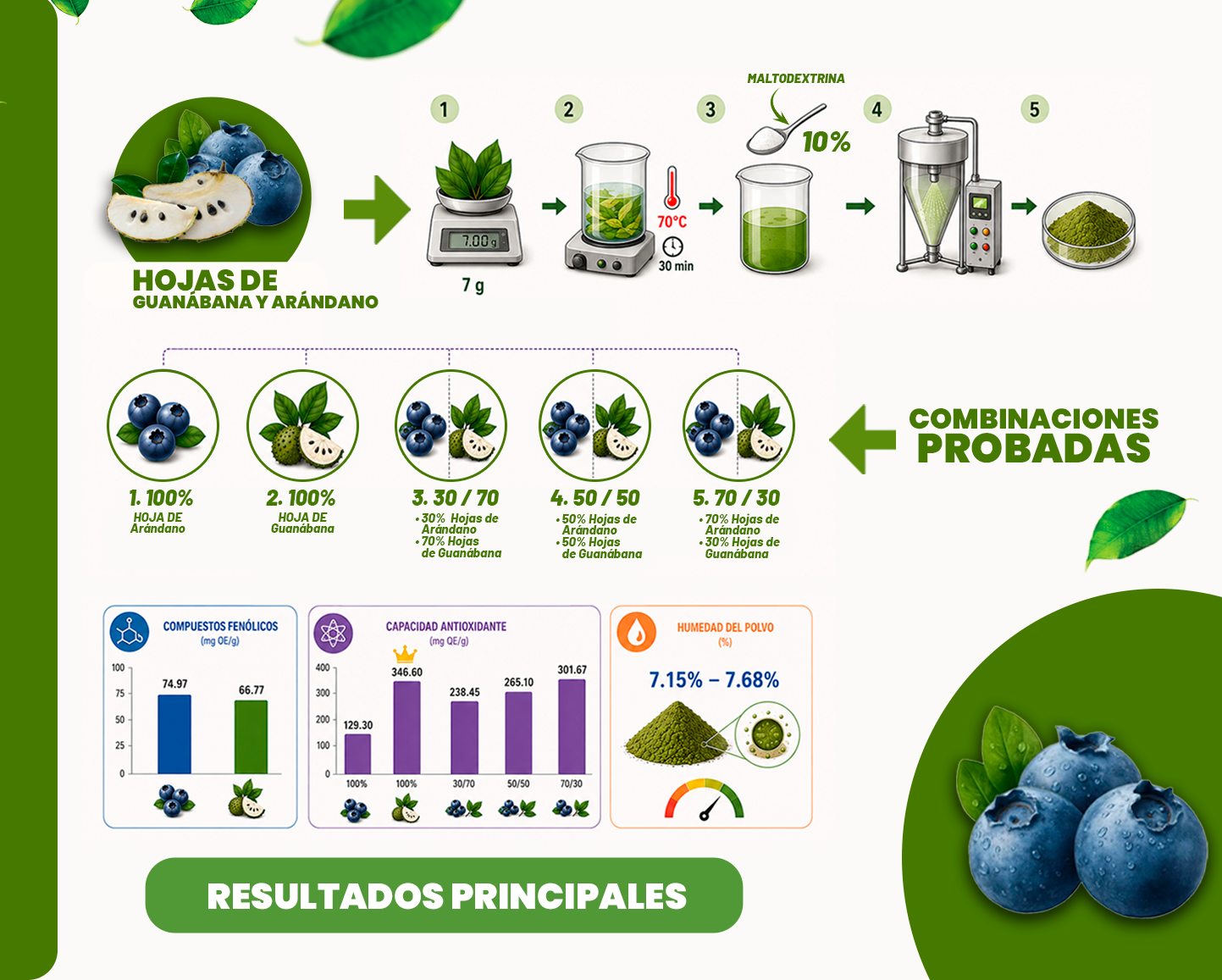
El objetivo de este estudio fue evaluar el efecto de la microencapsulación por atomización en el contenido de compuestos fenólicos y la capacidad antioxidante de extractos de hojas de guanábana y arándano. Se prepararon extractos frescos y microencapsulados mediante maltodextrina al 10 % como agente de pared, y se determinó el contenido fenólico total con el método de Folin-Ciocalteu. Los resultados se expresaron como equivalentes de quercetina (QE) al emplearla como curva estándar. Asimismo, se evaluó la capacidad antioxidante a través del ensayo DPPH, y todos los valores analíticos se expresaron en base seca. Los resultados mostraron que las hojas de arándano presentaron un mayor contenido de flavonoides inicial (74.97 mg QE/g), mientras que la guanábana registró una capacidad antioxidante superior (22.33 µmol TE/g). Tras el proceso de microencapsulación, la guanábana mantuvo los valores más altos (346.60 mg QE/g) y actividad antioxidante (17.77 µmol TE/g), aunque la mezcla 70 % guanábana y 30 % arándano destacó como formulación óptima, con 301.67 mg QE/g y 17.53 µmol TE/g. Las microcápsulas presentaron humedades entre 7.15 % y 7.68 %, parámetros de color dependientes de la proporción de hojas y una morfología esférica adecuada para la conservación de bioactivos. Se concluyó que el valor de IC50 de la mezcla optimizada (613 mg/mL) confirmó la capacidad de inhibir radicales libres, lo que respalda el potencial de estas microcápsulas como insumos para el desarrollo de productos nutracéuticos y alimentos funcionales.
Descargas
Descargas
Detalles del artículo
Citas
Aguilar-Hernández, G., García-Magaña, M. de L., Vivar-Vera, M. de L. Á., Sáyago-Ayerdi, S. G., Sánchez-Burgos, J. A., Morales-Castro, J., Anaya-Esparza, L. M., & Montalvo González, E. (2019). Optimization of ultrasound-assisted extraction of phenolic compounds from Annona muricata by-products and pulp. Molecules (Basel, Switzerland), 24(5), 904. https://doi.org/10.3390/molecules24050904
Bai, X., Zhou, L., Zhou, L., Cang, S., Liu, Y., Liu, R., Liu, J., Feng, X., & Fan, R. (2023). The research progress of extraction, purification and analysis methods of phenolic compounds from blueberry: A comprehensive review. Molecules (Basel, Switzerland), 28(8). https://doi.org/10.3390/molecules28083610
Batista, V. S. F., Nunes, G. L., Silva, A. F. M. da, Viegas, G. I., Lucas, B. N., Barin, J. S., Menezes, C. R. de, & Rosa, C. S. da. (2021). Addition of microencapsulated soybean molasses to pasta formulations. Ciencia rural, 51(9). https://doi.org/10.1590/0103-8478cr20200722
Bergesse, A. E., Asensio, C. M., Quiroga, P. R., Ryan, L. C., Grosso, N. R., & Nepote, V. (2023). Microencapsulation of phenolic compounds extracted from soybean seed coats by spray-drying. Journal of Food Science, 88(11), 4457–4471. https://doi.org/10.1111/1750-3841.16775
Birben, E., Sahiner, U. M., Sackesen, C., Erzurum, S., & Kalayci, O. (2012). Oxidative stress and antioxidant defense. The World Allergy Organization Journal, 5(1), 9–19. https://doi.org/10.1097/WOX.0b013e3182439613
Castro-López, C., Sánchez-Alejo, E. J., Saucedo-Pompa, S., Rojas, R., Aranda-Ruiz, J., & Martínez-Avila, G. C. G. (2016). Fluctuations in phenolic content, ascorbic acid and total carotenoids and antioxidant activity of fruit beverages during storage. Heliyon, 2(9), e00152. https://doi.org/10.1016/j.heliyon.2016.e00152
Ces, A. (2016). Evaluación de la actividad antioxidante de frambuesas comerciales [Universidade da Coruña]. https://ruc.udc.es/dspace/bitstream/handle/2183/17458/CesMartinez_Alejandro_TFG_2016.pdf?sequence=2&isAllowed=y
Ciaccheri, L., Adinolfi, B., Mencaglia, A., & Mignani, A. (2023). Smartphone-Enabled Colorimetry. Sensors, 23(1), 5559. https://doi.org/10.3390/s23125559
Drabinska, N., Jez, M., & Nogueira, M. (2021). Variation in the accumulation of phytochemicals and their bioactive properties among the aerial parts of cauliflower. Antioxidants (Basel, Switzerland), 10(10), 1597. https://doi.org/10.3390/antiox10101597
Ferreira, L. M. de M. C., Pereira, R. R., Carvalho-Guimarães, F. B. de, Remígio, M. S. do N., Barbosa, W. L. R., Ribeiro-Costa, R. M., & Silva-Júnior, J. O. C. (2022). Microencapsulation by spray drying and antioxidant activity of phenolic compounds from tucuma coproduct (Astrocaryum vulgare mart.) almonds. Polymers, 14(14), 2905. https://doi.org/10.3390/polym14142905
Fertilita, S., Sandhika, W., & Suprabawati, D. G. A. (2020). The Cytotoxic Activity of Annona muricata Linn Leaves Ethanolic Extract (AMEE) on T47D Breast Cancer Cell Line. Medical Laboratory Technology Journal, 1(1). https://doi.org/10.31964/mltj.v1i1.291
Fujii, K., Ota, Y., Nishiyama, K., Kunitake, H., Yamasaki, Y., Tari, H., Araki, K., Arakawa, T., & Yamasaki, M. (2019). Blueberry leaf polyphenols prevent body fat accumulation in mice fed high-fat, high-sucrose diet. Journal of Oleo Science, 68(5), 471–479. https://doi.org/10.5650/jos.ess18226
Guija, E., Inocente, M. Á., Ponce, J., & Zarzosa, E. (2015). Evaluación de la técnica 2,2-Difenil-1-Picrilhidrazilo (DPPH) para determinar capacidad antioxidante. Horizonte Médico, 15(1), 57-60. http://www.scielo.org.pe/scielo.php?script=sci_arttext&pid=S1727-558X2015000100008&lng=es&tlng=es.
Guillen-Poot, M. A., Hernández-Bolio, G. I., Pacheco, N., Herrera-Pool, E., García-Sosa, K., & Peña-Rodríguez, L. M. (2025). Identification of bioactive phytomarkers in fruits of “Nance” (Byrsonima bucidifolia), a traditional fruit consumed in Yucatan, Mexico. Chemistry & Biodiversity, 22(8), e202500355. https://doi.org/10.1002/cbdv.202500355
Hasmila, I., Natsir, H., & Soekamto, N. H. (2019). Phytochemical analysis and antioxidant activity of soursop leaf extract (Annona muricata Linn.). Journal of physics. Conference series, 1341(3), 032027. https://doi.org/10.1088/1742-6596/1341/3/032027
Hussain, M., Hassan, S., Waheed, M., Javed, A., Adil Farooq, M., & Tahir, A. (2019). Bioavailability and metabolic pathway of phenolic compounds. En Plant Physiological Aspects of Phenolic Compounds. IntechOpen.
Ichikawa, T., Sugamoto, K., Matsuura, Y., Kunitake, H., Shimoda, K., & Morishita, K. (2022). Inhibition of adult T-cell leukemia cell proliferation by polymerized proanthocyanidin from blueberry leaves through JAK proteolysis. Cancer Science, 113(4), 1406–1416. https://doi.org/10.1111/cas.15277
Ito, V. C., Alberti, A., Avila, S., Spoto, M., Nogueira, A., & Wosiacki, G. (2016). Effects of gamma radiation on the phenolic compounds and in vitro antioxidant activity of apple pomace flour during storage using multivariate statistical techniques. Innovative Food Science & Emerging Technologies: IFSET: The Official Scientific Journal of the European Federation of Food Science and Technology, 33, 251–259. https://doi.org/10.1016/j.ifset.2015.12.015
EXTRACTO DE HOJAS DE GUANÁBANA (Annona muricata L.) [Universidad Nacional Agraria La Molina]. http://45.231.83.156/handle/20.500.12996/4249
Kalt, W., Cassidy, A., Howard, L. R., Krikorian, R., Stull, A. J., Tremblay, F., & Zamora-Ros, R. (2020). Recent research on the health benefits of blueberries and their anthocyanins. Advances in Nutrition (Bethesda, Md.), 11(2), 224–236. https://doi.org/10.1093/advances/nmz065
Karaaslan, M., Ozden, M., Vardin, H., & Turkoglu, H. (2011). Phenolic fortification of yogurt using grape and callus extracts. Lebensmittel-Wissenschaft Und Technologie [Food Science and Technology], 44(4), 1065–1072. https://doi.org/10.1016/j.lwt.2010.12.009
Krichene, D., Salvador, M. D., & Fregapane, G. (2015). Stability of virgin Olive oil phenolic compounds during long-term storage (18 months) at temperatures of 5-50 °C. Journal of Agricultural and Food Chemistry, 63(30), 6779–6786. https://doi.org/10.1021/acs.jafc.5b02187
Li, Q., Mo, J., Xiong, B., Liao, Q., Chen, Y., Wang, Y., Xing, S., He, S., Lyu, W., Zhang, N., & Sun, H. (2022). Discovery of resorcinol-based polycyclic structures as tyrosinase inhibitors for treatment of Parkinson’s disease. ACS Chemical Neuroscience, 13(1), 81–96. https://doi.org/10.1021/acschemneuro.1c00560
Lourenço, S. C., Moldão-Martins, M., & Alves, V. D. (2020). Microencapsulation of pineapple peel extract by spray drying using maltodextrin, inulin, and Arabic gum as wall matrices. Foods (Basel, Switzerland), 9(6), 718. https://doi.org/10.3390/foods9060718
Lucia, C. M., Oliveira, L. A., Dias, K. A., Pereira, S. M. S., da Conceição, A. R., & Anandh Babu, P. V. (2023). Scientific evidence for the beneficial effects of dietary blueberries on gut health: A systematic review. Molecular Nutrition & Food Research, 67(15), e2300096. https://doi.org/10.1002/mnfr.202300096
Malarkodi, R., Gokulakrishnan, A., Sudha, D., & Liyakath, A. A. (2023). In vitro pro-inflammatory enzyme inhibition, anti-oxidant potential and biomolecule oxidation protective activity using different extracts of soursop (Annona muricata L.) leaves and fruits. International Journal of Zoological Investigations, 9(1), 609–619. https://doi.org/10.33745/ijzi.2023.v09i01.068
Marchi, J. P., Paranaense, U., Livero, F. A. dos R., Soare, A. A., da Silva, G. J., Soares, A. K. V., Giarolo, C. M., Jacomassi, E., de Souza, L. M., Bortolucci, W. de C., Gazim, Z. C., Campos, C. F. de A. A., Goncalves, J. E., Araujo, C. de S. A., Wietzikoski, S., Lovato, E. C. W., Paranaense, U., Paranaense, U., Paranaense, U., … Paranaense, U. (2022). Influence of different preparation techniques on the composition and antioxidant action of curcumin and curcuminoids. Boletín latinoamericano y del Caribe de plantas medicinales y aromáticas, 21(1), 51–65. https://doi.org/10.37360/blacpma.22.21.1.03
Matsuura, Y., Sakakibara, H., Kawaguchi, M., Murayama, E., Yokoyama, D., Yukizaki, C., Kunitake, H., & Sakono, M. (2018). Effects of blueberry leaf and stem extracts on hepatic lipid levels in rats consuming a high-sucrose diet. Functional foods in health and disease, 8(9), 447. https://doi.org/10.31989/ffhd.v8i9.538
Melini, V., Melini, F., & Acquistucci, R. (2020). Phenolic compounds and bioaccessibility thereof in functional pasta. Antioxidants (Basel, Switzerland), 9(4), 343. https://doi.org/10.3390/antiox9040343
Navarro-Flores, M. J., Ventura-Canseco, L. M. C., Meza-Gordillo, R., Ayora-Talavera, T. D. R., & Abud-Archila, M. (2020). Spray drying encapsulation of a native plant extract rich in phenolic compounds with combinations of maltodextrin and non-conventional wall materials. Journal of Food Science and Technology, 57(11), 4111–4122. https://doi.org/10.1007/s13197-020-04447-w
Nikolic, N., Zili´´c, S., Simi´c, M., Nikoli´c, V., Zivkovi´c, J., Markovi´c, S., & Savikin, K. (2023). Microencapsulates of blue maize polyphenolics as a promising ingredient in the food and pharmaceutical industry: Characterization, antioxidant properties, and in vitro-simulated digestion. Foods (Basel, Switzerland), 12(9). https://doi.org/10.3390/foods12091870
Ostrózka-Cieslik, A. (2022). The Potential of Pharmaceutical Hydrogels in the Formulation of Topical Administration Hormone Drugs. Polymers, 14(16), 3307. https://doi.org/10.3390/polym14163307
Pistia-Brueggeman, G., & Hollingsworth, R. I. (2001). A preparation and screening strategy for glycosidase inhibitors. Tetrahedron, 57, 8773-8778. https://doi.org/10.1016/S0040-4020(01)00877-8.
Pizzino, G., Irrera, N., Cucinotta, M., Pallio, G., Mannino, F., Arcoraci, V., Squadrito, F., Altavilla, D., & Bitto, A. (2017). Oxidative stress: Harms and benefits for human health. Oxidative Medicine and Cellular Longevity, 2017, 8416763. https://doi.org/10.1155/2017/8416763
Rudrapal, M., Khairnar, S. J., Khan, J., Dukhyil, A. B., Ansari, M. A., Alomary, M. N., Alshabrmi, F. M., Palai, S., Deb, P. K., & Devi, R. (2022). Dietary polyphenols and their role in oxidative stress-induced human diseases: Insights into protective effects, antioxidant potentials and mechanism(s) of action. Frontiers in Pharmacology, 13, 806470. https://doi.org/10.3389/fphar.2022.806470
Sánchez-Marzo, N., Lozano-Sánchez, J., Cádiz-Gurrea, M. de la L., Herranz-López, M., Micol, V., & Segura-Carretero, A. (2019). Relationships between chemical structure and antioxidant activity of isolated phytocompounds from lemon verbena. Antioxidants (Basel, Switzerland), 8(8), 324. https://doi.org/10.3390/antiox8080324
Sansone, F., Mencherini, T., Picerno, P., d’Amore, M., Aquino, R. P., & Lauro, M. R. (2011). Maltodextrin/pectin microparticles by spray drying as carrier for nutraceutical extracts. Journal of Food Engineering, 105(3), 468–476. https://doi.org/10.1016/j.jfoodeng.2011.03.004
Santos, M. C. P., & Gonçalves, É. C. B. A. (2016). Effect of different extracting solvents on antioxidant activity and phenolic compounds of a fruit and vegetable residue flour. Scientia agropecuaria, 7(1), 07–14. https://doi.org/10.17268/sci.agropecu.2016.01.01
Sharifi-Rad, M., Anil Kumar, N. V., Zucca, P., Varoni, E. M., Dini, L., Panzarini, E., Rajkovic, J., Tsouh Fokou, P. V., Azzini, E., Peluso, I., Prakash Mishra, A., Nigam, M., El Rayess, Y., Beyrouthy, M. E., Polito, L., Iriti, M., Martins, N., Martorell, M., Docea, A. O., … Sharifi-Rad, J. (2020). Lifestyle, oxidative stress, and antioxidants: Back and forth in the pathophysiology of chronic diseases. Frontiers in Physiology, 11, 694. https://doi.org/10.3389/fphys.2020.00694
Sokol-Letowska, A., Kucharska, A. Z., Szumny, A., Wi´nska, K., & Nawirska-Olsza´nska, A. (2018). Phenolic composition stability and antioxidant activity of sour cherry liqueurs. Molecules (Basel, Switzerland), 23(9), 2156. https://doi.org/10.3390/molecules23092156
Song, X., & Luming, C. (2014). Phenolic constituents, antimicrobial and antioxidant properties of blueberry leaves (V5). Journal of food and nutrition research, 2(12), 973–979. https://doi.org/10.12691/jfnr-2-12-18
Syafa’atun, T., & Marisa, N. (2020). Antioxidant and organoleptic test of Soursop (Annona muricata Linn.) leaf tea in herbal tea production process. Journal of natural sciences and mathematics research, 6(2), 49–56. https://doi.org/10.21580/jnsmr.2020.6.2.11220
Tang, G.-Y., Zhao, C.-N., Xu, X.-Y., Gan, R.-Y., Cao, S.-Y., Liu, Q., Shang, A., Mao, Q.-Q., & Li, H.-B. (2019). Phytochemical composition and antioxidant capacity of 30 Chinese teas. Antioxidants (Basel, Switzerland), 8(6), 180. https://doi.org/10.3390/antiox8060180
Untea, A., Lupu, A., Saracila, M., & Panaite, T. (2018). Comparison of ABTS, DPPH, phosphomolybdenum assays for estimating antioxidant activity and phenolic compounds in five different plant extracts. Bulletin of University of Agricultural Sciences and Veterinary Medicine Cluj-Napoca, 75(2), 110. https://doi.org/10.15835/buasvmcn-asb:2018.0009
Vrancheva, R., Ivanov, I., Dincheva, I., Badjakov, I., & Pavlov, A. (2021). Triterpenoids and other non-polar compounds in leaves of wild and cultivated Vaccinium species. Plants, 10(1), 94. https://doi.org/10.3390/plants10010094
Wilkowska, A., Ambroziak, W., Czyzowska, A., & Adamiec, J. (2016). Effect of microencapsulation by spray-drying and freeze-drying technique on the antioxidant properties of blueberry (Vaccinium myrtillus) juice polyphenolic compounds. Polish Journal of Food and Nutrition Sciences, 66(1), 11–16. https://doi.org/10.1515/pjfns-2015-0015
Xiang, J., Mlambo, R., Shaw, I., Seid, Y., Shah, H., He, Y., Kpegah, J. K. S. K., Tan, S., Zhou, W., & He, B. (2023). Cryopreservation of bioflavonoid-rich plant sources and bioflavonoid-microcapsules: emerging technologies for preserving bioactivity and enhancing nutraceutical applications. Frontiers in Nutrition, 10, 1232129. https://doi.org/10.3389/fnut.2023.1232129
Yulianti, R., Aprilia, C. A., Harfiani, E., & Khairi, K. (2020). Effects of soursop leaf extract and physical training on decreasing oxidative stress and pancreatic histopathology in diabetic rat models. Annals of Tropical Medicine and Public Health, 23(03), 84–95. https://doi.org/10.36295/asro.2020.2339
Yunivita, V., Lubis, P. H. A., & Arifin, A. Y. L. (2019). Annona muricata L leaf infusion effect on glucose absorption in the intestinal cells membrane of wistar rats model. Althea Medical Journal, 6(2), 80–85. https://doi.org/10.15850/amj.v6n2.509
Yusop, F. H., Manaf, S. F. A., & Hamzah, F. (2017). Preservation of Bioactive Compound via Microencapsulation. Chemical engineering research bulletin, 19, 50. https://doi.org/10.3329/cerb.v19i0.33796
Barra lateral del artículo
Barra lateral del artículo

Esta obra está bajo una licencia internacional Creative Commons Atribución-NoComercial-CompartirIgual 4.0.