

Evaluación de Algoritmos Random Forest y Stacking para Pronóstico de Demanda Eléctrica de Edificios Universitarios
##plugins.themes.bootstrap3.article.main##
Yenia Maza Díaz

Marcos Funes
Patricio Donato
Carlos Orallo
Resumen
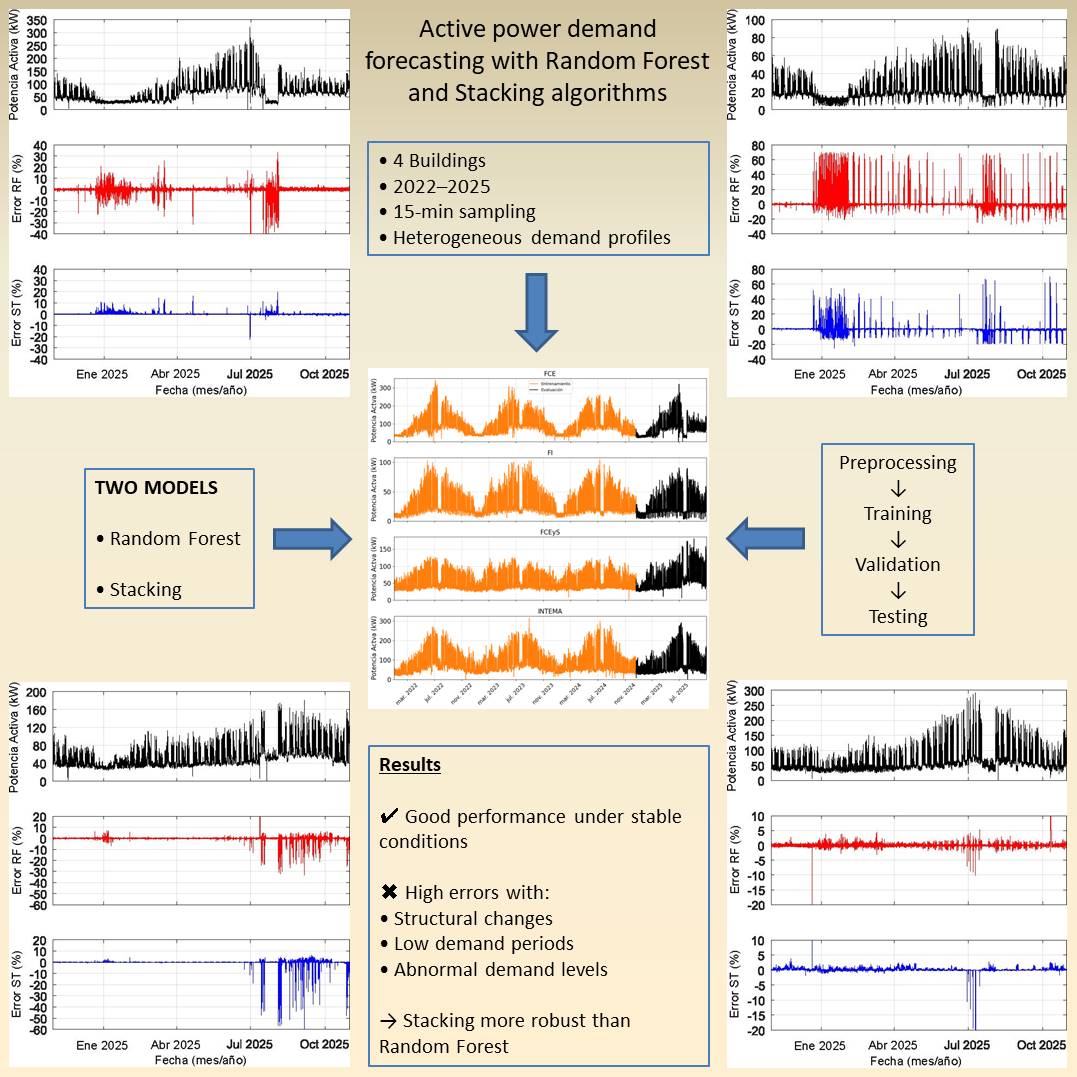
El avance de las Redes Eléctricas Inteligentes y la creciente disponibilidad de datos provenientes de sistemas de medición avanzados han impulsado el uso de técnicas de aprendizaje automático para el pronóstico de la demanda eléctrica. En este trabajo se analiza el desempeño de dos algoritmos supervisados —Random Forest y Stacking— aplicados a series temporales de demanda eléctrica correspondientes a cuatro edificios de la Universidad Nacional de Mar del Plata (UNMDP). El estudio considera registros históricos con un periodo de muestreo de 15 minutos, abarcando desde 2022 a 2025, estructurado en fases de preprocesamiento, entrenamiento, validación y evaluación comparativa. El objetivo principal es caracterizar la capacidad de ambos modelos para captar la dinámica temporal del consumo eléctrico institucional y determinar su adecuación para distintos perfiles de demanda. Los resultados indican que ambos algoritmos logran reproducir adecuadamente la dinámica temporal de la demanda cuando las condiciones operativas se mantienen dentro de los rangos observados durante el entrenamiento. Sin embargo, se observa una disminución en la precisión ante la presencia de cambios estructurales, períodos de baja ocupación o desviaciones significativas respecto de los patrones habituales de consumo. Estos hallazgos ponen de manifiesto que la calidad del pronóstico depende no solo del algoritmo utilizado, sino también de la representatividad y estabilidad de las series temporales disponibles. En este contexto, la incorporación de variables adicionales que reflejen condiciones operativas y/o ambientales, junto con esquemas de actualización o reentrenamiento periódico, podría contribuir a mejorar el desempeño del modelo.
Descargas
Descargas
Detalles del artículo
Citas
Abt, M., Leuders, T., Loibl, K., & Reinhold, F. (2024). Developing initial notions of variability when learning about box plots.
Mathematical Thinking and Learning, (pp. 1–24). https://doi.org/10.1080/10986065.2024.2421412.
Ahmad, N., Ghadi, Y., Adnan, M., & Ali, M. (2022). Load forecasting techniques for power system: Research challenges and survey. IEEE Access, 10:71054–71090. https://doi.org/10.1109/access.2022.3187839.
Alonso, O. A. & Bank, I.-A. D. (2023). Smart metering in latin america and the caribbean: Regulatory recommendations to
encourage the deployment of smart metering appropriate to the needs of individual countries. Technical report, Inter- American Development Bank (IADB). https://doi.org/10.18235/0004805.
Aquila, G., Morais, L. B. S., de Faria, V. A. D., Lima, J. W. M., Lima, L. M. M., & de Queiroz, A. R. (2023). An overview of short-term load forecasting for electricity systems operational planning: Machine learning methods and the brazilian experience. Energies, 16(21) article 7444. https://doi.org/10.3390/en16217444.
Atanasovski, M., Kostov, M., Arapinoski, B., & Spirovski, M. (2020). K-nearest neighbor regression for forecasting electricity demand. In Proceedings of the 55th International Scientific Conference on Information, Communication and Energy Systems and Technologies (ICEST), (pp. 110-113). https://doi.org/10.1109/ICEST49890.2020.9232768.
Bai, Y., Sun, H., Zhang, L., & Wu, H. (2023). Hybrid cnn-transformer network for electricity theft detection in smart grids.
Sensors, 23(20) article 8405. https://doi.org/10.3390/s23208405.
Breiman, L. (1996). Stacked regressions. Machine Learning, 24(1):49–64. https://doi.org/10.1007/BF00117832.
Carugati, I., Funes, M. A., Donato, P. G., Strack, J. L., Orallo, C. M., & Hadad, M. (2020). Calidad de energía en ciudades inte- ligentes: primeros resultados en la ciudad de mar del plata. In IEEE Congreso Bienal de Argentina ARGENCON 2020, (pp. 1–6), Resistencia, Argentina. IEEE. ISBN 978-1-7281-5958-4. https://doi.org/10.1109/ARGENCON49523.2020.9505326.
Cawley, G. & Talbot, N. (2010). On over-fitting in model selection and subsequent selection bias in performance evaluation.
Journal of Machine Learning Research, 11:2079–2107. https://dl.acm.org/doi/10.5555/1756006.1859921.
Chavan, M. (2024). Time series analysis in electrical load forecasting. Panamerican Mathematical Journal, 35(1):210–219. https://doi.org/10.52783/pmj.v35.i1s.2307.
Cutler, A., Cutler, D. R., & Stevens, J. R. (2012). Random forests. In Zhang, C. & Ma, Y., editors, Ensemble Machine Learning, (pp. 157–175). Springer. ISBN 978-1-4419-9326-7. https://doi.org/10.1007/978-1-4419-9326-7_5.
De Caro, F., Andreotti, A., Araneo, R., Panella, M., Rosato, A., Vaccaro, A., & Villacci, D. (2020). A review of the enabling methodologies for knowledge discovery from smart grids data. Energies, 13(24) article 6579. https://doi.org/10.3390/en13246579.
Deb, C., Zhang, F., Yang, J., Lee, S. E., & Shah, K. W. (2017). A review on time series forecasting techniques for building energy consumption. Renewable and Sustainable Energy Reviews, 74:902–924. https://doi.org/10.1016/j.rser.2017.02.085.
Defilippo, S. B., Neto, G. G., & Hippert, H. S. (2011). Short-term load forecasting by artificial neural networks specified by genetic algorithms – a simulation study over a brazilian dataset. In 13º Simposio Argentino de Investigación Operativa (SIO). URL https://core.ac.uk/download/pdf/296392374.pdf.
Donato, P., Hadad, M., Carugati, I., Funes, M., Strack, J., & Orallo, C. (2020). Smart grids in developing coun- tries: current status, challenges and upcoming trends. In Acosta, M., editor, Advances in Energy Research, (pp. 85-122). Nova Science. ISBN 978-1-53618-136-4. URL https://novapublishers.com/shop/ advances-in-energy-research-volume-33.
International Energy Agency [IEA] (2025). Electricity mid-year update 2025. URL https://www.iea.org/reports/ electricity-mid-year-update-2025.
Krzywinski, M. & Altman, N. (2014). Visualizing samples with box plots. Nature Methods, 11(2):119–120. https://doi.org/10.1038/nmeth.2813.
Lazzeri, F. (2020). Machine Learning for Time Series Forecasting with Python®. Wiley. ISBN 9781119682394. https://doi.org/10.1002/9781119682394.
Llopis-Ibor, L., Beltran-Royo, C., Cuesta-Infante, A., & Pantrigo, J. J. (2023). Fast incremental learning by transfer learning and hierarchical sequencing. Expert Systems with Applications, 212 article 118580. https://doi.org/10.1016/j.eswa.2022.118580.
Magalhães, B., Bento, P., Pombo, J., Calado, M. d. R., & Mariano, S. (2024). Short-term load forecasting based on optimized random forest and optimal feature selection. Energies, 17(8) article 1926. https://doi.org/10.3390/en17081926.
Mahmood, M., Chowdhury, P., Yeassin, R., Hasan, M., Ahmad, T., & Chowdhury, N.-U.-R. (2024). Impacts of digitalization on smart grids, renewable energy, and demand response: An updated review of current applications. Energy Conversion and Management: X, 24 article 100790. https://doi.org/10.1016/j.ecmx.2024.100790.
Massaoudi, M., Abu-Rub, H., Refaat, S. S., Chihi, I., & Oueslati, F. S. (2021). Deep learning in smart grid technology: A review of recent advancements and future prospects. IEEE Access, 9:54558–54578. https://doi.org/10.1109/ACCESS.2021.3071269.
Maza Diaz, Y., Donato, P., Funes, M., & Orallo, C. (2024). Evaluating machine learning algorithms for power demand forecasting. In XV Latin-American Congress on Electricity Generation and Transmission (CLAGTEE 2024). URL https://clagtee.fi.mdp.edu.ar/full-papers-search-engine/papers/ID061.pdf.
Melkumova, L. & Shatskikh, S. (2017). Comparing ridge and lasso estimators for data analysis. Procedia Engineering, 201:746– 755. https://doi.org/10.1016/j.proeng.2017.09.615.
Nassif, A. B. (2016). Short term power demand prediction using stochastic gradient boosting. In 2016 5th International Conference on Electronic Devices, Systems and Applications (ICEDSA), (pp. 1-4). https://doi.org/10.1109/ICEDSA.2016.7818510.
Oshiro, T. M., Perez, P. S., & Baranauskas, J. A. (2012). How many trees in a random forest? In Perner, P., editor, Machine Learning and Data Mining in Pattern Recognition, (pp. 154–168). Springer. ISBN 978-3-642-31537-4. https://doi.org/10.1007/978-3-642-31537-4_13.
Paredes, G., Vargas, L., & Maldonado, S. (2020). Reconfiguration and reinforcement allocation as applied to hourly medium-term load forecasting of distribution feeders. IET Generation, Transmission &; Distribution, 14(9):1791–1798. https://doi.org/10.1049/iet-gtd.2018.7127.
Pedregosa, F., Varoquaux, G., Gramfort, A., Michel, V., Thirion, B., Grisel, O., Blondel, M., Prettenhofer, P., Weiss, R., Dubourg, V., Vanderplas, J., Passos, A., Cournapeau, D., Brucher, M., Perrot, M., & Duchesnay, E. (2011). Scikit-learn: Machine learing in Python. Journal of Machine Learning Research, 12:2825–2830. https://dl.acm.org/doi/10.5555/1953048.2078195.
Powell, J., McCafferty-Leroux, A., Hilal, W., & Gadsden, S. A. (2024). Smart grids: A comprehensive survey of challenges, industry applications, and future trends. Energy Reports, 11:5760–5785. https://doi.org/10.1016/j.egyr.2024.05.051.
Probst, P., Wright, M. N., & Boulesteix, A.-L. (2019). Hyperparameters and tuning strategies for random forest. WIREs Data Mining and Knowledge Discovery, 9(3) article e1301. https://doi.org/10.1002/widm.1301.
Sapountzoglou, N., Lago, J., De Schutter, B., & Raison, B. (2020). A generalizable and sensor-independent deep learning method for fault detection and location in low-voltage distribution grids. Applied Energy, 276 article 115299. https://doi.org/10.1016/j.apenergy.2020.115299.
Seefoo Jarquin, C. S., Gandelli, A., Grimaccia, F., & Mussetta, M. (2023). Short-term probabilistic load forecasting in university buildings by means of artificial neural networks. Forecasting, 5(2):390–404. https://doi.org/10.3390/forecast5020021.
Uhrig, M. N., Vignolo, L. D., & Müller, O. V. (2024). Electricity demand forecast model based on meteorological variables: a case study for Entre Ríos province, Argentina. Doctoral dissertation, Universidad Nacional de La Plata. URL https:
//ri.conicet.gov.ar/handle/11336/253947.
Wu, W. & Peng, M. (2017). A data mining approach combining k-means clustering with bagging neural network for short-term wind power forecasting. IEEE Internet Things J., 4(4):979–986. https://doi.org/10.1109/JIOT.2017.2677578.
Barra lateral del artículo
Barra lateral del artículo

Esta obra está bajo una licencia internacional Creative Commons Atribución-NoComercial-CompartirIgual 4.0.