

Agresividad Climática y Concentración de Precipitaciones en una Cuenca Amazónica Peruana: Intercuenca Alto Huallaga
##plugins.themes.bootstrap3.article.main##
Guillermo Arriola Carrasco

Luis Villegas
Noe Marín
Cesar Idrogo
José Piedra
Jose Palomino
Billy Cayatopa
Resumen
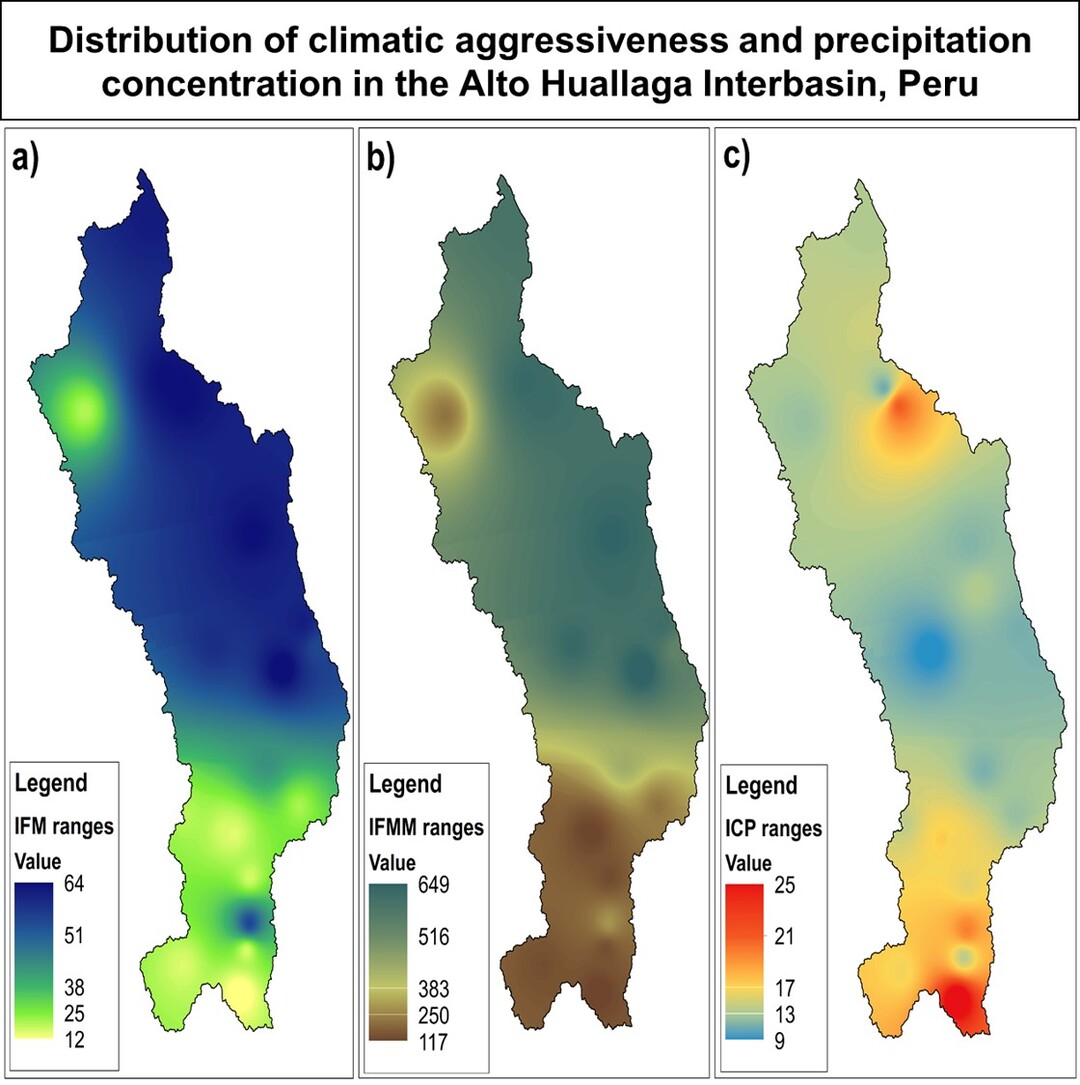
Las precipitaciones en la Amazonía central peruana se caracterizan por ser estacionales y con fuertes intensidades durante los primeros meses del año, conllevando a que se produzcan inundaciones y el posterior colapso de la infraestructura local de las provincias de las Regiones San Martín, Huánuco, Pasco y La Libertad de Perú, que se encuentran dentro de la delimitación de la Intercuenca Alto Huallaga. Por lo expuesto, la presente investigación tuvo por objetivo evaluar la agresividad climática y concentración de precipitaciones en la Cuenca Amazónica, aplicando para tal fin tres índices de agresividad y un índice de concentración de precipitaciones (ICP), los cuales se estiman a partir del registro de lluvias de las estaciones climáticas de la zona de estudio. Los resultados muestran una alta correlación entre la precipitación media y altitud (R2 = 0.72) y respecto a la agresividad, el índice de Fournier-Maule modificado (IFMM) fue el de mejor correspondencia con respecto a la altitud (R2 = 0.72) y precipitación media (R2 = 0.98), sin embargo, el ICP muestra correlaciones moderadas con la altitud (R2 = 0.21) y la precipitación media (R2 = 0.16). Así mismo, se estimaron los valores extremos de los diferentes índices para diferentes períodos de retorno y se desarrolló un modelo de regresión lineal múltiple que relaciona la agresividad climática y el ICP para estimar la precipitación media (R2 = 0.99). Finalmente, se concluye que la Intercuenca Alto Huallaga presenta una agresividad climática muy baja y la concentración de lluvias es moderadamente estacional.
Descargas
Descargas
Detalles del artículo
Citas
Aguiar, R., Da Rocha, E., De Souza, J., Dos Santos, J., & Dos Santos, J.S. (2019). Analysis of hydrological regime component of the Amazonas River basin in years of climate events. Revista Brasileira de Geografia Fisica, 12(3), 988-1002. https://doi.org/10.26848/rbgf.v12.3.p988-1002
Amiri, M., & Gocic, M. (2021). Analyzing the applicability of some precipitation concentration indices over Serbia. Theoretical and Applied Climatology, 146(1-2), 645-656. https://doi.org/10.1007/s00704-021-03743-5
Arriola, G., Villegas, L., Fernandez, J., Vallejos, J., & Idrogo, C. (2023). Assessment of parameters of the generalized extreme value distribution in rainfall of the Peruvian north. Revista Politécnica, 52(2), 99-112. https://doi.org/10.33333/rp.vol52n2.10
Arriola, G., Villegas, L., Marín, N., Idrogo, C., Piedra, J., & Arbulú, J. (2022). Assessment of climatic aggressiveness and precipitation concentration in the Chancay-Lambayeque basin, Peru. Revista Politécnica, 50(2), 15-22. https://doi.org/10.33333/rp.vol50n2.02
Azioune, R., Benhamrouche, A., Tatar, H., Martin-Vide, J., & Pham, Q. (2023). Analysis of daily rainfall concentration in northeastern Algeria 1980–2012. Theoretical and Applied Climatology, 153(3-4), 1361-1370. https://doi.org/10.1007/s00704-023-04526-w
Back, Á., GonCalves, F., & Fan, F. (2019). Spatial, seasonal, and temporal variations in rainfall aggressiveness in the south of Brazil. Engenharia Agricola, 39(4), 466-475. https://doi.org/10.1590/1809-4430-Eng.Agric.v39n4p466-475/2019
Baecheler, J., & Bravo, B. (2019). Analysis of aggressiveness rainfall in the far north of Chile. Proceedings of the IAHR World Congress. 3717-3725. https://doi.org/10.3850/38WC092019-1820
Bessaklia, H., Ghenim, A., Megnounif, A., & Martin-Vide, J. (2018). Journal of Water and Land Development, 36(1), 3-15. https://doi.org/10.2478/jwld-2018-0001
Bezak, N., Lebar, K., Huang, Y., & Chen, W. (2023). Data on 33 years of erroneous usage of rainfall erosivity equations. Data, 8(5). https://doi.org/10.3390/data8050075
Caicedo, M., Villegas, L., Arriola, G., Cayatopa, R., García, J., & Marín, N. (2024). Generation of flows applying a simple method of flood routing to monthly level in La Leche basin, Peru. Revista Politecnica, 53(1), 99-110. https://doi.org/10.33333/rp.vol53n1.09
Calixto, M. (2021). Modelamiento hidrológico con GRAJ para el pronóstico de caudales medios diarios con horizonte de 72 horas en la cuenca del Alto Huallaga [Tesis para optar el título de Ingeniero Agrícola, Universidad Nacional Agraria La Molina]. Repositorio institucional de la Universidad Nacional Agraria La Molina. https://hdl.handle.net/20.500.12996/5230
Carrión, S. (2018). Evaluación de la Intercuenca Alto Huallaga haciendo uso de la hidrología de bosques [Tesis para optar el título de Ingeniero Civil, Pontificia Universidad Católica del Perú]. Repositorio institucional de la Pontificia Universidad Católica del Perú. http://hdl.handle.net/20.500.12404/14598
Chen, W., Huang, Y., Lebar, K., & Bezak, N. (2023). A systematic review of the incorrect use of an empirical equation for the estimation of the rainfall erosivity around the globe. Earth-Science Reviews, 238. https://doi.org/10.1016/j.earscirev.2023.104339
Costa, A., Guimarães, S., Sales, D., Das Chagas, J., Marinho, M., Pereira, J., Martins, E., & Da Silva, E. (2023). Precipitation extremes over the tropical Americas under RCP4.5 and RCP8.5 climate change scenarios: Results from dynamical downscaling simulations. International Journal of Climatology, 43(2), 787-803. https://doi.org/10.1002/joc.7828
Da Motta, V., Espinoza-Dávalos, G., Moreira, D., & Comair, G. (2020). Variability of trends in precipitation across the Amazon river basin determined from the CHIRPS precipitation product and from station records. Water (Switzerland), 12(5). https://doi.org/10.3390/W12051244
De Brito, A., Da Silva, N., Tomasella, J., Ferreira, S., & Monteiro, M. (2022). Analysis of the rain anomaly index and precipitation trend for pluviometric stations in Central Amazonia. Revista Brasileira de Meteorologia, 37(1), 19-30. https://doi.org/10.1590/0102-778637014521
De Moura, R., Correia, F., Veiga, J., Capistrano, V., & Kubota, P. (2021). Evaluation of the Brazilian global atmospheric model in the simulation of the water budget components in the Amazon basin. Revista Brasileira de Meteorologia, 36(1), 23-37. https://doi.org/10.1590/0102-77863540078
Diodato, N., Ljungqvist, F., & Bellocchi, G. (2020). Fingerprint of climate change in precipitation aggressiveness across the central Mediterranean (Italian) area. Scientific Reports, 10(1). https://doi.org/10.1038/s41598-020-78857-3
Fernandez, H., Martins, F., & Isidoro, J. (2020). Mapping rainfall aggressiveness from physiographical data: Application to the Grândola Mountain Range (Alentejo, Portugal). Physical Geography, 41(5), 451-466. https://doi.org/10.1080/02723646.2019.1674557
Gallardo, Y., Fernández, P., Brown, O., & Valdimar, G. (2018). Estimación de la agresividad climática en el sector hidrogeológico CA-II-I del municipio de Venezuela, Ciego de Ávila, Cuba. Revista Científica Ciencia y Tecnología, 18(17), 1-13. https://doi.org/10.47189/rcct.v18i17.148
García-Barrón, L., Morales, J., & Sousa, A. (2018). A new methodology for estimating rainfall aggressiveness risk based on daily rainfall records for multi-decennial periods. Science of the Total Environment, 615, 564-571. https://doi.org/10.1016/j.scitotenv.2017.09.305
Herrera, C., Campos, J., & Carrillo, F. (2017). Estimación de datos faltantes de precipitación por el método de regresión lineal: Caso de estudio Cuenca Guadalupe, Baja California, México. Investigación y Ciencia de la Universidad Autónoma de Aguascalientes, 25(71), 34-44. https://doi.org/10.33064/iycuaa201771598
Hosking, J. (1990). L-moments: analysis and estimation of distributions using linear combinations of order statistics. Journal of the Royal Statistical Society, Series B, 52, 105-124. https://www.jstor.org/stable/2345653
Huang, Y., Wang, H., Xiao, W., Chen, L., Yan, D., Zhou, Y., Jiang, D., & Yang, M. (2018). Spatial and temporal variability in the precipitation concentration in the upper reaches of The Hongshui River basin, Southwestern China. Advances in Meteorology, 2018. https://doi.org/10.1155/2018/4329757
Ilbay-Yupa, M., Barragán, R., & Lavado-Casimiro, W. (2019). Regionalization of precipitation, its aggressiveness and concentration in the Guayas River basin, Ecuador. Granja, 30(2), 52-69. https://doi.org/10.17163/lgr.n30.2019.06
Kabolizadeh, M., Rangzan, K., Mohammadi, S., & Rabiei-Dastjerdi, H. (2024). Challenges of rainfall erosivity prediction: A novel GIS-Based optimization algorithm to reduce uncertainty in large country modeling. Earth Science Informatics, 17(1), 365-384. https://doi.org/10.1007/s12145-023-01178-2
Lana, X., Rodríguez-Solà, R., Casas-Castillo, M., Serra, C., Kirchner, R., & Martínez, M. (2023). Rainfall disparity at monthly scale on Catalonia (NE Spain): Dependence on geographic coordinates, altitude and distance to the Mediterranean coast. Theoretical and Applied Climatology, 153(3-4), 1293-1306. https://doi.org/10.1007/s00704-023-04533-x
Lee, J., Choi, J., Jang, S., & Kim, S. (2024). Effect of mountainous rainfall on uncertainty in flood model parameter estimation. Hydrology Research, 55(2), 221-236. https://doi.org/10.2166/nh.2024.144
Llampazo, G., Dávila, E., Del Águila, R., Cardozo, N., Díaz, A., & Del Castillo, D. (2023). Survival of plants species in seasonally flooded forests of the Peruvian Amazonia. Folia Amazonica, 32(1), 1-15. https://doi.org/10.24841/fa.v32i1.627
Llano, M. (2018). Spatial distribution of the daily rainfall concentration index in Argentina: Comparison with other countries. Theoretical and Applied Climatology, 133(3-4), 997-1007. https://doi.org/10.1007/s00704-017-2236-0
Llano, M. (2021). Temporal variability of daily concentration of precipitation in Argentina. Meteorologica, 46(2). https://doi.org/10.24215/1850468Xe005
Llano, M. (2023). Spatiotemporal variability of monthly precipitation concentration in Argentina. Journal of Southern Hemisphere Earth Systems Science, 73(2), 168-177. https://doi.org/10.1071/ES22040
López, M., Carmenates, D., Valero, L., & López, L. (2019). Indicadores de cambio climático en las precipitaciones. Revista Bases de la Ciencia, 4(2), 21-34. https://doi.org/10.33936/rev_bas_de_la_ciencia.v4i2.1566
Luna-Romero, A., Ramírez, I., Sánchez, C., Conde, J., Agurto, L., & Villaseñor, D. (2018). Distribución espacio-temporal de la precipitación en la cuenca del río Jubones, Ecuador: 1975-2013. Scientia Agropecuaria, 9(1), 63-70. https://doi.org/10.17268/sci.agropecu.2018.01.07
Manikanta, V., Nikhil, K., Das, J., & Umamahesh, N. (2023). On the verification of ensemble precipitation forecasts over the Godavari River basin. Journal of Hydrology, 616. https://doi.org/10.1016/j.jhydrol.2022.128794
Nunes, M., Cardoso, D., Melo, T., Dorneles, V., Knapp, A., & Cecconello, S. (2023). Erosivity and seasonal rainfall for Pelotas-RS, Brazil with the RainfallErosivityFactor package and Modified Fournier Index. Journal of South American Earth Sciences, 132. https://doi.org/10.1016/j.jsames.2023.104649
Olguín, J. (2019). Índices de agresividad climática como estimadores del factor de riesgo de la erosión hídrica en el Departamento de Tarija. Agrociencias, 4(7): 1-10. https://dicyt.uajms.edu.bo/revistas/index.php/agrociencias/article/view/1113
Pizarro, R., Cornejo, F., González, C., Macaya, K., & Morales, C. (2008) Análisis del comportamiento y agresividad de las precipitaciones en la zona central de Chile. Ingeniería Hidráulica en México, 23(2), 91-109. Retrieved from SCOPUS database
SENAMHI (2018). Estudio: Estimación de umbrales de inundación en la Región Hidrográfica del Pacífico. Lima, Perú: Dirección de Hidrología del Servicio Nacional de Meteorología e Hidrología del Perú. https://repositorio.senamhi.gob.pe/handle/20.500.12542/241
Valdés-Pineda, R., Pizarro, R., Valdés, J., Carrasco, J., García-Chevesich, P., & Olivares, C. (2016). Spatio-temporal trends of precipitation, its aggressiveness and concentration, along the Pacific coast of South America (36–49°S). Hydrological Sciences Journal, 61(11), 2110-2132. https://doi.org/10.1080/02626667.2015.1085989
Vargas, M., Beskow, S., de Moura, M., da Cunha, Z., Beskow, T., & de Morais da Silveira, J. (2023). GAM-IDF: a web tool for fitting IDF equations from daily rainfall data. International Journal of Hydrology Science and Technology, 16(1), 37-60. https://doi.org/10.1504/IJHST.2023.131882
Wang, Z., Wang, Z., Feng, P., Dong, Y., Zhang, Z., & Yang, Y. (2022). Study on applicability of remote sensing precipitation products in hilly-plain-wetland complex area of northeast China. Water Supply, 22(3), 3498 – 3507. https://doi.org/10.2166/WS.2021.387
Spatial analysis and temporal trends of daily precipitation concentration in the Mantaro river basin: Central Andes of Peru. Stochastic Environmental Research and Risk Assessment, 31(6), 1305-1318. https://doi.org/10.1007/s00477-016-1235-5
Zubieta, R., Saavedra, M., Espinoza, J., Ronchail, J., Sulca, J., Drapeau, G., & Martin-Vide, J. (2019). Assessing precipitation concentration in the Amazon basin from different satellite-based data sets. International Journal of Climatology, 39(7), 3171-3187. https://doi.org/10.1002/joc.6009
Barra lateral del artículo
Barra lateral del artículo

Esta obra está bajo una licencia internacional Creative Commons Atribución-NoComercial-CompartirIgual 4.0.